
If you’re planning a family trip from Vancouver to Seattle, the practical choice is to prioritize ticket flexibility that matches your group’s needs — whether that means easy changes, predictable refunds, or simple exchanges for a child who gets tired. Start by deciding how important flexibility is compared with price and convenience: are you likely to change dates, need partial refunds, or prefer refundable upgrades? Then compare the main transport modes — intercity rail, cross-border buses, and ferries/combined options — focusing on change and cancellation rules, child fare policies, and luggage or stroller allowances. This article lays out what flexibility usually looks like, the tradeoffs families face, and exactly what to verify on a provider’s final booking page before you pay.
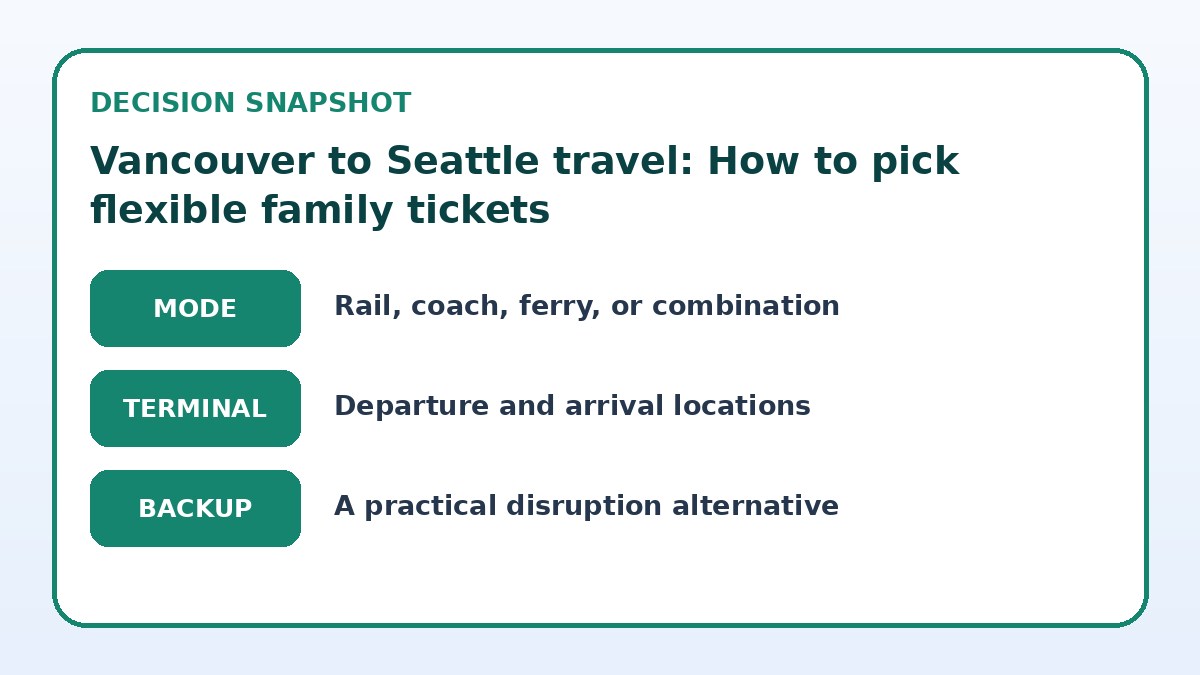
See current options before you compare the details
Availability and final conditions change. Open Trip.com now or keep reading for the practical comparison.
What flexibility means for families
Ticket flexibility covers changes, cancellations, refunds, and how easily you can move a booking to another person or date. For families this often matters more than for solo travelers: a sick child, delayed start, or an attraction you decide to extend can force a change. Flexible fares commonly allow free or low-cost changes up to a certain time before departure, offer partial or full refunds, or permit rebooking with a small administrative fee. Less flexible fares lock you to a specific time and passenger list and may only issue travel credits rather than cash refunds.
Families should also look beyond headline change fees. Read the fine print for per-passenger vs per-ticket rules, whether infants need a separate ticket, and restrictions on transfers or refunds across different service classes. Some providers allow name substitutions; others require cancellations and brand-new bookings. Stroller and child-seat policies, baggage allowances for kids, and how proof of age is handled affect the real-world usefulness of ‘flexible’ tickets for a family trip.
Comparing transport modes: flexibility tradeoffs
Intercity rail often markets flexible fare tiers and onboard comfort, but availability and cross-border procedures can change the practical experience. Train operators may offer refundable and changeable fares alongside cheaper nonrefundable options; however, cross-border journeys can add documentation checks or immigration pauses that affect when you can catch the next service. If you value the ability to swap to a later departure on the same day without large surcharges, look for explicit same-day rebooking or open-ticket rules in the provider’s policy.
Buses between Vancouver and Seattle sometimes provide abundant seats and frequent departures, which can feel flexible even if the fare is technically nonrefundable. Bus companies may allow simple exchanges for a later departure on the same day or within a short window, but family-size groups can encounter limits on holding seats. Ferry and combined multi-operator options introduce complexity: tickets might be nonrefundable or valid only on specific sailings, and switching between different carriers often requires dealing with each operator’s separate rules and fees.
| Approach | Best for | Tradeoff to check |
|---|---|---|
| Buy refundable or fully flexible tickets | Families expecting schedule changes, medical issues, or uncertain return dates. | Higher upfront cost but fewer headaches if you must change plans; verify exact refund timing and processing method. |
| Choose semi-flexible fares with low change fees | Families who might alter travel by a day or two but can commit within a modest penalty window. | Lower than refundable fares, but multiple changes add fees; check per-passenger vs per-ticket fee structure. |
| Buy nonrefundable, low-cost tickets | Budget-conscious families with fixed schedules and backup plans for minor delays. | Cheapest up front; changes often impossible or costly, so consider travel insurance or one flexible seat. |
| Mix and match (one flexible seat plus cheaper tickets) | Families who want protection for the primary caretaker while saving on additional passengers. | Balances cost and flexibility, but sorting different ticket types and policies can complicate rebooking and seating. |
Ready to check the option that fits your plan?
Use your exact dates and traveler details so the provider page can show the current total and conditions.

How to compare ticket terms side-by-side
Create a short comparison checklist for each quote: change fee amount and timing, refundability (cash vs credit), child fare rules and proof needed, name-change or transfer options, and any stroller/baggage specifics. Use the provider’s exact booking page to confirm these items because headline pages and third-party listings sometimes omit exceptions like blackout dates, minimum notice periods, or per-person penalties. If you’re comparing multiple suppliers or fare classes, note whether a small paid upgrade unlocks full flexibility—sometimes moving up one fare tier is worthwhile for peace of mind with a family.
Because providers change policies, copy the key terms into your phone before you pay, or take screenshots of the final booking page and the full terms. If you’re using a third-party site to compare options (Trip.com can be a place to check current availability), verify the final price and the full change/refund policy on the carrier’s official checkout page. When crossing the Canada–US border, confirm how documentary checks are handled and whether changing a crossing time affects immigration processing for children.
Before you book
- Confirm change and cancellation fees on the provider’s final booking page, not just the summary or marketing copy.
- Verify how child fares and infant policies are applied and what proof of age is required at boarding or immigration.
- Check whether tickets are transferable or allow name changes without full cancellation and rebooking.
- Note stroller, car seat, and checked-baggage allowances and whether they differ for child or infant tickets.
- If mixing operators, confirm each carrier’s rules and whether combined tickets permit cross-operator rebooking.
- Screenshot the final checkout terms (fees, refund method, and tickets) and save the confirmation email for border checks.
Picking the right approach for your family
Decide which scenario matters most: last-minute changes, illness, early return, or connecting trips. If changes are likely, prioritize fully refundable fares or those with low change fees and simple rebooking. If you’re confident about dates but traveling on a tight budget, a cheaper nonrefundable fare may be acceptable—just factor in travel insurance or a separate refundable option for the most vulnerable family members. For families with infants or toddlers, confirm infant seating, stroller rules, and whether a parent needs to reserve a seat for the child.
Also consider operational cadence: if buses run very frequently on your chosen day, you might accept a nonrefundable ticket because the alternative departure is nearby in time. If train or ferry departures are sparse, spending more for a flexible ticket reduces the risk of lengthy waits or complex rebooking. Finally, account for border formalities: flexibility in travel time is only useful if all family members have the right documentation and can re-enter the destination country when plans change.
Frequently asked questions
Can I change a child’s ticket independently from adult tickets?
Policies vary by operator; some allow you to change an individual passenger on a multi-person booking, while others require cancelling and rebooking the entire reservation. Check the carrier’s change policy for per-passenger rules and any age-based conditions. On the provider’s final booking page, look for wording about ‘per passenger changes’ or ‘name changes’ and whether change fees are assessed per ticket. If the site is unclear, contact the carrier’s customer service before you purchase, and consider splitting bookings so you can modify a child’s ticket without affecting other passengers.
Is travel insurance a good substitute for flexible tickets?
Travel insurance can cover illness, cancellations, and some unforeseen events, but it doesn’t substitute for operational flexibility like same-day exchanges or waived change fees. Insurance claims have their own conditions, documentation requirements, and claim processing times—so they may reimburse you later rather than enable an immediate rebook. If real-time flexibility is crucial (for example, catching a later train or bus same day), a flexible fare is more practical. Use insurance as a backstop for larger financial losses or medical emergencies, and always compare policy exclusions before relying on it.
How do border checks affect changing tickets between Vancouver and Seattle?
Changing your travel time can alter when you’ll pass through border controls and how long any queueing or document checks might take. Carriers don’t control immigration processing, so ensure everyone in your party has appropriate travel documents and any required authorizations before you rebook. If a change means you’ll cross at a different time of day, factor in potentially different wait times at land border crossings or at ferry terminals. Always verify on the carrier’s final booking page whether rebooking affects refundability or requires updated passenger details for cross-border travel.
Final planning note
Families deciding how to travel from Vancouver to Seattle should match ticket flexibility to how likely plans are to change. If there’s any chance of shifts in dates, a refundable or clearly rebookable fare reduces stress and often pays off despite a higher initial cost. For budget travelers with stable dates, nonrefundable tickets plus a contingency plan can work, but read the fine print on child fares and refunds first. Before you pay, check the provider’s final booking page for the exact rules on changes, refunds, name swaps, and child documentation, and save screenshots or confirmation emails. That preparation keeps your family focused on the trip itself instead of paperwork.
Continue planning
Check current options and final conditions
Use the provider page to confirm live availability, the final total, cancellation terms, and every condition that matters to your trip.
This evergreen planning guide was created with AI-assisted drafting and a structured quality review. It does not display live prices, schedules, availability, visa guidance, or provider rankings. Verify current details before booking. Some links are affiliate links; we may earn a commission at no additional cost to you.