
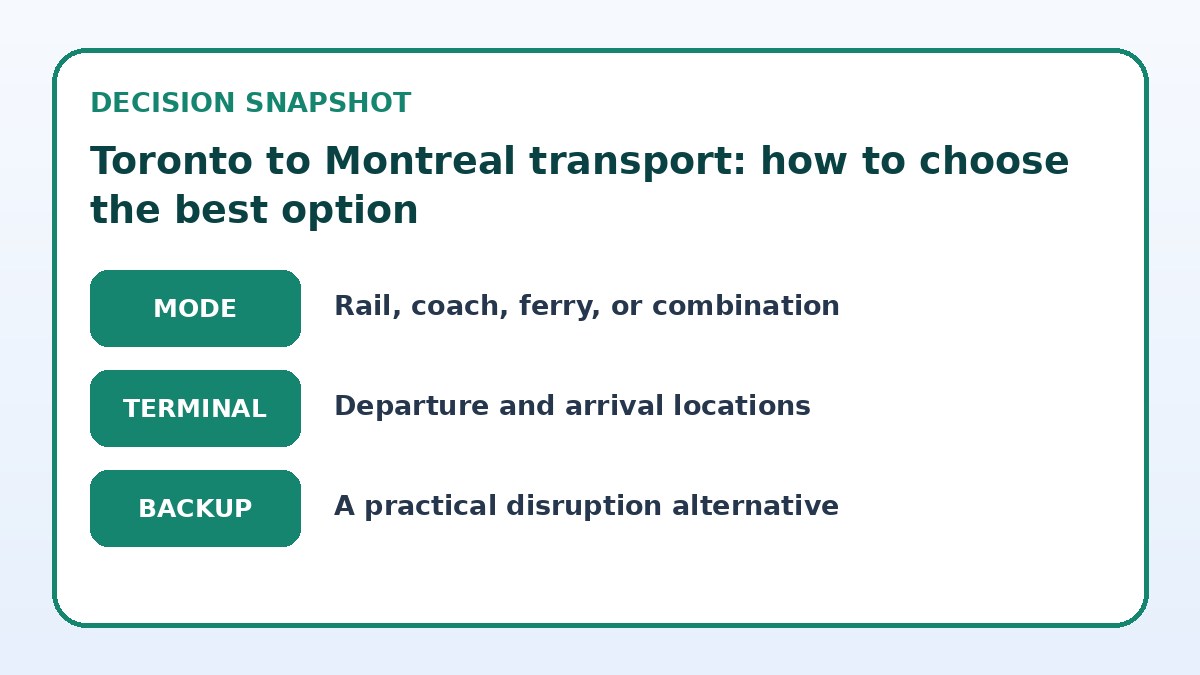
If you need to travel between Toronto and Montreal for business, start by choosing the option that gives you the right mix of reliability, total door-to-door time, and workspace. For most business travelers who want predictable schedules and time to work, intercity rail and air are the two primary contenders, with driving or express coach services as situational alternatives. Your decision should hinge on the meeting time, whether you need a flexible return, how much luggage or equipment you’ll carry, and whether uninterrupted work time onboard matters more than a slightly faster journey. Below I lay out the practical tradeoffs and specific decision criteria you can use to pick the most suitable transport option for your priorities and schedule.
How to weigh total door-to-door time and schedule reliability
When comparing options for Toronto to Montreal transport, think beyond the advertised travel time. For flights, add time for travel to and from the airports, check-in, security, and potential delays. For trains and coaches, factor in the time to reach downtown stations, boarding procedures, and potential late arrivals. The most practical choice balances scheduled running time with predictable, controllable pre- and post-journey steps so you can reliably plan meetings at the other end.
To evaluate reliability, compare how each option handles common disruptions. Air travel is sensitive to weather and airport congestion; driving is vulnerable to traffic and construction; rail and scheduled coaches typically suffer fewer minute-to-minute schedule shifts, though they can still be affected by track or road incidents. For business travel, favor the mode where you can build a realistic buffer and still arrive with time to prepare—this often beats shaving minutes off the advertised door-to-door time.
Productivity, comfort and onboard amenities
If you need to work en route, prioritize options that let you use your time effectively. Trains frequently provide more room to set up a laptop, steadier internet access where available, and fewer interruptions from seatbelt signs or tray-table restrictions. Airlines sometimes offer fast Wi‑Fi but you’ll face short bursts of usable time and airport-related distraction. Coaches vary widely in seat comfort and power availability; inspect seat pitch and power outlets before booking if productivity matters.
Comfort also affects how ready you are after arrival. Consider seat ergonomics, ability to stand or move, restroom availability, and the noise environment. If arriving fresh for a meeting is essential, choose the option that best matches your need for rest or focused preparation. Bring noise-cancelling headphones and a compact travel kit to improve productivity and appearance regardless of the transport you select.
| Approach | Best for | Tradeoff to check |
|---|---|---|
| Train | Business travelers needing workspace and downtown-to-downtown service | May be slightly slower than flying but often offers more productive onboard time |
| Flight | Those needing the fastest airborne segment or facing early/late schedules | Airport transfers and security add time and unpredictability to total journey |
| Driving (self or chauffeur) | Travelers who require door-to-door control, multiple stops, or equipment transport | Traffic and concentration demands reduce onboard productivity and add variability |
| Express coach | Cost-conscious travelers or when other modes are unavailable | Less onboard space and comfort can limit work and rest compared with trains |
Cost, flexibility and baggage considerations
Cost isn't just the ticket price; include transfers, parking, baggage surcharges, and the value of your time. Some business travelers find refundable or flexible fare classes worth the premium because schedules change. Check what’s included with each fare: onboard Wi‑Fi, seat selection, and baggage allowances can tilt the decision. If you plan to bring a larger carry-on or equipment, verify size and handling rules on trains, airlines, and coaches before booking.
Flexibility matters if your meeting time could shift. Trains often have nominal change policies or easy day-of rebooking on certain fare types, while low-cost air fares or nonrefundable coach tickets may be less accommodating. For a quick return on short notice, prioritize options with straightforward change or standby rules. Always confirm the final rebooking or cancellation terms on the provider’s booking page so you know any fees and process details before committing.
Before you book
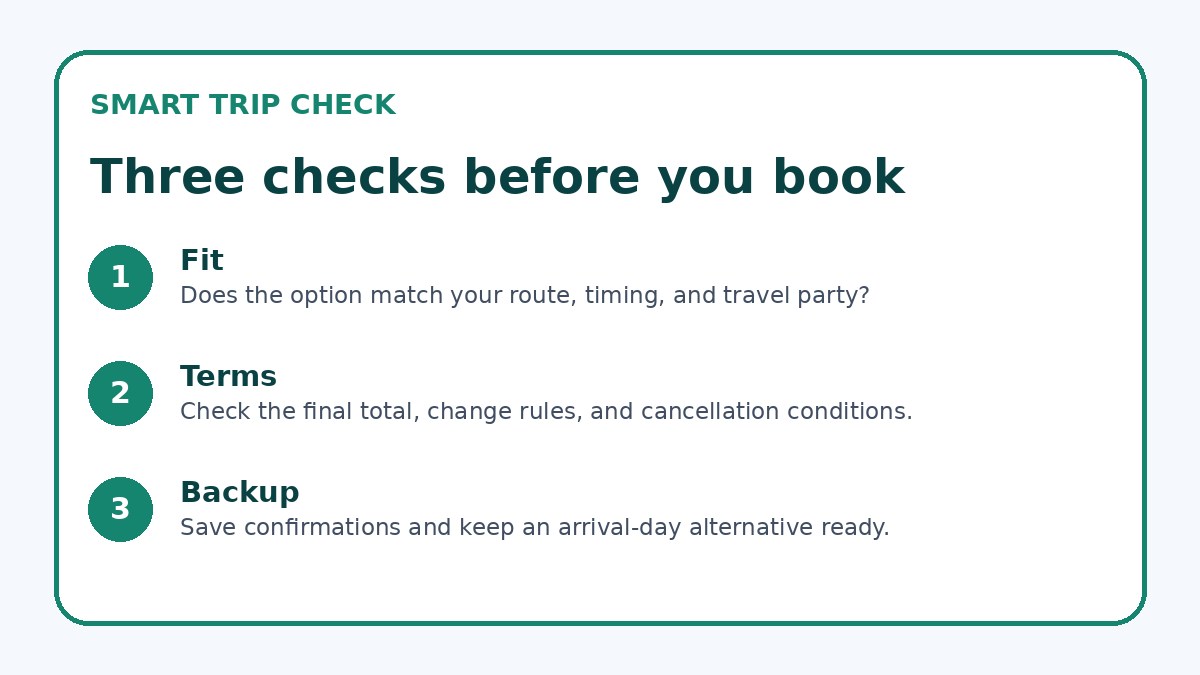
- Confirm total door-to-door travel time for each option, including transfers, to compare real arrival windows.
- Verify exact change, cancellation, and baggage rules on the carrier’s booking page before you buy.
- Choose a seat or fare type that provides power outlets and a work-friendly environment if you need to be productive.
- If flying, plan airport transfers and build a buffer for check-in and security to avoid missed meetings.
- For driving, check current traffic forecasts and parking availability at your destination before departing.
- Reserve return travel or flexible fares if your meeting schedule could change to avoid costly rebooking.
Practical booking checklist and last-minute strategies
When booking, align your selection with the logistics at both ends: proximity of stations or airports to your meeting venues, evening transport availability, and local ground transit options. If your arrival is late, check whether taxis, rideshares, or public transit run when you need them. For same-day round trips, compare early departures and late returns across modes to find the window that lets you attend required meetings without an overnight stay.
If you face last-minute changes, prioritize modes that let you switch within business hours and consider travel insurance or fare protections that cover schedule disruption. Use provider booking pages to verify slot availability, exact change and cancellation rules, and any special boarding requirements. Trip.com can be a quick place to compare current availability, but always verify final ticket terms directly with the carrier or operator before completing purchase.
Frequently asked questions
Is the train usually better than flying for business trips between Toronto and Montreal?
Many business travelers prefer trains when they value uninterrupted work time and a downtown arrival; trains often allow more comfortable laptop use and fewer security steps than air travel. Flying can be quicker in airborne time but requires airport transfers and security time that add to the door-to-door total. The smarter choice depends on your meeting times, tolerance for transfers, and whether onboard productivity or absolute elapsed time is your priority. Compare complete travel time, not just flying time, and confirm schedules before booking.
How should I choose between driving and taking public transport for a same-day business trip?
Choose driving if you need flexible departure times, carry bulky equipment, or require multiple stops that public transport won’t serve efficiently. Opt for rail or coach if you want to use travel time productively and avoid traffic stress. Consider parking availability and costs, expected traffic along the route, and whether a professional chauffeur would let you use travel time more effectively. For same-day returns, prioritize predictable travel times to ensure you can make your outbound and return segments without undue risk.
What practical checks should I make right before booking any Toronto to Montreal transport?
Before purchasing, check the operator’s official booking page for exact boarding locations, change and cancellation fees, baggage allowances, and seat assignment rules. Verify how much time you’ll need for transfers at each end, and whether late arrivals or early departures fit local ground-transport schedules. If you depend on onboard Wi‑Fi or power, confirm availability and any usage limits. Finally, review rebooking procedures in case your meeting time shifts so you’re not surprised by fees or long waiting lists.
Final planning note
Choosing the most practical Toronto to Montreal transport for business comes down to matching your priorities with the realities of each mode. If uninterrupted productive time and a downtown arrival matter most, trains often win; if the narrowest airborne segment is your priority, include airport transfers in your calculation before selecting flights. Driving gives control and flexibility at the cost of fatigue and traffic risk, while coaches balance cost and convenience for simpler itineraries. Use the decision criteria above—total door-to-door time, onboard productivity, flexibility, and baggage needs—then confirm exact rules and schedules on the provider’s booking page before you commit.
Continue planning
Check current options and final conditions
Use the provider page to confirm live availability, the final total, cancellation terms, and every condition that matters to your trip.
This evergreen planning guide was created with AI-assisted drafting and a structured quality review. It does not display live prices, schedules, availability, visa guidance, or provider rankings. Verify current details before booking. Some links are affiliate links; we may earn a commission at no additional cost to you.