Practical answer first: for a smooth return to Toronto’s airports, choose a transfer option that matches your flight time, luggage, and meeting schedule — ride-hail or taxi for door-to-door reliability, airport rail links and express shuttles for predictable travel times when terminals and connections are convenient, and a pre-booked private transfer if you need guaranteed waiting service. Decide by weighing predictability, cost transparency, and time buffer. Business travelers should allow extra margin for downtown traffic and security lines, confirm pickup/dropoff points at your hotel, and book or reserve the balance of certainty required for the meeting or onward flight. Below I unpack tradeoffs, timing tips, and the precise checks to make on provider pages so you can book with confidence.
See current options before you compare the details
Availability and final conditions change. Open Trip.com now or keep reading for the practical comparison.
Choose the right transfer for your schedule
Start by matching transfer type to your itinerary constraints. If you have fixed deadlines — an early morning or late-night flight — prioritize services that minimize unknowns. Train or airport rail links can be fast and avoid surface traffic but require walking and timed connections; they work best when your hotel is near a station and you’re comfortable with luggage. Door-to-door options like taxis, ride-hail, or private car services remove the station walk and can collect you from a hotel entrance, which is often convenient after meetings or when travelling with a briefcase and carry-on.
When decisions hinge on timing, estimate total door-to-gate time and add a sensible buffer. For business trips, consider a larger buffer than for leisure to account for last-minute calls, sending final emails, or retrieving materials from the office. If you need the flexibility to change pickup times, prioritize a provider with transparent change and cancellation terms. Finally, decide whether you want the certainty of a booked vehicle waiting for you or the speed of hopping on the next available train; each reduces one kind of risk while increasing another.
Weigh predictability, cost, and convenience
Predictability matters most for tight schedules. Fixed-schedule services like airport express buses and rail often run on published timetables so you can plan precisely if their stops suit your location. These options generally remove the variable of traffic, though they require additional walking or short local transfers. Taxis and ride-hail offer door-to-door convenience and can save time for short distances, but road congestion, curb rules, and pickup delays can introduce variability — so they’re better when you have an adequate time cushion.
Cost considerations are a business traveler’s reality, but don’t let price be the only driver. A slightly more expensive pre-booked transfer may deliver guaranteed pick-up and inside-the-hotel meet-and-greet that saves time and stress, which is often worth the premium when a meeting or connecting flight is at stake. For recurring trips, consider a corporate account with preferred suppliers to streamline billing and receipts. Always factor in hidden time costs like walking, check-in, and security lines when comparing options.
| Approach | Best for | Tradeoff to check |
|---|---|---|
| Ride-hail or taxi | Flexibility and door-to-door pickup for unpredictable finish times | Variable travel time due to traffic and potential curb/pickup delays |
| Airport rail or express train | Predictable journey time and avoiding road congestion | Requires station access, walking with luggage, and adherence to schedules |
| Hotel or shared shuttle | Direct service from hotel with fixed routes and group loading | May run on a schedule with specific pick-up points and less flexibility |
| Pre-booked private transfer | Guaranteed pickup, waiting service, and corporate billing ease | Usually higher cost and requires accurate timing and booking details |
Ready to check the option that fits your plan?
Use your exact dates and traveler details so the provider page can show the current total and conditions.
What to verify before you book
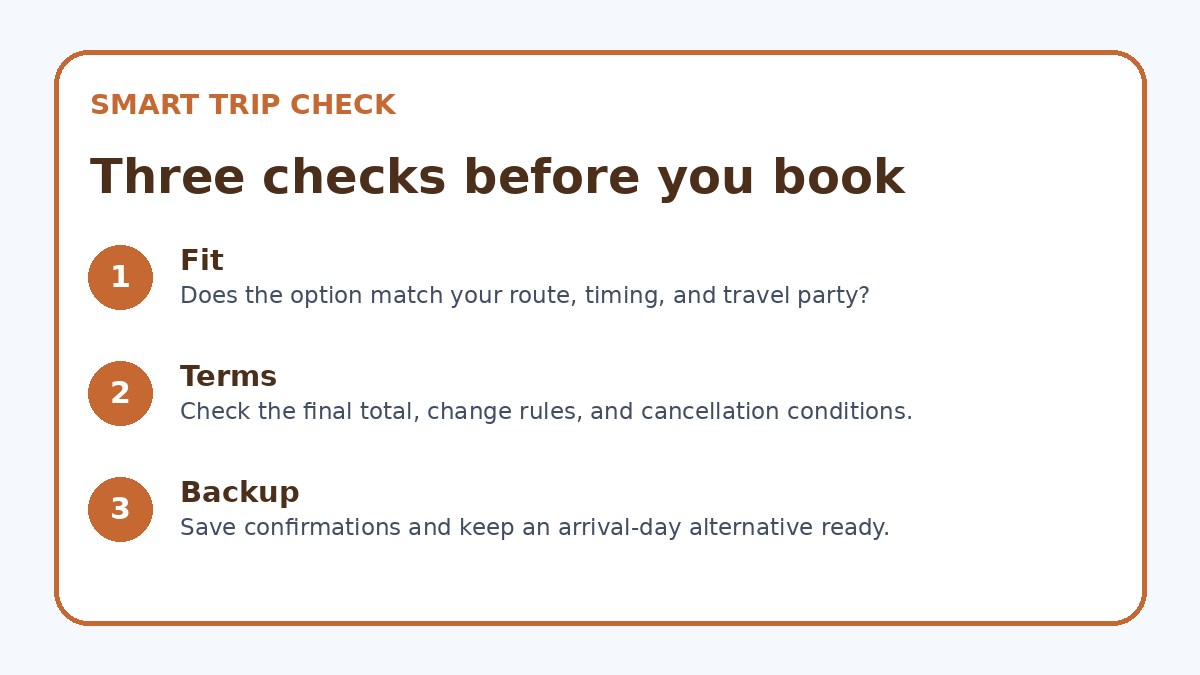
Whenever provider-specific facts could change, verify them on the booking page before you confirm. Check exact pickup and drop-off addresses, how long drivers will wait after the scheduled pickup time, luggage allowances, and any requirements for showing booking confirmation. For rail and shuttle services, confirm station names, transfer stops, and whether you need to reserve a seat or can buy a ticket on arrival. If you rely on a hotel shuttle, confirm the pickup point and schedule with the front desk the night before departure.
Also confirm practical details that affect timing: whether the transfer serves your terminal, whether there’s an extra step such as a short hotel shuttle to a main stop, and how to contact the provider if plans change. If using ride-hail, check where drivers are permitted to wait and whether your hotel has a designated pickup point that could speed or complicate a pickup. If you want to compare live availability or offers, Trip.com can be used as one place to look, but always verify the final booking terms on the provider’s own site.
Before you book
- Confirm your flight terminal and the recommended arrival time for checked luggage and security before choosing transfer timing.
- Verify the exact pickup location at your hotel and whether the provider can meet you at a specific entrance or lobby.
- Check the provider’s wait-time, cancellation, and change policies on their booking page before completing payment.
- Have at least one backup transfer method ready on your phone (two ride-hail apps or taxi number plus train schedule).
- Leave a time buffer beyond suggested arrival to cover traffic, security lines, and last-minute meeting delays.
- Save contact details for the driver or operator and your hotel front desk, and keep booking confirmations accessible offline.
Handle late meetings and last-minute changes
For meetings that commonly overrun, choose a transfer with flexible cancellation or easy rebooking. Pre-booked private cars that allow paid waiting time can be useful when timing is uncertain; just verify waiting policies before confirmation. If a train or shuttle departure fits tightly with your schedule, know the frequency and the next available departures in case you miss one, and have a backup taxi or ride-hail app ready. Keep your driver or operator contact details and your hotel’s front desk number handy to coordinate changes swiftly.
When you’re pressed for time, prioritize options that minimize walking, handoffs, and terminal transfers. A short, well-coordinated door-to-door ride may save time versus a multi-step rail journey even if the latter is typically faster. Maintain a simple contingency plan: an alternative pickup window, an app with multiple ride providers installed, and a clear plan for where to meet a driver at your hotel. A calm, prepared approach keeps your return trip predictable even when your schedule slips.
Frequently asked questions
How early should a business traveler leave downtown Toronto for an international flight?
Allowing time for surface travel, airport check-in, and security varies by terminal and airline, but plan for more than just drive time. Decide on a travel window that covers a worst-case traffic scenario for your preferred route and adds time for hotel departure procedures and luggage handling. If you choose a fixed-schedule service like rail, work backwards from the train departure time and factor in the walk or local transfer to the station. Whatever you decide, verify current recommended airport check-in and security suggestions with your airline before finalizing the pickup time.
Is it better to take rail or a taxi to Toronto’s airports?
Neither is universally better; choose based on priorities. Rail generally offers more predictable timing and avoids road congestion, so it’s preferable when stations are convenient and you can handle luggage. Taxis and ride-hail provide door-to-door service and are often quicker for hotels not near a station or when carrying multiple bags. Compare the total door-to-gate time, not just scheduled journey time, and confirm any station-to-terminal transfers needed when choosing between them.
What should I check when booking a corporate airport transfer?
When arranging corporate transfers, confirm billing arrangements, cancellation and change policies, and whether receipts meet your company’s expense rules. Verify vehicle class, luggage allowances, driver waiting time, and pickup details so there are no surprises on departure. Ask whether the provider offers account management or consolidated invoicing to simplify expense reporting, and confirm contact procedures for last-minute schedule changes. Always check the provider’s booking page for the exact contract terms you’ll be accepting.
Final planning note
Planning the return trip to Toronto’s airport as a business traveler is about matching risk tolerance to transfer type: choose predictable, schedule-based services to avoid traffic uncertainty, or pick flexible door-to-door options if meetings often overrun. Verify pickup points, wait policies, luggage rules, and terminal coverage on the provider’s booking page before you confirm. Keep contingency options and contact details handy, and leave a sensible time buffer so that travel stress doesn’t follow you onto the plane. A small amount of pre-trip verification and a clear backup plan will keep your return journey calm and efficient.
Continue planning
Check current options and final conditions
Use the provider page to confirm live availability, the final total, cancellation terms, and every condition that matters to your trip.
This evergreen planning guide was created with AI-assisted drafting and a structured quality review. It does not display live prices, schedules, availability, visa guidance, or provider rankings. Verify current details before booking. Some links are affiliate links; we may earn a commission at no additional cost to you.