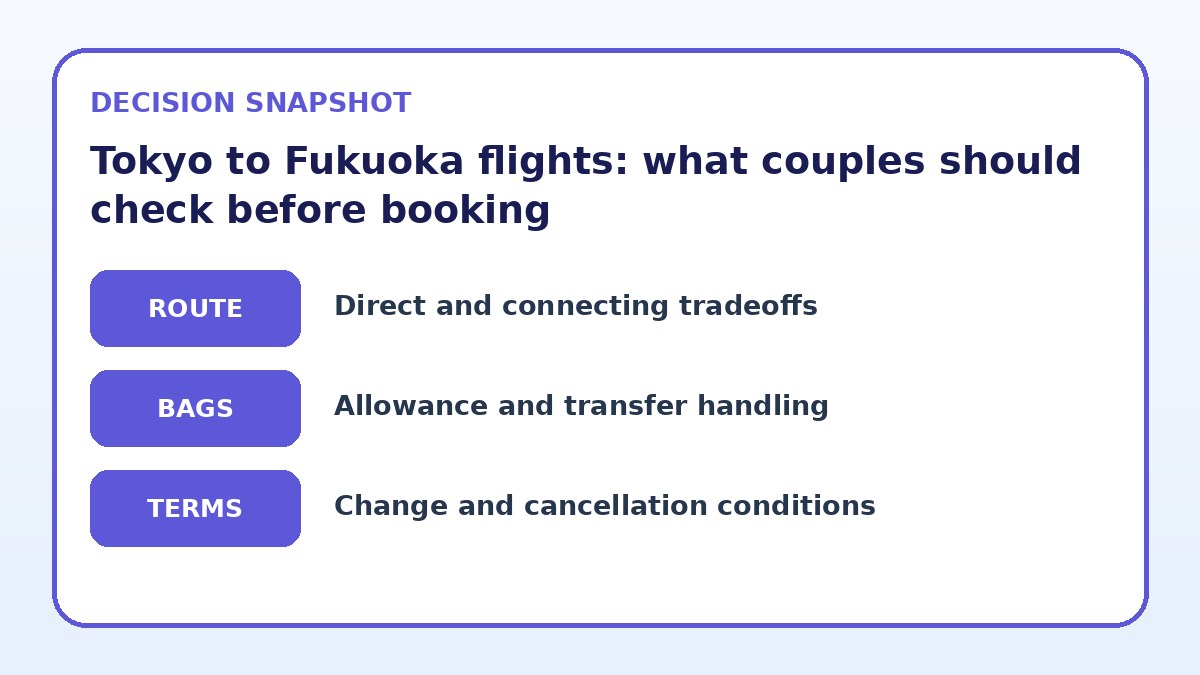
If you and your partner are planning travel between Tokyo and Fukuoka, start by deciding how important flexibility is to your trip: can you accept strict non-refundable fares for savings, or do you need freely changeable tickets because plans may shift? For most couples the practical move is to compare three things on every fare: change fees and allowance for same-day swaps, cancellation refunds or credits, and what happens when only one traveler needs to change. Before you book, check the carrier’s full fare rules on the final booking page for precise wording about penalties, payable taxes, and how refunds are issued. Keep an eye on whether the fare allows name changes, whether carry-over of value to future travel is automatic, and whether partner travel must be rebooked together to avoid extra fees.
See current options before you compare the details
Availability and final conditions change. Open Trip.com now or keep reading for the practical comparison.
Understand the three change-and-cancellation elements that matter
When comparing Tokyo to Fukuoka flights as a couple, focus on three contract elements: change fees and permitted changes, cancellation outcomes (refund, voucher, or travel credit), and the rules for modifying one passenger on a joint reservation. Change fees can be a flat amount, a percentage, or waived for certain fare types. Some fares only permit date changes within specific windows, and others require payment of any fare difference along with a fee. Cancellation language often hides whether taxes are refundable or retained by the carrier. The booking page should clearly state how refunds are processed—bank transfer, card reversal, or voucher.
Rules for modifying passengers on the same reservation are especially important for couples who want to keep seats together. Some carriers force all passengers on a single PNR to be reissued, which can mean higher costs or loss of preferred seats when only one person changes plans. Others let you change a single passenger without touching the companion’s ticket. If you value keeping seat assignments or loyalty benefits linked, check whether reissuing will reset seat maps, affect lounge access, or change accrual of miles for either traveler.
When to favor flexible fares versus cheaper restrictive tickets
Choose flexible fares if your travel dates are uncertain, one of you has work that can change, or you’re coordinating with events that might shift. Flexible tickets typically allow free or low-cost date changes and refund options; that convenience reduces stress and the need to juggle complex rebookings for two passengers. For many couples, the incremental cost for a flexible fare can be justified by the peace of mind of being able to adjust just one traveler without affecting the other. Consider also whether your schedule might need same-day changes—some fare types explicitly exclude same-day standby or may charge a premium.
Opt for restrictive, lower-cost fares when your plans are fixed, travel is off-peak, and you’re confident both partners will travel as scheduled. Lower-cost fares may be non-refundable and charge substantial fees for changes or reissues, but they can work well for planned leisure trips where itinerary certainty is high. If you pick a restrictive fare, plan contingencies: purchase travel insurance that covers cancellations for covered reasons, or leave refundable options for at least one leg of the journey. Weigh the total potential cost—ticket plus worst-case fees—against the flexible alternative.
| Approach | Best for | Tradeoff to check |
|---|---|---|
| Flexible fare together on one reservation | Couples who value being able to change either ticket while preserving seats and benefits | Higher fare cost and potential joint reissue complexity if carrier rules differ for companions |
| Cheap non-refundable fares on one reservation | Couples with fixed plans who prioritize low upfront cost | High change/cancellation fees and risk both tickets being impacted by one change |
| Separate reservations with similar fares | Couples who expect individual plan changes and prefer independent ticket control | Potential loss of contiguous seats, separate check-in processes, and split loyalty benefits |
| One flexible ticket and one cheap ticket | Couples balancing budget with a safety net if one partner’s plans are uncertain | Asymmetric protection—one partner remains exposed to strict fees and conditions |
Ready to check the option that fits your plan?
Use your exact dates and traveler details so the provider page can show the current total and conditions.
Practical steps to verify rules on the booking page
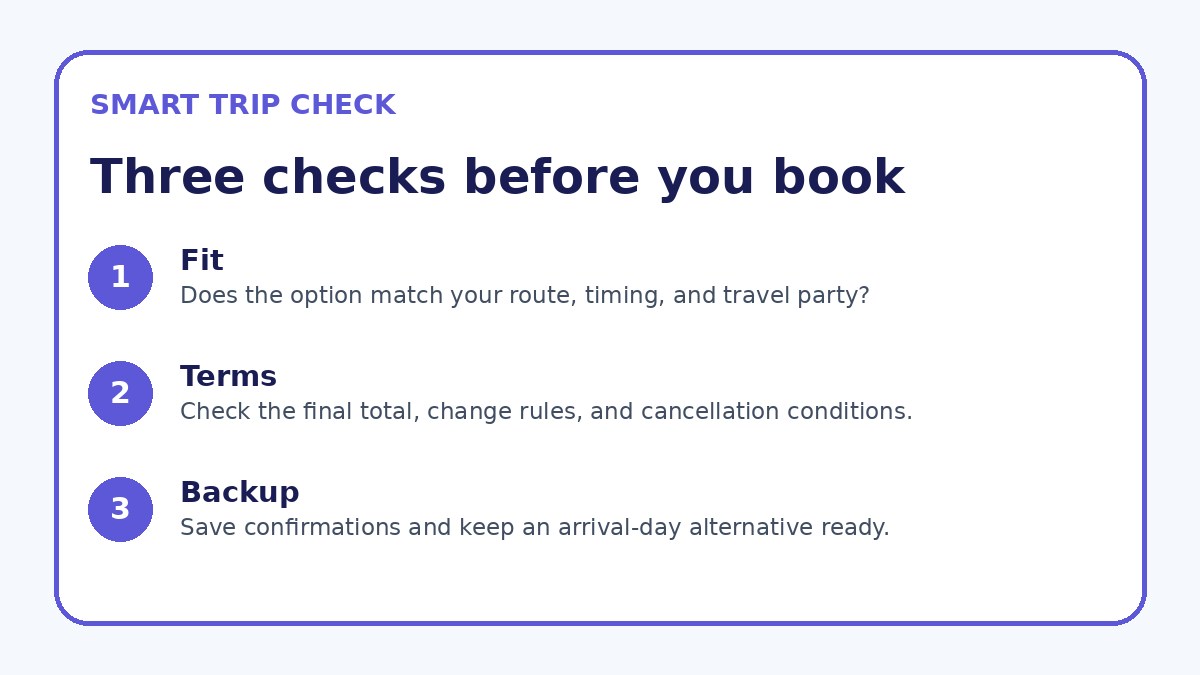
Always arrive at the airline or travel-agent final booking page before you commit. Look for the fare conditions or ‘fare rules’ link, which should list change fees, permitted changes, and cancellation terms. Verify exactly how refunds are handled: are they full refunds to the original form of payment, vouchers, or travel credits with expiry dates? Also check whether taxes are refundable and whether the carrier deducts processing fees. If the fare mentions reissue or endorsement codes, take a screenshot or copy the wording—those codes can be critical if you need customer-service help later.
If you’re booking through a third party, confirm the agent’s own change and cancellation handling. Some agents bundle their own fees or channel-specific rules that differ from booking direct. Trip.com can be one place to compare current availability and the listed conditions, but always cross-check on the airline’s official booking page before paying. Finally, if you hold elite status with an airline, verify whether your benefits (fee waivers, standby priority, or free changes) apply to the chosen fare class and how they affect companions on the same reservation.
Before you book
- Read the fare rules link on the final booking page and save a screenshot of change and cancellation wording.
- Confirm whether changes can be made for a single passenger without reissuing the entire reservation.
- Check how refunds are processed—card reversal, bank transfer, or voucher—and note any expiry dates or processing fees.
- If you book through an agent, verify the agent’s own fees and cancellation procedures in addition to the airline’s.
- Decide together whether to keep tickets on one PNR or split reservations, then document seat and loyalty implications.
- If you have airline status, check whether fee waivers or benefits apply to companion tickets and include them when booking.
Couples’ tradeoffs: seats, loyalty, and splitting reservations
Deciding whether to keep both tickets in a single reservation or split them is a common couple-level tradeoff. A single PNR makes it easy to keep seats together and manage one itinerary, but it ties both travelers to the same reissue rules and can force both tickets to change if the airline’s policy requires group reissuing. Splitting reservations gives each person maximum independence—one partner can rebook without touching the other’s ticket—but it can complicate seat selection, block fewer contiguous seats, and reduce joint recognition of loyalty benefits like companion upgrades.
Also weigh loyalty program implications. If one partner has status that brings change-fee waivers, confirm whether companion tickets booked on the same PNR receive the same benefit, or if the waiver applies only to the member’s portion. If status benefits could eliminate fees, keeping the reservation together may save money. Conversely, if neither of you has status and you expect different change needs, separate reservations might be cleaner despite potential seat separation. Whatever you choose, note the rules for complementary services and how reissuing may affect them.
Frequently asked questions
Can one partner change their Tokyo to Fukuoka flight without affecting the other?
It depends on the airline’s rules and how you booked. If both tickets are on the same reservation (PNR), some carriers require reissuing the whole booking when any passenger changes, while others allow single-passenger modifications. Before you buy, read the fare rules on the booking page for language about modifying passengers. If the fare is ambiguous, contact the airline’s reservations or customer service and get a reference number or transcript of the guidance. Splitting into separate reservations is a reliable way to ensure independent changes, though it may complicate seat assignments and joint benefits.
Should couples buy travel insurance instead of paying for flexible fares?
Travel insurance can cover many cancellation reasons but the coverage depends on the policy details and the reasons for canceling. Insurance policies commonly exclude voluntary changes or some types of work-related or event-related cancellations unless specified. Compare the cost of refundable or flexible fares against insurance premiums and the policy’s covered reasons, maximum payouts, and claim process. If you need protection for unpredictable but non-covered reasons, flexible fares or the airline’s change protections might be the safer choice. Always read both the fare rules and the insurance policy wording carefully before deciding.
What exactly should I verify on the airline’s final booking page before paying?
Check the fare conditions link for the change fee amount, whether free changes are permitted, how fare differences are handled, and the cancellation outcome (refund to card, travel credit, or voucher) including any expiry. Verify the refundable status of taxes and whether processing fees apply. Look for specifics on modifying individual passengers, policies about reissuing and seat assignments, and the exact contact route for customer service or refunds. If you booked through a third party, confirm any additional agent fees and their refund or change handling before completing payment.
Final planning note
For couples traveling Tokyo to Fukuoka, the most practical approach is to agree on your flexibility needs first, then compare fares on the three core items: change fees and allowances, cancellation outcomes, and rules for modifying individual passengers. Decide whether keeping both tickets on a single reservation or splitting them better matches your risk tolerance for changes, seat placement, and loyalty benefits. Always verify the exact fare rules on the airline’s final booking page and record screenshots or confirmation text. If you want a quick way to compare options, sites such as Trip.com can list availability and note conditions, but cross-check the carrier’s own booking page before you pay. With the right checks, you can balance cost against peace of mind and travel together with fewer surprises.
Continue planning
Check current options and final conditions
Use the provider page to confirm live availability, the final total, cancellation terms, and every condition that matters to your trip.
This evergreen planning guide was created with AI-assisted drafting and a structured quality review. It does not display live prices, schedules, availability, visa guidance, or provider rankings. Verify current details before booking. Some links are affiliate links; we may earn a commission at no additional cost to you.