If you’re flying solo from Tokyo to Fukuoka, your main booking decision isn’t just price: it’s how flexible the ticket is if your plans change. The practical answer up front is to prioritize a fare that balances a reasonable change/cancellation policy with acceptable baggage allowances and a schedule that minimizes connection risk. Low-cost, basic economy-style fares often look cheap but can carry significant penalties or no refunds; mid-tier refundable or semi-flexible fares cost more but save stress later. Before you commit, have exact travel dates, the passenger’s name as on ID, contact details, and any frequent-flier or special-assistance needs ready. Use those details to check final fare rules on the carrier’s booking page and cross-check with a comparison site such as Trip.com for a quick availability snapshot. Remember: the carrier’s final booking page is the authoritative source for change fees, timelines, and refund mechanics.
See live routes for your exact travel day
Compare direct and connecting choices with the same baggage and traveler details.
Routing: direct vs connecting and where change rules matter
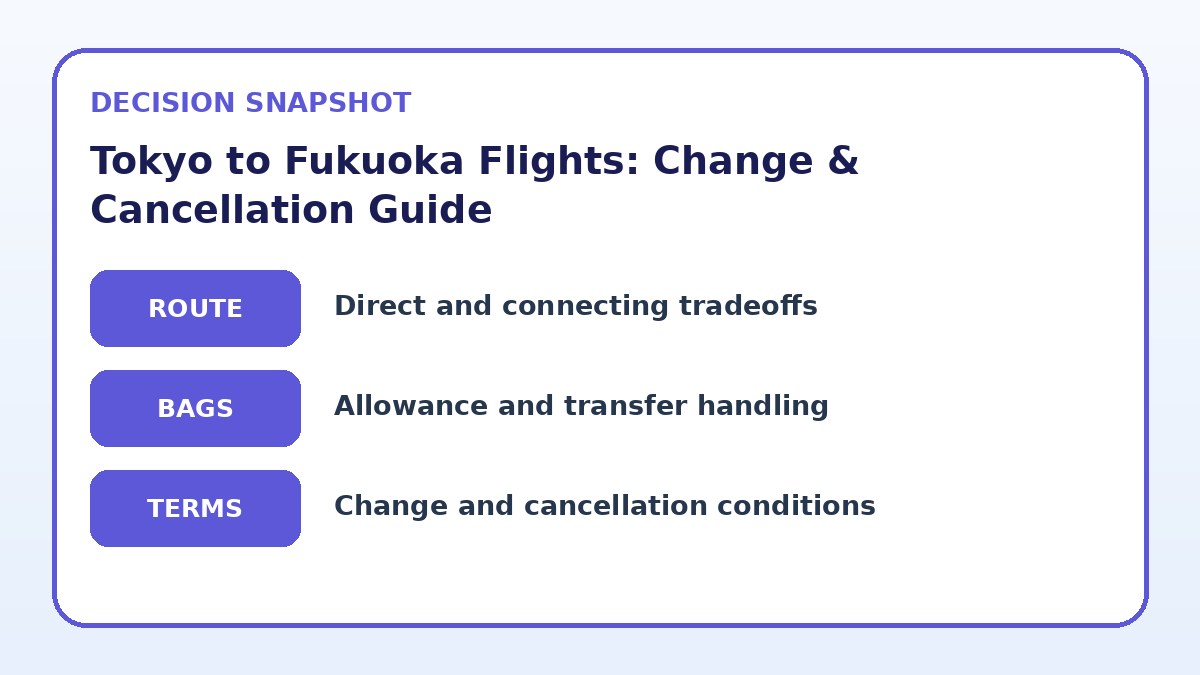
On the Tokyo to Fukuoka route you’ll commonly see direct flights that are simplest operationally and connecting options that can be cheaper or align with particular departure times. For a solo traveler, each routing choice affects how change and cancellation rules apply. If you book a single ticket with a connection operated through one carrier or partners, the whole itinerary is usually treated as one contract: change or cancellation can affect the entire ticket. If you assemble separate legs—for example, booking a cheap mainland connection separately—each segment carries its own rules and fees, so a missed connection won’t automatically be protected by the earlier carrier.
When checking routing, verify on the booking page whether changes can be made per segment or to the whole itinerary, and whether the carrier charges a flat fee plus fare difference or only fare difference. Also check whether the airline allows same-day rebookings or standby options for a fee or free of charge; some carriers offer day-of-travel flexibility for a premium fare class. If you need a tight schedule, favor direct services or single-ticket connections with clear through-ticket protections to reduce the chance that a change to one leg requires reissuing the whole ticket.
Baggage and connection risk: impact on change/cancellation decisions
Baggage rules interact with fare conditions in real ways: low-cost or basic fares might exclude checked bags and any later add-on can cost more than upgrading to a flexible fare at purchase. If your plan could change—longer stay, extra souvenirs, or a new internal transfer—consider paying for a fare that includes baggage or allows free same-class upgrades. Also check whether baggage allowances transfer if you change to another flight or fare: some airlines charge a new fee if you move to a lower-included-baggage fare when rebooking.
Connection risk is another practical factor. Tight connections raise the probability you’ll need to change plans after delays or cancellations. Solo travelers should check minimum connection times on itineraries that mix airports or carriers. If you expect to carry extra luggage, give yourself extra buffer time and prefer routings where checked bags are auto-transferred under one ticket rather than collected and rechecked. Always confirm on the carrier’s final booking or the ticket receipt how baggage is handled when the itinerary is changed or partially canceled.
Compare flight-selection strategies
| Flight strategy | Best for | Risk to check |
|---|---|---|
| Buy a basic economy/non-refundable low fare | Travelers certain of dates who want lowest upfront cost | Little to no flexibility; fees or no refunds for changes and baggage often extra |
| Purchase a semi-flexible fare with low change fees | Solo travelers who want a balance of cost and some flexibility | Moderate premium over basic fares; fare difference still may apply on rebooking |
| Choose a refundable or fully flexible fare | Anyone needing maximum schedule freedom or likely to cancel | Highest upfront cost but reduces financial risk and simplifies rebooking |
| Assemble separate legs for lowest combined price | Experienced solo travelers ready to manage connection risk themselves | Each leg has separate rules—missed connections usually aren’t protected |
Recheck the complete itinerary
Confirm airports, connection handling, baggage, and change conditions before deciding.
Schedule fit and day-of flexibility: read the fine print
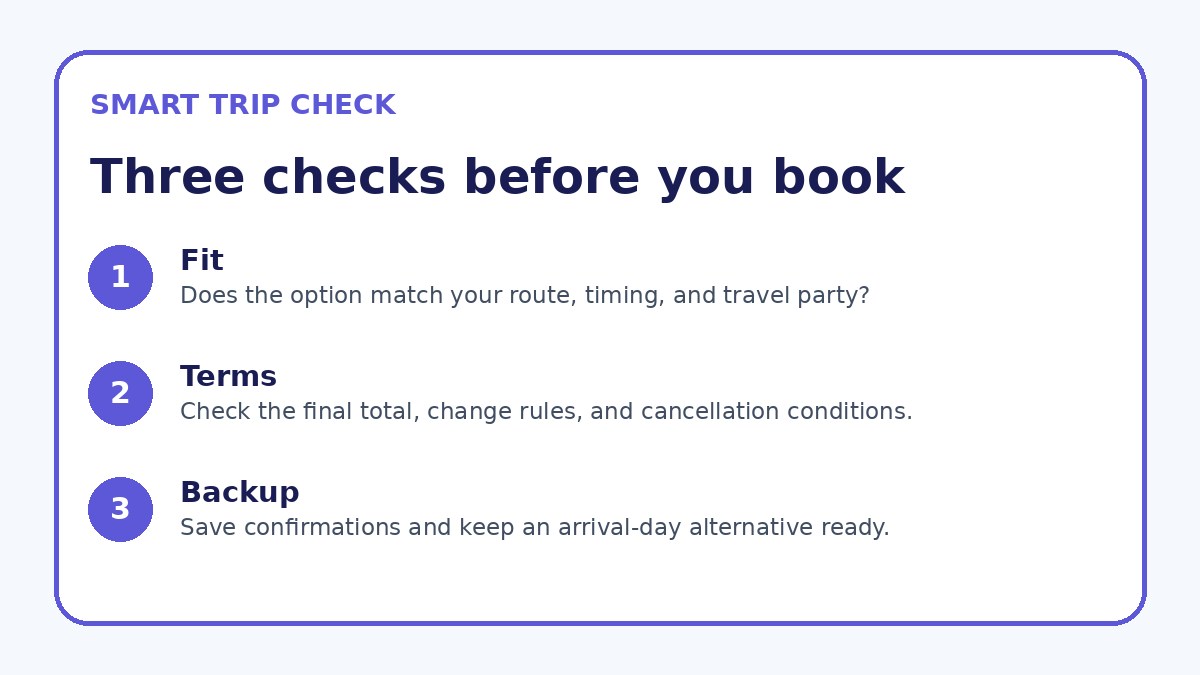
Schedule fit is more than departure hour: it’s how forgiving the ticket is when you need to change arrival or return times. Some fares allow free name corrections but charge for date changes; others permit limited free rebooking within a specific window after purchase or up to departure. Solo travelers with uncertain schedules should check whether airlines permit same-day changes for a fee or for free when moving to an earlier or later flight operated by the same carrier. These options often depend on fare class, elite status, and seat availability.
On the booking page, look for explicit timings when changes are allowed (for example, up to 24 hours before departure) and whether fare difference applies regardless of timing. Also confirm the reissue process: can you change online, or must you call the airline? If you might need to switch to a different carrier or airport entirely, learn whether the ticket provides travel credit rather than refunds, and how long that credit remains valid. These operational details determine how practical the fare will be when your plans evolve.
Flight details to verify
- Have exact travel dates, passenger name as on ID, contact phone, and email ready before searching fares.
- Open the carrier’s official fare rules and read sections on changes, cancellations, and refunds before booking.
- Compare baggage inclusion across fare classes; calculate the cost to add baggage later if needed.
- Check whether the ticket can be changed online and how long before departure changes are allowed.
- Note any travel-credit expiry dates and whether credits can be used on partner airlines.
- If booking separate legs, ensure sufficient buffer time and verify whether checked bags transfer automatically.
Fare conditions: refunds, credits, change fees, and what to verify
Fare conditions determine your financial exposure when plans change. Key elements to verify are whether a fare is refundable, whether it converts to travel credit, and whether change fees are fixed or waived. Some carriers offer no-fee changes for select fare classes or within specified time windows; others always apply a change fee plus any fare difference. For cancellations, verify whether taxes and third-party fees are refundable—these sometimes follow different rules from the ticket price itself.
Always confirm the exact wording on the airline’s final booking page: the ticketing rules, the timeline for making changes or cancellations, and any administrative fee for processing. If a travel credit will be issued, check its expiry date, any blackout rules, and whether it can be used on partner airlines. If you rely on a travel comparison site for options, use it to shortlist fares but finalize changes and refunds through the carrier or the booking agent whose terms you accept. This ensures you know the real conditions that will apply if you need to change plans.
Flight Guide questions travelers ask
Can I get a refund if I cancel a cheap Tokyo to Fukuoka fare?
Cheap or basic fares often have very restricted refund policies, and many are non-refundable. What matters is the airline’s specific fare rules shown at booking: some carriers will offer a travel credit instead of a monetary refund, while others may refund taxes only. Always check the final booking page for cancellation timelines, any administrative fees, and whether refunds are returned to the original payment method or as a credit. If a refund is important, choose a refundable fare or buy trip protection from a reputable insurance provider and verify the insurer’s eligible reasons for coverage.
How do change fees and fare differences work when rebooking?
Most tickets subject to changes require you to pay a change fee plus any fare difference between the original and new ticket. The carrier’s rules will state whether the fee is a fixed amount or waived under certain conditions (such as within 24 hours of purchase). Fare difference applies when the new ticket is more expensive; sometimes the carrier will refund the difference if the new fare is lower, but many apply ticketing rules that convert the remainder to a travel credit. Always confirm the total payable amount for a change on the airline’s final reissue page before confirming any new itinerary.
Is it safer to book a direct flight from Tokyo to Fukuoka?
Direct flights reduce operational complexity because there’s no separate connection to worry about: fewer touchpoints mean fewer opportunities for delay-induced missed connections. For solo travelers, a direct routing simplifies luggage handling and reduces the chance you’ll need to make on-the-spot changes. However, direct flights can be more expensive or less convenient in departure time. Balance the value of a direct routing against the fare and flexibility you need; if flexibility is a priority, a slightly higher-priced refundable direct ticket may be worth the peace of mind.
Final decision note
For a solo traveler on the Tokyo to Fukuoka route, the central booking question is how much flexibility you need versus how much you want to save upfront. Explicitly compare fare rules, baggage inclusion, and the carrier’s change and cancellation mechanics before you click purchase. Prepare exact traveler details and consult the airline’s final booking page to verify fees, refund options, and credit expiries. If uncertainty is likely, prefer a semi-flexible or refundable fare; if your dates are fixed, a basic fare may be acceptable but confirm baggage and change penalties. Use comparison tools like Trip.com to view options quickly, but always rely on the carrier or agent’s ticketing terms for the final decision.
Continue planning
Check current options and final conditions
Use the provider page to confirm live availability, the final total, cancellation terms, and every condition that matters to your trip.
This evergreen planning guide was created with AI-assisted drafting and a structured quality review. It does not display live prices, schedules, availability, visa guidance, or provider rankings. Verify current details before booking. Some links are affiliate links; we may earn a commission at no additional cost to you.