If you’re a solo traveler planning time in Taipei, the practical decision usually comes down to convenience versus simplicity. For most visitors who will stay in the central city and visit museums, night markets and nearby day-trip spots, Taipei’s MRT, buses and plentiful taxis cover nearly every need with minimal navigation stress. Renting a car brings flexibility for early-morning departures, destinations outside the metro area, or if you plan an island-wide driving loop. But driving in Taipei also means learning local traffic patterns, parking constraints in dense neighborhoods, and dealing with occasional tolls and mountain roads if you head out of the basin. Below you’ll find a clear comparison, the tradeoffs to weigh by itinerary and personality, and a checklist of concrete things to confirm before booking a rental or relying on public transport.
See current options before you compare the details
Availability and final conditions change. Open Trip.com now or keep reading for the practical comparison.
When public transport is the better bet
Taipei’s public transport network is dense and designed for urban travelers. The city’s MRT lines cover the central business and tourist districts, while an extensive bus system fills in gaps to neighborhoods and attractions. For a solo traveler prioritizing museums, temples, food markets, and evening neighborhoods like Ximending or Shilin, the MRT plus short taxi rides will usually be the quickest and least complicated way to move around. You won’t need to hunt for parking or worry about local driving rules, and you can focus on decisions about where to eat or what neighborhood to explore next rather than watching road signs.
Time of day matters: MRT and bus frequency is high during peak hours and remains reliable into the evening on main lines, which suits a solo traveler who wants to maximize daytime sightseeing and return to a single base each night. If your plan includes nightlife or late-night markets, note the last train times for the lines you’ll use and have a taxi app as backup. Also consider luggage: public transport is more convenient for lightweight overnight bags, but if you’ll carry bulky gear it may feel less comfortable than door-to-door driving.
When renting a car makes sense
A rental car becomes attractive when your itinerary emphasizes early starts, flexibility, or travel to places the rail network doesn’t serve well. Solo travelers who want to visit coastal villages, highland tea terraces, or remote trailheads that require multiple bus changes will save time and avoid complicated transfers by driving. A car also lets you build a looser schedule—stop at scenic lookouts, carry more gear for photography or hiking, and depart hours before scheduled buses. If your route includes a loop of Taiwan that leaves the Taipei basin, having a car avoids the uncertainty of intercity bus schedules and offers private space on long drives.
However, driving Taipei and nearby regions requires preparation. You’ll need to verify driver license requirements, book a vehicle size appropriate for narrow streets, and plan for parking at each destination—urban lots can be scarce or expensive. Mountain roads on some day-trip routes may be narrow and winding; consider whether you’re comfortable with those conditions alone. For short city-centered stays, the benefits of a rental are usually outweighed by the hassle of traffic and parking.
| Approach | Best for | Tradeoff to check |
|---|---|---|
| Public transport (MRT, buses, taxis) | City-centered itineraries, low-stress navigation, budget-conscious solo travelers | Less flexible schedule and limited reach to remote or early-morning destinations |
| Short-term car rental for day trips | Single-day excursions to remote sites or coastal/highland areas with poor transit links | Higher cost for one-day use and need to plan parking and return timings |
| Multi-day car rental | Self-guided exploration outside Taipei or multi-stop island routes | Ongoing costs and extra time spent on navigation, tolls, and parking logistics |
| Mixed approach (transit in-city, car for selective days) | Travelers seeking both convenience in the city and freedom on specific day trips | Requires more planning and possibly multiple bookings—but gives balanced benefits |
Ready to check the option that fits your plan?
Use your exact dates and traveler details so the provider page can show the current total and conditions.
Cost, convenience and hidden tradeoffs
Comparing costs between transit and renting depends on the specifics of your trip: rental rate, fuel, parking, and tolls versus daily transit passes, occasional taxis, and the time cost of transfers. Don’t forget ancillary costs—fuel, highway tolls, parking fees in the city, and possible drop-off charges if you return the car at a different location. For single-day excursions where transit connections are clunky, a rental or hiring a private driver might make sense despite higher expense; for multi-day urban stays, transit fares accumulate more slowly and require less administrative overhead.
Convenience often trumps raw cost for solo travelers who value low stress. Public transport means no parking hunts, no navigation stress, and a lower risk of traffic fines or unfamiliar local rules. Renting a car gives you autonomy but also hands you responsibility for route planning, parking, and vehicle condition. Consider the tradeoff between flexibility and cognitive load—if you prefer a relaxed, low-decision trip you’ll likely favor transit; if you enjoy driving and independent exploration, a car may be worth the extra effort.
Before you book
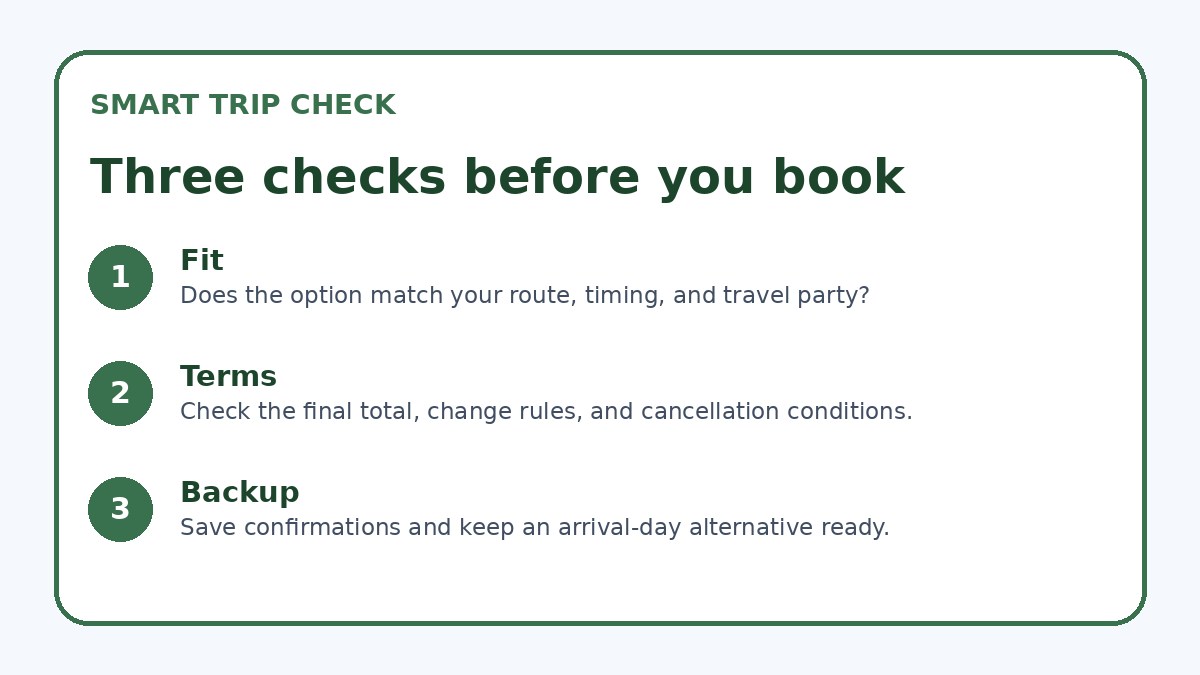
- Map every planned stop and mark whether it’s within easy MRT access, requires a single bus, or needs multiple transfers.
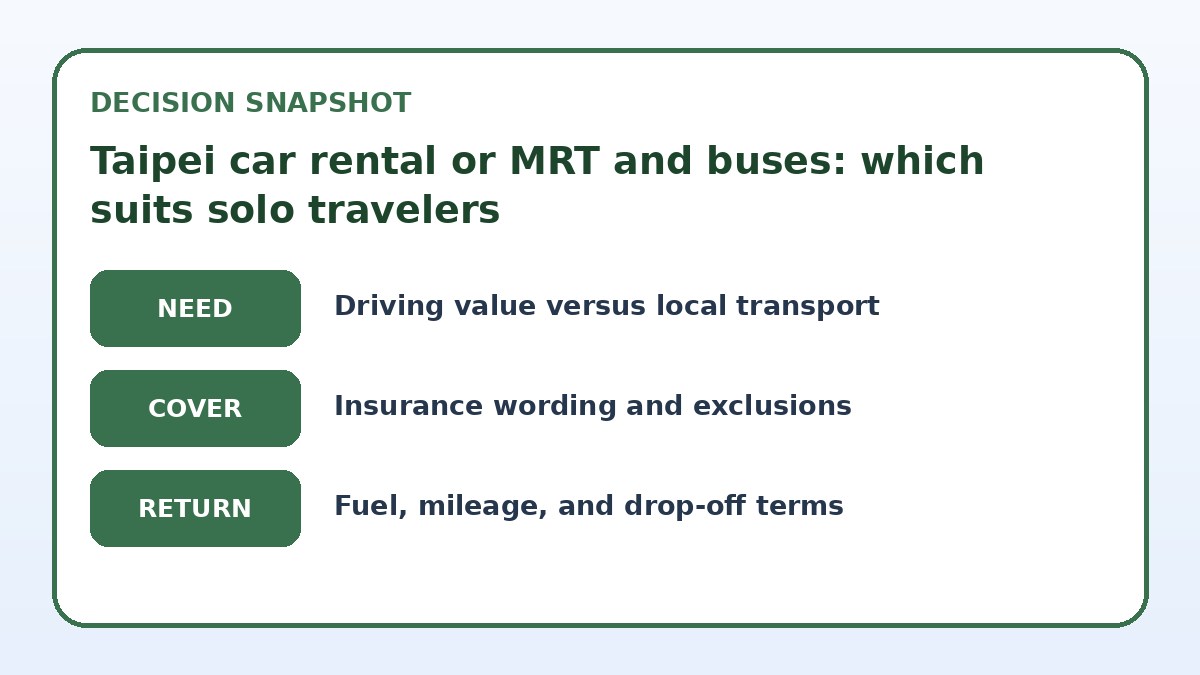
- If renting, confirm driver license rules, required ID, insurance coverage limits, fuel policy, and any mileage or drop-off restrictions on the provider’s booking page.
- Check parking options in each urban neighborhood and at attractions; note cost, availability, and whether reservations are possible.
- Plan backup transit: install a reliable taxi app and save MRT/bus route maps in offline mode in case plans change.
- Decide luggage strategy: choose a smaller rental car if you’ll navigate narrow streets, or reduce baggage to ease public-transport mobility.
- Compare travel time versus cost for each major leg; for marginally reachable sites, test whether an organized tour or private transfer is easier than self-driving.
How to decide: checklist and booking tips
Start by mapping your planned stops and noting which are inside the Taipei MRT network and which require multiple bus transfers. If more than three key stops sit outside convenient transit links, a rental becomes more attractive. Also factor in your tolerance for early departures or late returns—if your best experience relies on a sunrise start or returning after transit hours, driving can solve that scheduling friction. Consider luggage and comfort: carrying large backpacks on crowded trains is different from comfortable door-to-door driving.
On the booking side, verify licensing and insurance requirements with the rental provider, and read the final terms on the provider’s page for cross-border rules and drop-off locations—these details change frequently and must be confirmed. For transit, check MRT line maps, bus timetables, and whether an EasyCard or similar travel card will simplify fares. Trip.com is one optional place to compare current car rental availability and conditions, but always confirm vehicle details, fuel policy, insurance, and mileage limits directly with the rental company before you pay.
Frequently asked questions
Is it hard to drive in Taipei if I’m used to city traffic elsewhere?
Driving in Taipei is manageable for experienced urban drivers, but there are differences to expect. Traffic can be congested in central districts during rush hours, with many motor scooters sharing lanes and frequent lane changes at intersections. Parking is limited in dense neighborhoods and may require payment or a permit in some buildings. If you’re comfortable navigating unfamiliar roads, reading local signs, and handling busy intersections, you can drive successfully; if that sounds stressful, using the MRT and taxis reduces friction. Always check the rental company’s rules and local driving regulations before you get behind the wheel.
Can I rely on taxis instead of renting a car for flexible travel?
Taxis are a convenient option for many solo travelers and fill gaps when transit doesn’t fit your schedule. In-city trips are usually simple, and taxis are an efficient way to get to and from night markets or late trains. For longer day trips or rural destinations, taxi fares can become expensive and drivers may be less willing to wait for long sightseeing stops. For multi-stop rural exploration, a rental or organized transport may be more economical and flexible. Before you travel, check local taxi apps and typical service coverage in the areas you plan to visit.
How do I compare renting a car vs organized tours for day trips?
Organized tours remove driving, navigation, and parking decisions and often include a guide and set itinerary—good for solo travelers who want one-click convenience. Renting a car gives you freedom to change stops, linger longer, or follow personal interests, but adds planning and logistical responsibilities. To choose, list the exact stops, compare the sum of rental plus parking and fuel against available tour prices, and weigh how much you value autonomy over convenience. If a specific remote site needs early access or unusual timing, a car might be the better fit; otherwise, a tour can be simpler and sometimes more efficient.
Final planning note
For most solo visitors who plan to stay in Taipei’s central neighborhoods and do a handful of nearby day trips, public transport is the simplest, lowest-stress choice. The MRT and buses connect the bulk of tourist sites efficiently, and taxis fill timing gaps without the hassle of parking or local driving rules. Choose a rental when your itinerary includes multiple remote destinations, early-start excursions, or a desire for complete independence; be honest about your comfort driving unfamiliar roads and managing parking. Use the checklist above to map stops, verify rental terms on the provider’s booking page, and decide whether a mixed approach—transit for the city and a rental for specific days—gives you the best of both worlds.
Continue planning
Check current options and final conditions
Use the provider page to confirm live availability, the final total, cancellation terms, and every condition that matters to your trip.
This evergreen planning guide was created with AI-assisted drafting and a structured quality review. It does not display live prices, schedules, availability, visa guidance, or provider rankings. Verify current details before booking. Some links are affiliate links; we may earn a commission at no additional cost to you.