If you’re planning Sydney to Melbourne transport for the first time, the practical decision is which stations or terminals fit your itinerary and how to link them smoothly. Decide first whether you prioritise speed, cost, or convenience: that determines whether you fly between airports, take a long‑distance coach, or travel by train. Each option uses different arrival and departure points in both cities, and transfers between those points—airport to central station, or interstate terminal to local transport—shape total journey time and stress. This guide puts the decision tools up front: how to assess transfer distances, luggage handling, public-transport links, and where to verify provider details before you commit. Read on for tradeoffs and step-by-step checks so your Sydney–Melbourne leg starts and ends where you need it to, not where connections force you to be.
See current options before you compare the details
Availability and final conditions change. Open Trip.com now or keep reading for the practical comparison.
Match your route to arrival and departure points
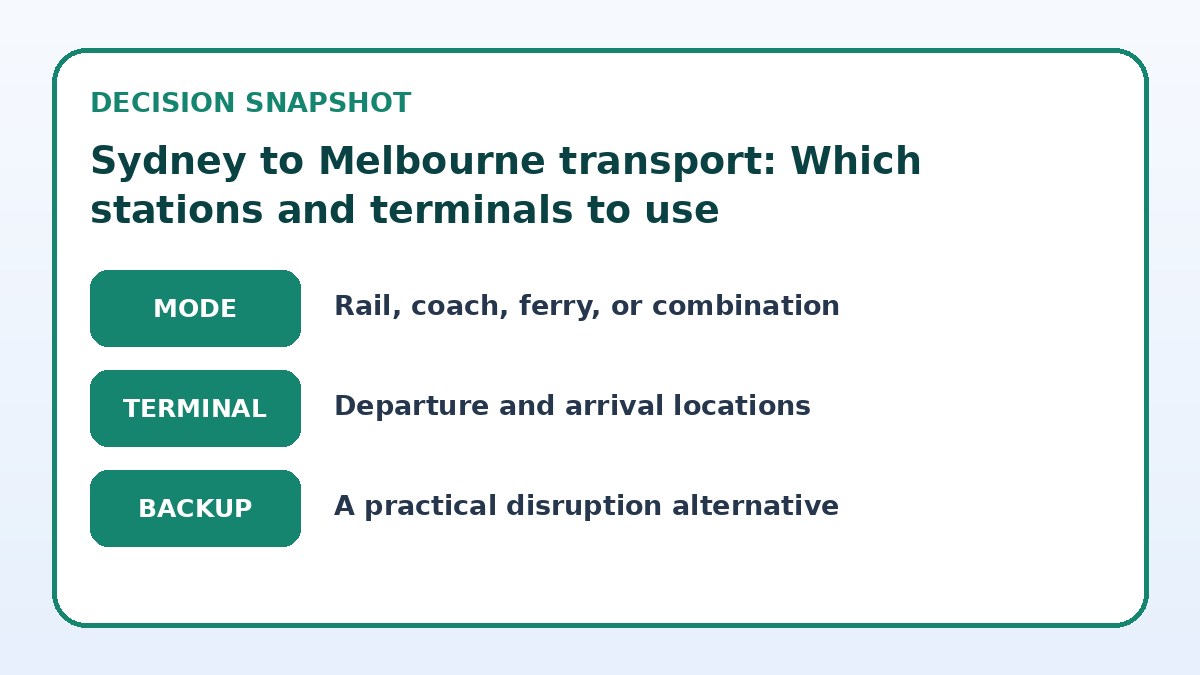
Sydney to Melbourne transport covers airport-to-airport, train-to-train, and coach options, and each uses different terminals or stations. For air travel, check which Sydney and Melbourne airports are offered on your search: some services use the major international terminals while others use domestic terminals or secondary airports. For rail and coach, confirm whether long‑distance services arrive at a central city terminal or a suburban hub. The practical effect is the same: the chosen point determines the onward transfer you must plan—for example, whether you need a short tram into the CBD or a longer shuttle to a suburban motel.
When choosing, think about where you need to be on arrival—CBD, a specific neighbourhood, or an airport hotel—and then work backward to the best terminal or station. A slightly longer main-leg trip that drops you into the city centre may save time and cost on transfers compared with a quicker arrival at an outlying terminal. For first-time visitors, mapping actual walking distances and typical transit connections between terminals and your accommodation reduces surprises and helps you pick the logical travel option for your priorities.
Transfers: practical considerations and mobility needs
Transfers vary from quick shuttle rides to multi-step public-transport journeys. Evaluate luggage handling—do you need assistance or a porter?—and whether step-free access is available at the terminals and stations you plan to use. If you have mobility constraints or young children, prioritise options with simpler, direct transfer routes and clear indoor connections. Look at typical peak-hour congestion: an easy transfer at off-peak times can become slow and crowded during morning or evening peaks, turning a short connection into a stressful dash.
Also consider the frequency and reliability of onward links: some suburban terminals have infrequent buses or longer waits between services, while central stations and major airport terminals tend to have frequent trains, trams, or express shuttles. For travel with tight connections, allow buffer time for delays and factor in time needed to collect checked baggage, clear security (where relevant), and move between levels or terminals. If you rely on ride-hailing or taxis, check pickup zone rules at each terminal before you arrive.
| Approach | Best for | Tradeoff to check |
|---|---|---|
| Fly between airports | Travelers prioritising speed for the main leg and flexible flight schedules | Can require longer or more complex ground transfers between distant terminals and city centre |
| Long-distance train to central station | Those who prefer fewer transfers to reach the CBD and want simpler baggage routines | Longer overall travel time; check platform layouts and step-free access for luggage |
| Intercity coach to major terminal | Budget-focused travelers who prioritise direct drop-offs nearer suburban destinations | May have fewer services and longer, less comfortable journeys; transfer options can be limited |
| Mixed-mode (train/flight/coach) with local taxi | Travelers needing specific arrival neighbourhoods or flexible door-to-door plans | More moving parts increase risk of missed connections and complicate baggage handling |
Ready to check the option that fits your plan?
Use your exact dates and traveler details so the provider page can show the current total and conditions.
Comparing direct and connecting options
For Sydney to Melbourne transport, direct services reduce transfer complexity but may not always match your door-to-door needs. A direct flight might be fast between airports but require lengthy transfers to your final city location; a train or coach that arrives in a central terminal can save transfer time even if the journey itself takes longer. When comparing providers, list total expected travel stages: access to departure point, check-in and security (for air), the main leg, baggage collection, and transfer to final destination. That full journey perspective reveals where time and effort are truly spent.
If a route requires a connection—such as a train that requires a taxi to an airport for a flight—compare the extra steps’ reliability and contingency options. Consider how easy it is to rebook a missed connection, whether luggage can be through-checked, and whether you have time to transfer comfortably. When providers’ pages present schedules, verify if the booking allows realistic minimum connection times and whether they specify terminal names, transfer services, and luggage policies on the final booking page.
Before you book
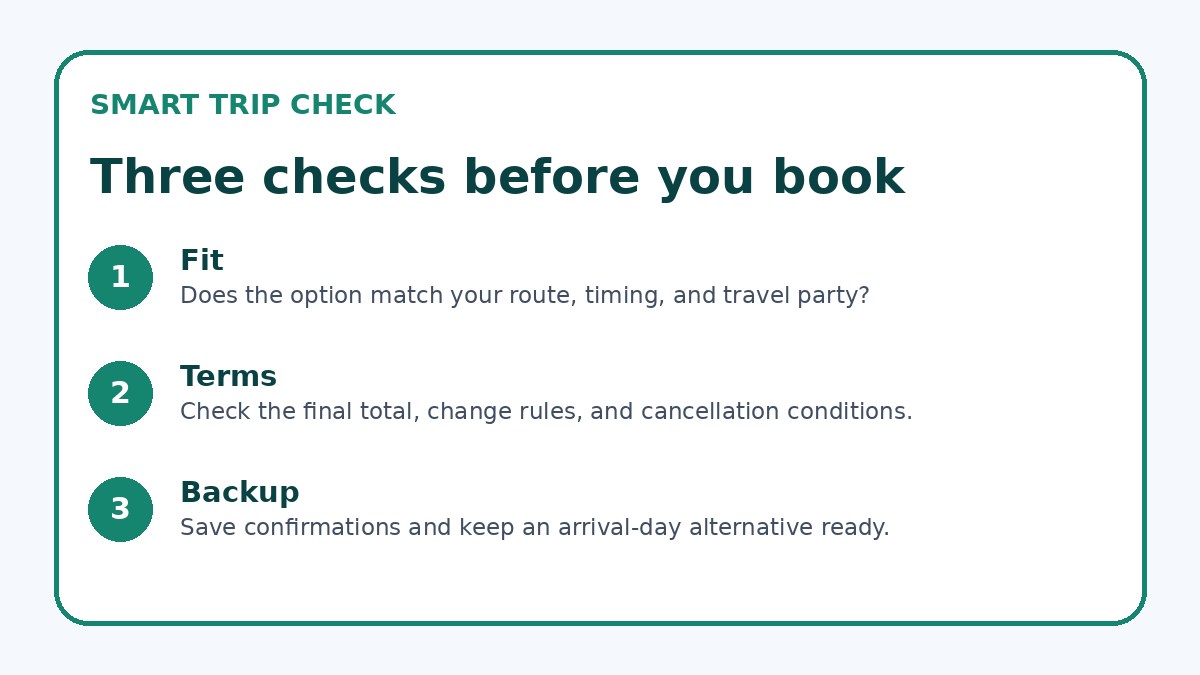
- Confirm the exact terminal or station name shown on your booking confirmation and match it to local transit maps.
- Estimate door-to-door time including baggage collection and transfers, and add at least 30–60 minutes buffer.
- Check step-free access, elevator locations, and assistance services at each terminal if you have mobility or heavy-luggage needs.
- Identify official shuttle, tram, train, or taxi pickup points and note any app requirements or card payments needed.
- Verify luggage rules and whether your booking allows through‑checking between legs or requires rechecking.
- Look up contingency options—alternate terminals, later services, or nearby hotels—before you depart for unexpected delays.
Practical planning steps and final checks
Before you book, run a simple transfer audit: map the arrival terminal or station to your accommodation, estimate door-to-door time, and identify backup options if the first leg is delayed. Check local transit maps for train and tram routes, confirm shuttle or taxi pickup locations at each terminal, and note whether you’ll need a transit card or app. For visitors unfamiliar with Australian transport systems, identifying a single easy-to-reach transfer hub in each city simplifies navigation and reduces cognitive load during arrival.
On the booking page, verify provider-supplied terminal and station names, baggage allowances, and any transfer services. If the provider offers multiple terminals or transfer partners, check which one your booking uses—not every ticket will use the same terminal. Trip.com can be used as one place to compare current availability and terminal details, but always confirm final transfer information on the provider’s official booking confirmation. Finally, build in at least a moderate buffer for international arrivals, unfamiliar signage, and local traffic.
Frequently asked questions
How do I choose between flying and taking the train from Sydney to Melbourne?
Decide by comparing door-to-door time, not just the main-leg duration. Flying can be fastest in the air, but if terminals are distant from your start or end points, additional transfer time may erase the advantage. Trains often arrive in central stations, which can simplify transfers to city accommodation and reduce taxi or shuttle costs. Also consider luggage handling and the number of steps in transfers: if you want fewer moving parts and easier baggage routines, choose the option that drops you closest to your final destination.
What transfer time should I allow between a long-distance arrival and my next connection?
Allow a comfortable buffer beyond scheduled travel times to handle baggage, navigation, and local traffic. For air-to-city transfers, plan for baggage collection and travel time to your next stop—often 30–90 minutes depending on proximity and traffic. For train or coach arrivals in central terminals, shorter buffers may suffice, but still factor in platform changes and potential crowds. If you have a tight onward connection, check whether providers specify minimum connection times on the booking page and consider earlier services to reduce risk.
How can I verify transfer logistics before I book?
Use the provider’s official booking confirmation to confirm terminal and station names, baggage policies, and pickup locations. Cross-check those names on local transit maps and airport or station websites to find exact shuttle, tram, or taxi points. If provider pages list multiple terminal options, make sure you know which one applies to your ticket. Trip.com can be a quick place to compare availability and terminal details, but always confirm final transfer specifics on the provider’s official page or in the confirmation email before relying on a connection.
Final planning note
Planning Sydney to Melbourne transport for the first time becomes straightforward if you prioritise where you actually need to start and finish the day. Focus on arrival and departure points, map the real transfer steps between them, and choose the option that minimises complex connections for your needs. Verify terminal and station names, luggage rules, and local pickup points on the provider’s booking page before you travel. Build modest buffers for baggage and local traffic, and have a contingency plan for delayed legs. With those checks done, you’ll make a decision that fits your schedule, comfort level, and final destination in the city.
Continue planning
Check current options and final conditions
Use the provider page to confirm live availability, the final total, cancellation terms, and every condition that matters to your trip.
This evergreen planning guide was created with AI-assisted drafting and a structured quality review. It does not display live prices, schedules, availability, visa guidance, or provider rankings. Verify current details before booking. Some links are affiliate links; we may earn a commission at no additional cost to you.