Practical answer up front: for most first-time visitors making a single short hop to Melbourne, choose the Sydney airport that gives you the simplest combination of reliable access from where you’re staying, the fewest transfers, and the departure times you need. That often means prioritizing ground travel time and connection simplicity over tiny fare differences. If you have heavy luggage, an early-morning start, or tight onward connections in Melbourne, the airport with the most direct and frequent ground transport from your accommodation will likely be the most practical. Read on to learn the tradeoffs — access, check-in and security time, domestic terminal layout, and how to compare direct versus connecting options when you shop for Sydney to Melbourne flights.
See current options before you compare the details
Availability and final conditions change. Open Trip.com now or keep reading for the practical comparison.
Which Sydney airports serve flights to Melbourne and why it matters
Greater Sydney is served by more than one airport option that can put you on a flight to Melbourne — each airport has different ground-transport connections, terminal layouts, and peak traffic patterns. For a first-time visitor, these differences affect how long it takes to get to the gate, how easy it is to check baggage or use public transport, and how much buffer time you should plan before departure. Your accommodation location in Sydney often dictates the best choice: an airport closer by will reduce taxi or train time and may let you leave later in the morning or return later at night.
Also consider transfers: if you arrive internationally and then continue to Melbourne the same day, the practicality of swapping terminals or transferring across the city becomes a key factor. Even if the air time is short, transfers that require long bus rides, multiple metro changes, or heavy traffic can turn a half-day of travel into a full-day chore. For families, travelers with mobility needs, or anyone carrying bulky luggage, fewer transfers and simpler terminal navigation are usually worth paying a little more for.
How to compare direct versus connecting flight options
When you check Sydney to Melbourne flights, first establish whether a direct flight is available on your preferred dates and times. Direct flights are typically faster and introduce less risk of missing connections; they also simplify luggage handling because you won’t need to re-check bags. If a direct option exists from your chosen departure airport at a reasonable time, it will often be the most practical choice for first-time visitors who prioritize predictability and minimal hassle.
Connecting options can make sense when direct schedules don’t match your plans or when a connecting airport is far more convenient from your location. If you consider a connection, compare the total journey time including layover, the minimum connection time recommended by the airline, and whether a single ticket covers both legs (protecting you in case of delays). Always verify connection details on the airline’s final booking page and allow extra buffer for security checks and transfer distances.
| Approach | Best for | Tradeoff to check |
|---|---|---|
| Choose airport nearest your hotel or arrival point | Minimizing door-to-door travel time | May limit flight time choices or slightly higher fares |
| Pick airport with the most frequent departures | Flexible schedules and last-minute changes | Could require longer ground travel if it’s farther from where you stay |
| Opt for direct flights only | Simplicity and lower connection risk | Fewer time slots and possibly higher ticket prices |
| Accept a connecting itinerary for a cheaper ticket | Saving money when schedule flexibility is high | Longer total journey time and higher risk of missed connections |
Ready to check the option that fits your plan?
Use your exact dates and traveler details so the provider page can show the current total and conditions.
Ground transport, check-in, and pre-flight timing considerations
Choose the airport that offers the most reliable ground-transport options from where you will be coming or staying. Frequent train or shuttle services, straightforward taxi numbers, or short rides by rideshare reduce the stress of tight schedules. Also factor in typical peak-hour traffic: if your hotel is near a major roadway that clogs during commute hours, an airport slightly farther away but served by a fast rail link might save you time and anxiety.
Plan check-in and security time based on the terminal layout and how comfortable you are with crowding and queueing. Some terminals are compact with short walking distances to gates; others require longer walks or shuttle transfers within the airport. If you’re unfamiliar with the airport, allow extra time for locating your airline counter, clearing security, and finding your gate — and check the airline’s final booking page for the carrier’s recommended arrival time before departure.
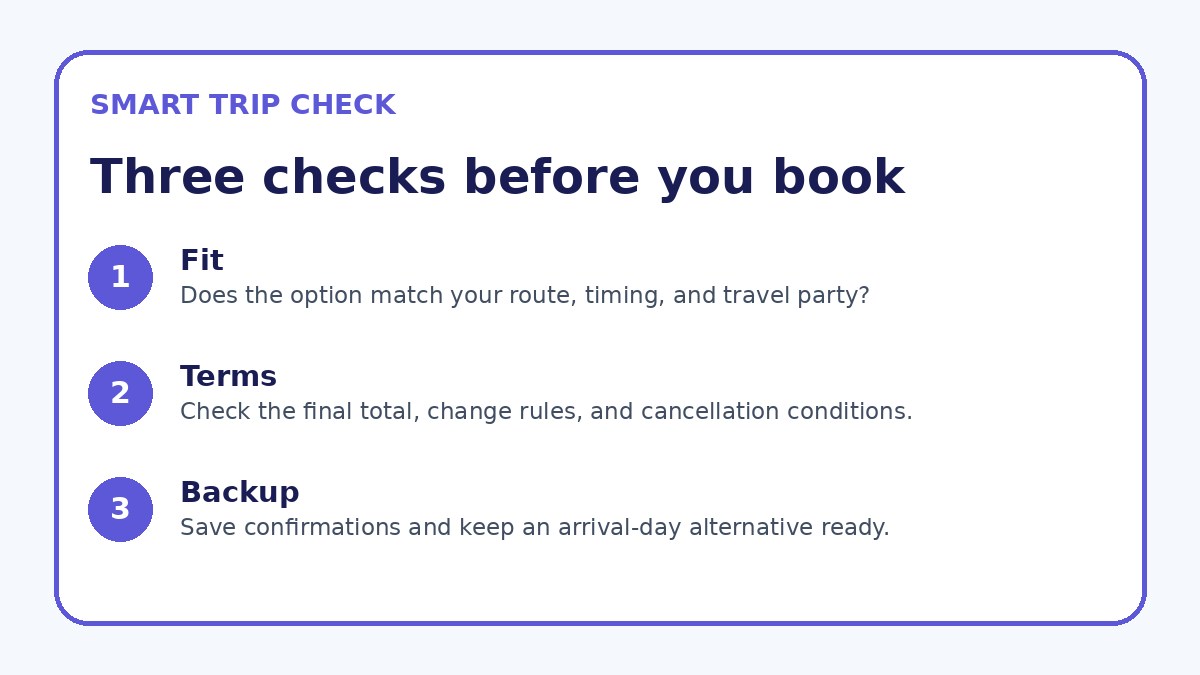
Before you book
- Confirm which Sydney terminal your airline uses and the recommended arrival time on the airline’s official booking page.
- Map your door-to-door travel time from your accommodation to each candidate airport, using typical traffic or rail schedules for your travel time of day.
- Check whether your trip requires luggage re-checking between international and domestic terminals, and plan extra time if so.
- Compare total journey time (ground travel + waiting + flight) for direct and connecting options before choosing the cheapest fare.
- Verify baggage allowances, carry-on rules, and any seat reservation policies on the carrier’s final booking page before payment.
- Download your boarding pass, save airline contact numbers, and note alternate departure times in case of delays or schedule changes.
Practical tips for booking and day-of-travel decisions
When selecting among Sydney to Melbourne flights, compare door-to-door journey time, not just flight duration. Add time for getting to the airport, security, and any in-airport transfers. If you’re balancing price and convenience, set a personal maximum for acceptable ground travel time or number of transfers — this helps you ignore small fare differences that aren’t worth the extra hassle. Use airline booking pages and a secondary aggregator like Trip.com to compare current schedules and seat availability, but verify transfer rules, baggage allowances, and check-in deadlines on the airline’s official site before you finalize booking.
On travel day, have a backup plan and contact options: download your boarding pass, confirm terminal and gate details, and make sure your phone can access mobile boarding or documents if needed. Allow more buffer time if you’re traveling with a group, young children, or specialized equipment. Finally, if your trip is time-sensitive or you have a tight onward connection in Melbourne, prioritize earlier departures and simpler transfers over last-minute lower fares.
Frequently asked questions
Which Sydney airport will get me to Melbourne fastest overall?
Fastest overall depends on your starting point in Sydney and the time of day. A shorter drive or direct rail link to the departure airport usually yields the quickest door-to-door trip, even if the airborne time is similar. Compare total travel time: estimate transit time from your accommodation, add recommended pre-flight arrival buffer and the scheduled flight duration. If you're arriving internationally the same day, include transfer time between terminals. Use the airline’s booking page for terminal and schedule details, and allow extra time for peak-hour delays.
Is it worth switching airports to save money on a Sydney to Melbourne flight?
Switching airports can be worth it if the savings exceed the additional time and inconvenience of longer ground travel. Calculate the value of your time: include taxi or train cost differences, increased travel time, and any added stress or risk from tighter connections. If you have flexible plans and no heavy luggage, a cheaper flight from a slightly farther airport can be a sensible choice. If you have tight schedules, children, or physical constraints, favor the more convenient airport even if the fare is higher. Always confirm final fare rules and baggage terms on the airline’s site.
How early should I arrive at the Sydney airport before a domestic flight to Melbourne?
Airlines set their own check-in and boarding deadlines, so verify the required arrival time on the airline’s official booking page; recommendations vary by carrier and travel class. As a general planning rule for first-time visitors, allow extra buffer beyond the airline’s minimum: traffic, unfamiliar terminal layouts, and security queues can add unexpected delays. For those needing special assistance, traveling with large luggage, or connecting from an international arrival, add significant extra time. If you’re comfortable with airport navigation and traveling light, a smaller buffer may be reasonable, but err on the side of arriving earlier than later.
Final planning note
Choosing the most practical Sydney departure airport for a trip to Melbourne comes down to three simple tradeoffs: ground access, schedule fit, and complexity of transfers. For first-time visitors, prioritize the airport that reduces door-to-door time and minimizes transfers — this shortens stress and unpredictability even when the flight itself is brief. Use the airline’s official booking page to confirm terminal details, check-in deadlines, baggage rules, and whether a flight is direct or requires connections. Balance price against time and convenience, and prepare contingencies for traffic, security queues, or schedule shifts. With those comparisons done, you’ll make a decision that keeps your trip simple and your travel day predictable.
Continue planning
Check current options and final conditions
Use the provider page to confirm live availability, the final total, cancellation terms, and every condition that matters to your trip.
This evergreen planning guide was created with AI-assisted drafting and a structured quality review. It does not display live prices, schedules, availability, visa guidance, or provider rankings. Verify current details before booking. Some links are affiliate links; we may earn a commission at no additional cost to you.