If you’re flying solo between Sydney and Melbourne, the single most useful step is to prioritise flexible terms over small upfront savings. Before you book, compare fare types and the provider’s published change and cancellation policies: look for how many free changes (if any) are allowed, whether refunds are permitted, how change fees are calculated, and whether credits or vouchers are used instead of cash refunds. Also check transfer rules for connecting itineraries, and whether the fare allows changes to both date and passenger name. Make sure you can view the full fare rules on the booking page or the airline’s contract of carriage — these are what govern your options, not a summary sentence in a search result. If you want a quick cross-check of current availability and policy summaries, you can view options on Trip.com, but always verify policy details on the carrier or ticketing agent’s final booking page.
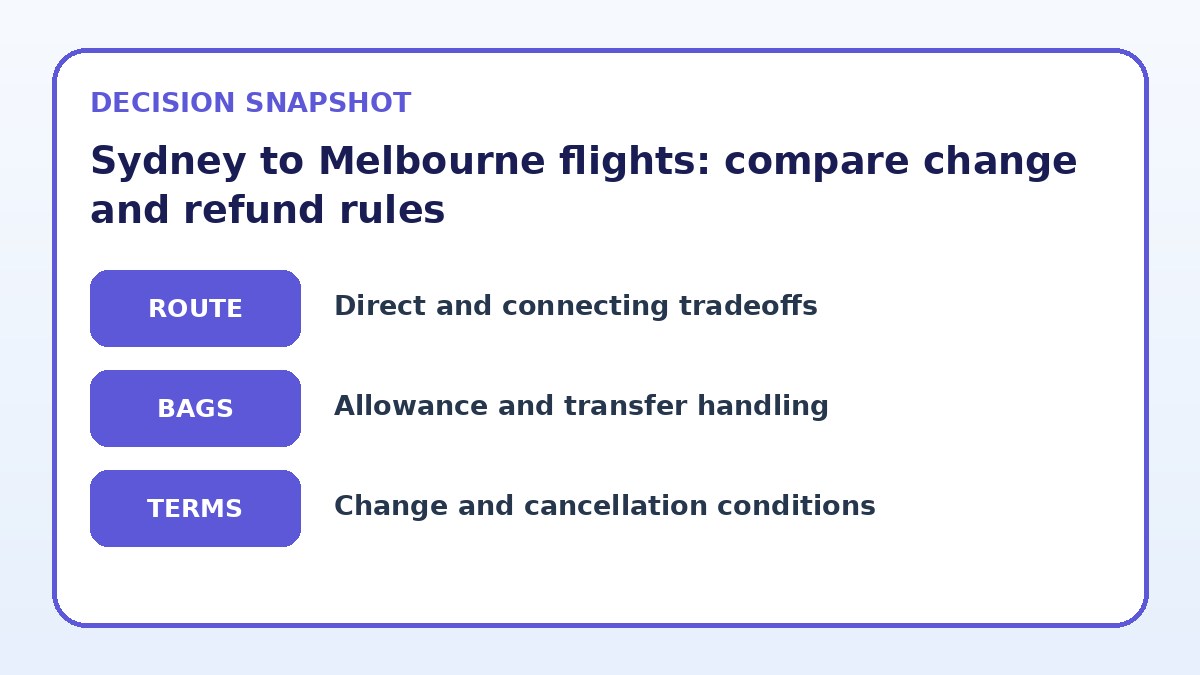
See current options before you compare the details
Availability and final conditions change. Open Trip.com now or keep reading for the practical comparison.
Understanding the basic fare rule types
Airlines and online agencies usually sell several fare families: restricted (basic), standard (flexible), and refundable or premium. Restricted fares typically offer the lowest upfront cost but limit or forbid refunds and charge for date or route changes. Flexible fares add higher flexibility: free or low-cost changes, limited refundability, or the ability to rebook without penalty within a set window. Refundable fares give the broadest options but come with the highest price. For a solo traveller who values freedom to adjust plans, choose a fare that explicitly states free changes or cash refunds, not only vouchers.
Keep in mind how providers present these rules. Booking engines often show a short line about 'changes allowed' — but that line can omit limits such as time windows, maximum number of changes, or fare-difference charges. The operative document is the detailed fare rule or contract of carriage; it explains when fees apply, how refunds are processed, and whether taxes are refunded. If you don’t see those specifics on the booking page, use the airline’s customer support or the ticketing agent’s help centre to request the full rule text before paying.
Change fees, fare differences and effective costs
When a ticket allows changes, you often still pay the difference between the original fare and the new fare. That means a low-cost ticket with modest change fees can become expensive when demand or seasonality pushes the new fare higher. Some carriers waive change fees but still require payment of any fare difference; others bundle both into a single penality. For solo travellers, estimate a realistic scenario where you need to move your flight by several days and compare the total cost — fee plus likely fare difference — to the price of a more flexible ticket bought upfront.
Also check whether the provider issues travel credits or refunds. Credits or vouchers can be useful if you will definitely use the same airline, but they can be restrictive: expiry dates, blackout dates, and non-transferability reduce value. A refundable ticket or one that guarantees cash refunds offers the most latitude if plans might be cancelled entirely. If you’re deciding between a cheaper non-refundable fare and a pricier flexible one, calculate break-even points: how many times you’d need to change or how likely cancellation is, and whether insurance would cover those costs.
| Approach | Best for | Tradeoff to check |
|---|---|---|
| Buy a basic non-refundable fare | Solo travellers confident about fixed travel dates and prioritising low upfront cost | Low price now but high or no refunds and full fare differences for changes |
| Select a flexible or refundable fare | Travellers who value the option to cancel or rebook with minimal hassle | Higher initial cost but lower risk of expensive changes or lost funds |
| Book a single-ticket connecting itinerary across carriers | Those who want through-check baggage and protection for missed connections | You must accept the most restrictive carrier’s rules and potentially complex rebooking procedures |
| Assemble separate tickets for each leg | Price-driven travellers seeking specific timings from different carriers | No automatic protection for missed connections; changes require separate dealings with each carrier |
Ready to check the option that fits your plan?
Use your exact dates and traveler details so the provider page can show the current total and conditions.
Connecting flights and mixed carriers: verify the whole itinerary
For Sydney to Melbourne travel, direct flights are common but not guaranteed; some itineraries involve connections or codeshares with different rules attached. When your itinerary includes multiple carriers, the most restrictive carrier’s rules often govern the whole ticket, and refunds or changes may require dealing with the original ticketing carrier. If you’re booking a single ticket that contains more than one operator, review the combined fare rules and ask the seller to confirm who manages changes and refunds for each segment.
If you assemble a trip by booking separate legs with different carriers, be aware that a change or delay on the first leg won’t automatically protect you on subsequent independently booked legs. Solo travellers who value simplicity should prefer a single-ticket option with through-checking of baggage and a clear rebooking process. Whenever connections are involved, ask explicitly whether the carrier accepts responsibility for missed connections and whether they will rebook you without extra cost under their policies.
Before you book
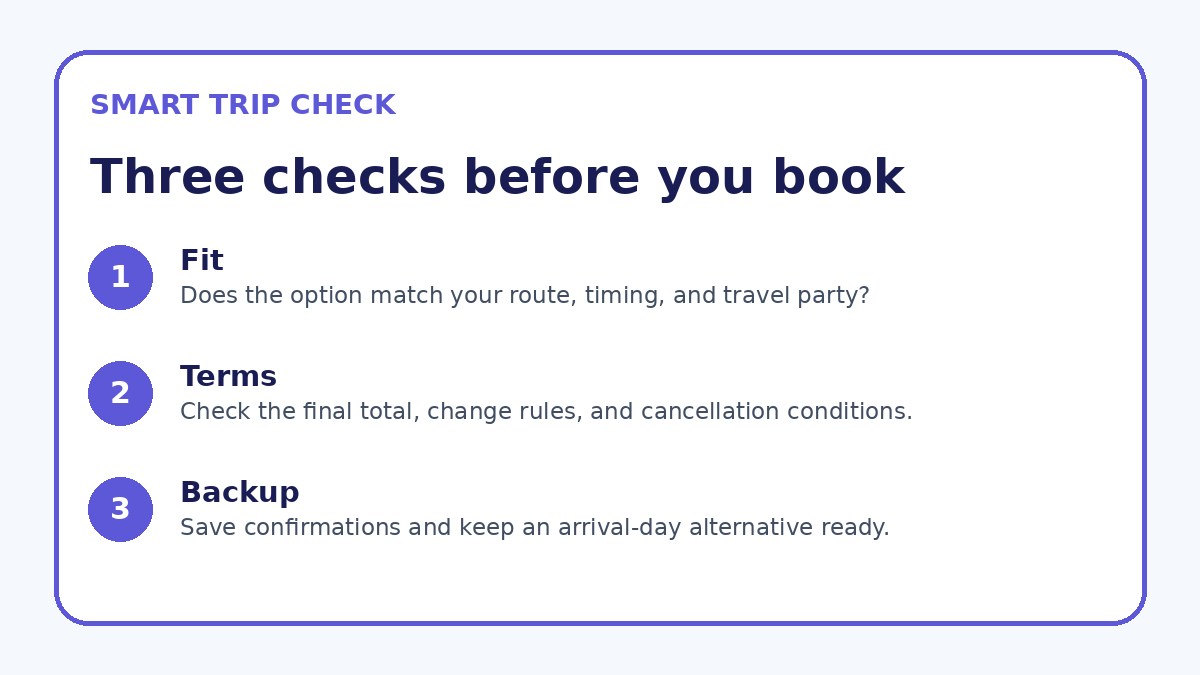
- Open and save the full fare rules or contract of carriage shown on the booking page before payment.
- Confirm whether changes are free, subject to fees, or require payment of any fare difference.
- Verify refund type: cash refund, travel credit/voucher, or non-refundable; note expiry and restrictions.
- Check who issued the ticket (airline or third-party agent) and which contact to use for post-sale changes.
- If your itinerary includes connections, confirm whether the ticket is single or separate and who covers missed connections.
- Record the time limits and method for making changes (online, phone, or airport counter) and check name accuracy.
What to verify on the final booking page and at check-in
Before you complete payment, expand the fare rule details and save a copy (screenshot or PDF) of the full terms. Confirm which party issues the ticket — the airline, a travel agency, or an online marketplace — and who will handle post-sale requests. Verify whether changes can be made online, require phone contact, or must be processed at an airport counter, and note any time limits (for example, changes allowed only up to 24 hours before departure). These operational details affect how easily you can react if plans change last-minute.
At check-in, confirm the name on the ticket matches your travel document exactly; many carriers charge for name corrections or disallow transfers. If you used travel credit or a voucher previously issued, double-check its remaining balance and expiry before applying it. Also reconfirm baggage allowances and whether rebooking requests during irregular operations (delays, cancellations due to weather or strikes) will be addressed by the carrier or require you to contact the ticketing agent. Knowing these steps ahead reduces stress and unexpected costs.
Frequently asked questions
Can I change my Sydney to Melbourne flight for free if plans change?
It depends on the fare type and the carrier’s current policy. Some fares explicitly allow free changes within a set window or under specific conditions; others charge a fee or only issue travel credit. Always read the fare rules on the booking page to see whether change fees are waived and whether you must pay any fare difference. If the booking was made through an agent, verify whether the agent adds its own service fee for processing changes. If you’re unclear, contact the airline or seller before booking to get a definitive answer.
Will I get a cash refund if I cancel my ticket?
Refunds are dictated by fare rules and the ticketing party. Refundable tickets usually allow cash refunds after any applicable administrative processes, whereas non-refundable tickets typically provide travel credit or no refund. Taxes and government fees may be partly refundable depending on the carrier and local regulations. If an airline cancels the flight, many carriers provide refunds even on non-refundable fares, but you must confirm this in the airline’s policy. Always check the exact refund remedy on the final booking page and keep screenshots of the terms you relied on.
How do change and cancellation rules affect flexible plans for solo travellers?
Rules determine how much risk you carry if plans shift — whether you pay fees, lose funds, or receive usable credit. Solo travellers who need freedom to adapt should factor in not only the change fee but also potential fare differences and voucher limitations. Evaluate the probability you’ll change plans and compare that to the price difference for a more flexible ticket. Consider whether your credit card or separate travel insurance covers cancellations or change costs for reasons you expect might occur, and read those policies carefully for exclusions and claim procedures.
Final planning note
When planning Sydney to Melbourne flights as a solo traveller, the practical priority is clarity: choose a ticket with terms that match how likely you are to change plans. Read and save the full fare rules, confirm refund types, and understand how change fees and fare differences will be applied. If your schedule is uncertain, a flexible or refundable fare can reduce stress even if it costs more upfront; if your dates are fixed, a basic fare may be appropriate but accept the greater risk. For connecting or mixed-carrier itineraries, insist on a single-ticket solution if you want protection for missed connections. Always verify final policy language on the carrier or ticketing agent’s booking page before you pay, and consider Trip.com for a side-by-side view of availability while using the carrier’s terms as the authority.
Continue planning
Check current options and final conditions
Use the provider page to confirm live availability, the final total, cancellation terms, and every condition that matters to your trip.
This evergreen planning guide was created with AI-assisted drafting and a structured quality review. It does not display live prices, schedules, availability, visa guidance, or provider rankings. Verify current details before booking. Some links are affiliate links; we may earn a commission at no additional cost to you.