
If you’re traveling from Sydney to Melbourne with extra bags, the practical choice of departure airport can save time, reduce stress, and cut unexpected fees. Sydney has more than one airport option for outbound travelers, and each brings different advantages depending on how much luggage you have, whether you need a vehicle to reach the terminal, and how comfortable you are handling transfers or checked-baggage allowances. Start by prioritizing whether you want minimal ground handling, the fewest transfers, or lower baggage fees at booking. That decision narrows your options quickly. This guide lays out the core tradeoffs—ground access, check-in and baggage handling, domestic vs. alternative terminals, and how to verify carrier baggage rules—so you can pick the departure point that fits your physical load and travel temperament.
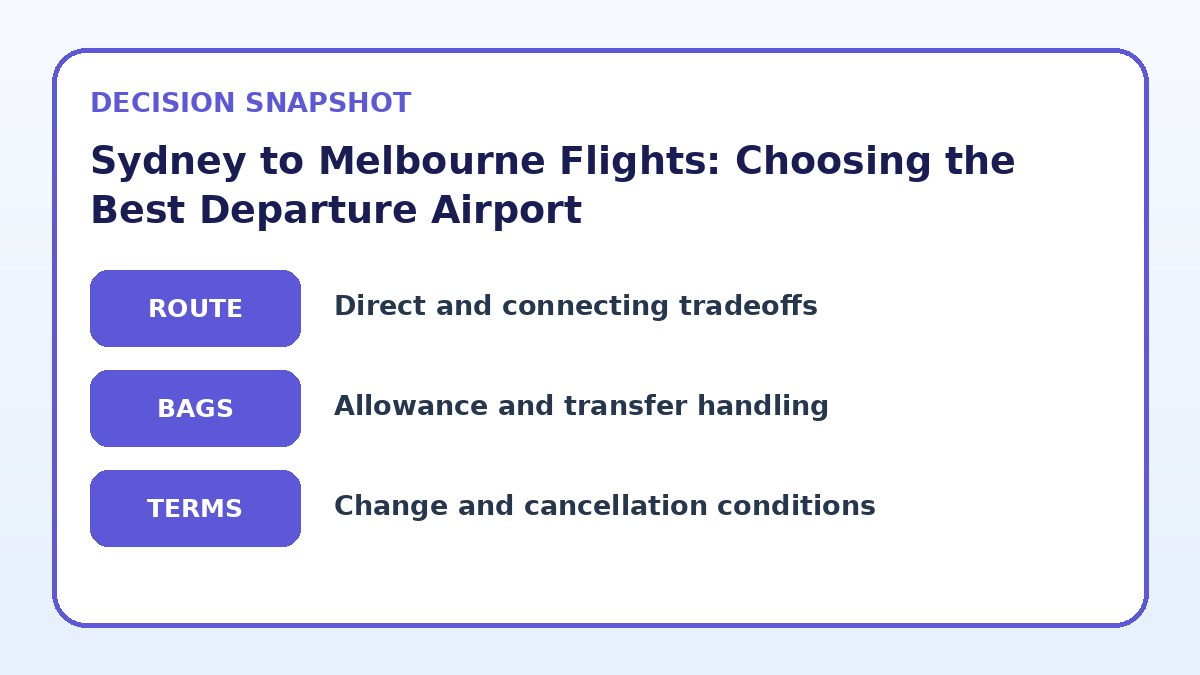
See current options before you compare the details
Availability and final conditions change. Open Trip.com now or keep reading for the practical comparison.
Key decision criteria for travelers with extra luggage
Start your decision by listing what matters most for your group and luggage: total bag count, maximum single-bag weight, whether you need special handling, and how much time you have before departure. Those constraints determine whether you should prioritize a shorter drive to the terminal, a direct shuttle or taxi, or an airport with simpler curbside or drop-off procedures. Also factor in how comfortable you are managing bulky items through public transit or busy walkways—what’s a minor inconvenience for one traveler can be a deciding burden for another.
Next, confirm the specific baggage rules of the airline and fare class you plan to book. Baggage allowances, oversized-item procedures, and fees can differ by carrier and by aircraft type. If your bag exceeds standard checked limits, you may need to pre-book special handling or reserve space for oversized items. Before committing to an airport based on convenience alone, check the airline’s final booking page for their exact limits and any required arrangements for large or heavy items.
Ground access and logistics: rides, parking, and transfers
Ground access can outweigh nominal differences between airports when you’re hauling multiple or heavy bags. An airport that is closer to where you’re staying, offers covered drop-off lanes, or has straightforward short-term parking will save hands-on effort and reduce the number of times you must load and unload luggage. If you’re using a rideshare or taxi, check whether the terminal has a dedicated pick-up and drop-off point that minimizes walking and stairs; some terminals require a short shuttle or a walk through a multi-level complex.
If you plan to use public transport, be realistic about the walking distances and transfer steps required. Trains, buses, and light rail can be fast, but they often add stairs, platform gaps, or long ramps that complicate moving heavy suitcases. For travelers with mobility concerns or sensitive gear, a slightly longer drive to a terminal with a simpler curbside layout may be far more practical than a shorter public-transport trip that includes multiple transfers and carrying requirements.
| Approach | Best for | Tradeoff to check |
|---|---|---|
| Prioritize shortest drive to terminal | Travelers with many or heavy bags who want minimal handling | May limit airline or schedule choices and could be pricier for the preferred terminal |
| Prioritize best baggage allowances | Those with overweight or multiple checked items willing to trade ground convenience for lower fees | Could require longer transfers or using terminals with more complex access |
| Prioritize fewer touchpoints (nonstop flights) | Passengers with fragile, valuable, or oversized items seeking lower mishandling risk | Direct flights may be less flexible in timing and sometimes cost more |
| Prioritize public-transport accessibility | Travelers avoiding parking fees or taxis who can manage luggage on trains or buses | Public transit routes may include stairs, longer walks, or schedule constraints |
Ready to check the option that fits your plan?
Use your exact dates and traveler details so the provider page can show the current total and conditions.
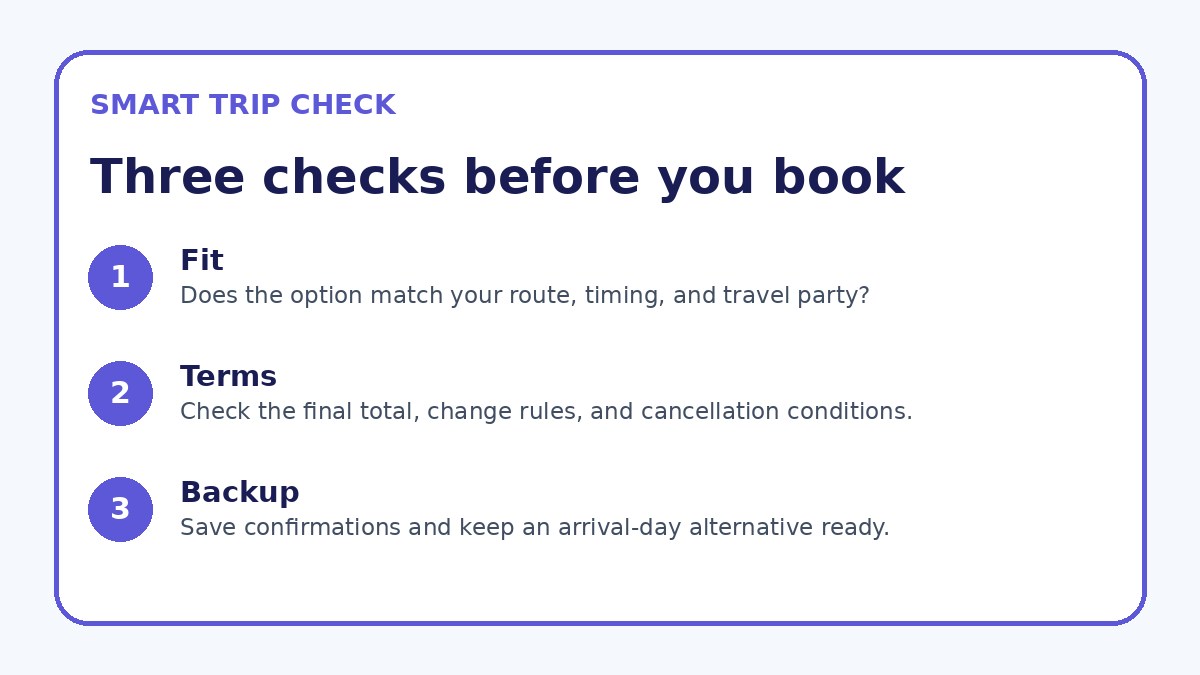
Check-in, baggage drop, and security considerations
When you have extra luggage, the check-in and baggage drop experience becomes central. Some terminals provide fast-track or dedicated baggage drop lanes for pre-checked passengers, while others process larger volumes through a single shared counter. If you need special handling—oversized surfboards, skis, or boxes—look for terminals and airlines that explicitly list those services and whether you must book handling ahead. On busy days, counters with automated bag drop can cut waiting and standing time significantly if you have pre-printed tags or an airline app QR code.
Security checkpoints are another element that affects the ease of moving bulky bags through the terminal. Wider lanes, well-staffed screening areas, and clear signage reduce bottlenecks; crowded or narrow screening zones increase the physical effort of moving suitcases. If timing is tight, choose flights from terminals known for smoother security flows—or allow additional buffer time at check-in when booking your Sydney to Melbourne flights. Always verify the airport’s current terminal layouts and check-in rules on the airline’s booking page before travel.
Before you book
- Confirm exact baggage allowances, extra-bag charges, and oversized-item procedures on the airline’s final booking page before selecting a departure airport.
- Measure and weigh your luggage at home to determine whether you need to pre-book oversize or overweight handling.
- Map door-to-door travel time from your accommodation to each candidate terminal, including typical traffic at your planned departure hour.
- Check whether the terminal offers covered drop-off lanes, short-term parking, or curbside assistance to reduce handling burden.
- If using public transport, identify station access points and the number of steps, ramps, or transfers required between platform and terminal.
- If considering connecting flights, verify that baggage will be through-checked and review minimum connection times and terminal transfer logistics.
How to compare direct versus connecting options and fees
On some itineraries, travelers with extra luggage consider connecting flights because of lower fares or different baggage policies. However, connections typically mean extra handling and re-checking of bags, which increases the risk of delay or misrouting. If you’re carrying fragile or high-value items, a single nonstop movement from check-in to arrival reduces touchpoints and the chance of problems. When comparing options, weigh the time and handling cost of a connection against any potential fare savings.
If you do consider a connecting itinerary, compare the minimum connection time and the ease of transferring between aircraft types and terminals. Short layovers may not allow time to reclaim and re-check baggage if required, so prefer through-checked itineraries where the airline accepts responsibility for transfer. Always confirm on the carrier’s final booking page whether bags will be transferred automatically, if re-tagging is necessary, and what the contingency plan is for oversized items in case of a missed connection.
Frequently asked questions
Should I pick the closest Sydney airport to avoid baggage hassles?
Often the closest airport reduces time spent moving luggage, but closeness alone isn’t the only factor. Check whether the nearby terminal has covered drop-off lanes, short-term parking, and a straightforward curbside layout. Also compare the airline’s baggage rules on their booking page—if the carrier operating from the closer airport imposes stricter size or weight limits than alternatives, you could trade less travel time for higher fees or extra handling needs. Balance the distance to the terminal with the carrier’s baggage policy and the ground services available.
Can I avoid extra handling by choosing a nonstop Sydney to Melbourne flight?
A nonstop itinerary typically minimizes baggage touchpoints because checked luggage is handled once at origin and then delivered at arrival. That lowers the risk of misrouting or delays and reduces the physical effort of multiple transfers. However, nonstop flights may have stricter carry-on limits depending on aircraft type, and they may operate from specific terminals you must reach. Always confirm on the airline’s booking page whether your bags will be through-checked and whether any special handling needs to be arranged for oversized items.
How do I handle oversized or oddly shaped luggage from Sydney terminals?
For oversized items—sports equipment, crates, or musical instruments—start by checking the airline’s specific handling rules and whether you must reserve space ahead. Some terminals have dedicated oversized baggage counters or staff trained for large items, while others require early arrival and manual assistance at the check-in desk. Before travel, contact the airline via the booking page or customer service to confirm required documentation, drop-off location, and recommended arrival time to ensure staff can process the item without last-minute issues.
Final planning note
Choosing the most practical departure airport for Sydney to Melbourne flights when you have extra luggage is a matter of prioritizing what you value most: fewer ground transfers, lower baggage costs, or smoother check-in and security flow. Start by confirming baggage allowances and special-handling rules on the airline’s final booking page. Then compare door-to-door convenience, terminal layouts, and whether nonstop service is available for your preferred times. If you need a quick comparison of available flights and current conditions, you can check Trip.com as one option to view itineraries, but always rely on the carrier’s official booking details for baggage policies and terminal instructions. With a clear priority list and a brief verification step, you’ll pick the departure airport that reduces hassle and keeps your trip moving smoothly.
Continue planning
Check current options and final conditions
Use the provider page to confirm live availability, the final total, cancellation terms, and every condition that matters to your trip.
This evergreen planning guide was created with AI-assisted drafting and a structured quality review. It does not display live prices, schedules, availability, visa guidance, or provider rankings. Verify current details before booking. Some links are affiliate links; we may earn a commission at no additional cost to you.