Practical answer first: most first-time travelers choose flying, then weigh whether a direct flight or a connecting itinerary fits their priorities; a smaller group prefers a sea+land crossing via Busan–Fukuoka for a different pace. Start by deciding what you value most—time in transit, comfort, price transparency, or the experience of travel between countries. Once you know that, compare door-to-door journey times, likely connections, and the total hassle of transfers. This article lays out the tradeoffs, how to compare direct versus connecting flights, when a mixed sea-and-rail option makes sense, and exactly what to verify on booking pages before you commit.
Decide by your primary priority: time, comfort, or experience
If minimizing door-to-door time is your top priority, focus your search on the most direct air connections between the Seoul area and the Tokyo area. That reduces risk from extra transfers and makes a short trip readable and predictable, particularly for travelers on tight schedules or those who dislike complex logistics. When comparing options, always calculate the full journey from your origin address to your final Tokyo accommodation, not just the airborne segment. For first-time visitors, simplicity often translates to lower stress and quicker recovery on arrival.
If comfort and in-flight amenities matter more than speed, compare cabin classes, seat pitch, and onboard services across carrier types. Full-service options often include meals and a more generous baggage allowance; low-cost carriers typically charge extras for checked bags and seat selection. When assessing comfort, read recent seat maps and independent cabin reviews, and verify what is included directly on the provider’s booking page—don’t assume amenities because of an airline name or search snippet. Confirm baggage rules and changes to carry-on policies before finalizing any reservation.
Comparing direct flights with connecting itineraries
Direct flights reduce the number of touchpoints where something can go wrong: one boarding, no mid-route transfers, and simpler luggage handling if the carrier transfers bags through. However, direct options can have fewer departure times and sometimes a different price structure. When you compare, look at total elapsed time, the number of transfers, and the minimum connection times required at any intermediate airports. Also check whether the connection is on a single ticket—this can affect baggage handling and protection if the first leg is delayed, so verify the carrier’s transfer policies on the booking confirmation page.
Connecting itineraries can enlarge your schedule and routing choices and may open up lower-cost or flexible ticket classes, but they require careful coordination. If you consider a self-transfer between flights or between airports, factor in time to collect luggage, clear immigration and security, transfer between terminals or airports, and re-check baggage. Look for plausible buffer times and confirm whether a single-ticket connection or separate tickets is used; different ticket types carry different protections for missed connections. For first-time visitors, prioritize connections with more generous layover windows unless you’re experienced with tight turnarounds.
| Approach | Best for | Tradeoff to check |
|---|---|---|
| Direct flight | Travelers prioritizing simplicity and shortest transfer counts | Fewer schedule choices and potentially less flexibility for cheaper fares |
| Connecting flight | Those seeking lower fares or wider timing options | Higher risk of missed connections and longer door-to-door time |
| Sea + rail (ferry to Japan then train) | Travelers who want a scenic, slower cross-border experience | More complex scheduling and a greater need for overnight buffers |
| Mixed-ticket self-transfer | Flexible planners who combine carriers to optimize price/times | You assume responsibility for missed connections and separate baggage handling |
When to consider a sea + rail crossing for variety and slow travel
A sea-plus-rail route changes the journey from a short hop into part of the travel experience. This approach typically involves traveling from Seoul to a Korean port city, taking a ferry to Kyushu or another Japanese port, then continuing to Tokyo by train. It’s attractive if you want a relaxed pace, scenic coastal travel, or to break the journey into distinct travel days. However, it requires syncing ferry schedules with land transport timetables and accommodating extra overnight stays. For a first-time visitor, this option can feel more adventurous but also demands more flexible planning and clear scheduling.
To evaluate this route, map each leg separately: your inland transfer to the Korean port, the ferry crossing timetable and boarding requirements, and the onward rail or bus journey in Japan. Confirm booking rules for the ferry—especially whether luggage is included or handled differently than airlines—and check train seat reservations on the Japanese side. Because ferries and local trains operate to their own schedules, verify connections and potential overnight stays on the operators’ booking pages. If you choose this route, build in at least one extra day of buffer for delays or missed connections.
Before you book
- Confirm the exact departure and arrival airports and map out ground transfer times at both ends.
- Check baggage allowances and fees on the operator’s final booking page and add potential transfer luggage charges.
- Verify whether your reservation is a single ticket through-checked for baggage and missed-connection protections.
- Allow realistic minimum connection times if changing terminals or transferring between airports in the same city.
- If considering ferries, confirm boarding procedures, luggage rules, and whether reservations are required on the ferry operator’s site.
- Compare total door-to-door time including transfers, and add at least one buffer day for sea routes or tight connections.
Practical checks before you buy and useful comparison criteria
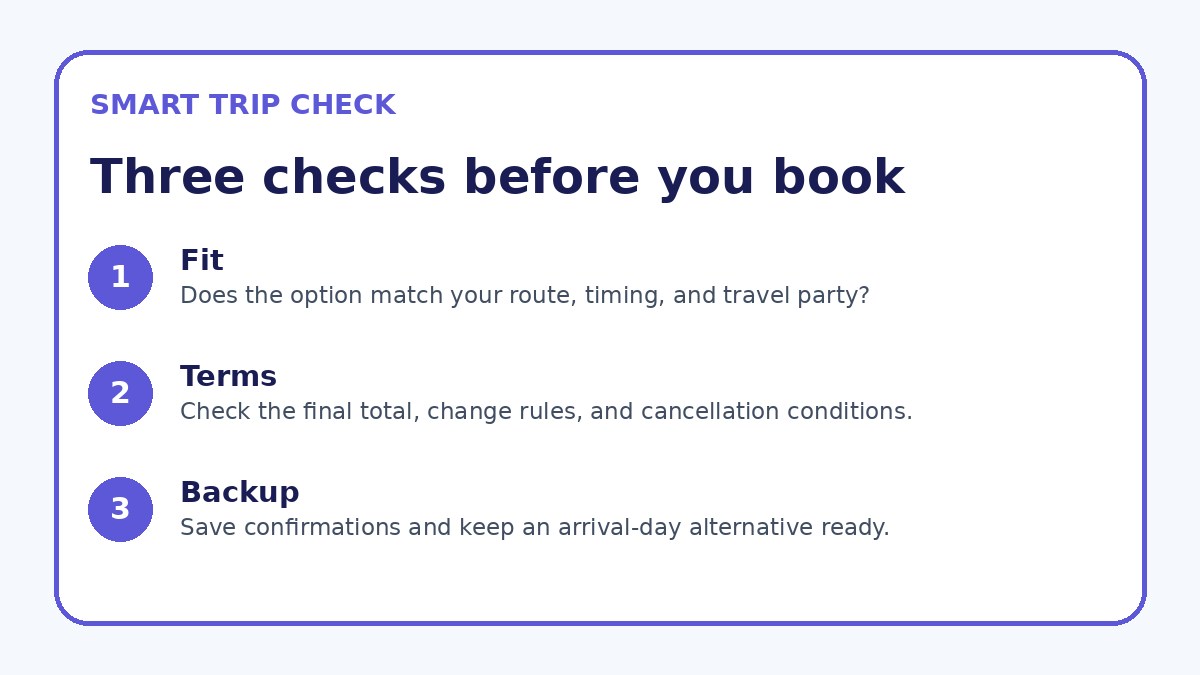
Before you press purchase, verify a short checklist of details that affect the trip: the exact departure and arrival airports, estimated transfer times to and from those airports, baggage allowances and fees, ticket change/cancellation terms, and whether the booking is on a single ticket. If your itinerary uses different carriers or separate tickets, confirm how baggage is handled and whether you need to re-check luggage. Always open the final booking page and read the fare or ticket conditions carefully—this is the authoritative source for what’s included and any restrictions.
Compare total door-to-door time, number of transfers, total cost after adding luggage and transfer fees, and the level of protection for missed connections. Think about personal factors too: how comfortable are you with language barriers at transfer points, do you prefer more predictable schedules, and will you be traveling during local holidays when services might be busier? As you shortlist options, use official carrier and operator pages for final verification; Trip.com can be used once to compare availability, but confirm critical operational details with the operator before booking.
Frequently asked questions
Should I always pick the shortest flight between Seoul and Tokyo?
Not necessarily. The shortest airborne time reduces time in the air, but your total journey includes transfers to and from airports, possible waits at connections, and baggage handling. Also consider departure and arrival airport locations relative to where you stay in Tokyo—an airport slightly farther away could still be faster door-to-door if it has quicker ground connections. Weigh the whole-trip time, convenience of transfers, and personal tolerance for transit complexity rather than focusing only on airborne duration.
How can I protect myself if I choose a connecting itinerary?
First, prefer a single-ticket connection when available because carriers usually handle interline baggage transfers and offer more established policies for missed connections. If you must buy separate tickets, build generous layovers, allow time for immigration and baggage claim, and avoid late-night tight connections. Purchase travel insurance that covers missed connections and consider booking refundable or changeable fares if your schedule is uncertain. Always confirm the transfer rules and protection level on the booking confirmation page before you finalize payment.
Is it worth checking ferry+train routes instead of flying?
Ferry-plus-train routes are worth checking if you value a different travel experience, want to split the trip into scenic legs, or prefer avoiding multiple flight changes. These routes typically require more planning—timing between port arrivals and train departures, possible overnight stays, and separate bookings—so they suit travelers who enjoy a slower pace. For practical decision-making, cost and total travel time are only part of the equation: consider how the journey itself fits your travel goals and whether you’re comfortable managing independent connections.
Final planning note
Choosing between direct flights, connecting flights, and mixed sea-and-rail options from Seoul to Tokyo comes down to a few simple questions: how much time do you want to spend traveling, how much complexity can you tolerate, and what kind of travel experience do you want? For first-time visitors, simplicity usually wins—direct or single-ticket routes reduce stress—but connecting or sea routes can be right for those chasing savings or a unique journey. Whatever you pick, verify airport names, baggage rules, transfer protections, and connection requirements on the final booking pages before you pay; use one comparison site like Trip.com if it helps shortlist options, but always confirm operational details with the carrier or operator directly.
Continue planning
Check current options and final conditions
Use the provider page to confirm live availability, the final total, cancellation terms, and every condition that matters to your trip.
This evergreen planning guide was created with AI-assisted drafting and a structured quality review. It does not display live prices, schedules, availability, visa guidance, or provider rankings. Verify current details before booking. Some links are affiliate links; we may earn a commission at no additional cost to you.