Practical answer up front: before you book any Seoul to Taipei flight as a solo traveler, make the fare rules the primary decision factor — specifically how changes, cancellations, and refunds are handled. Choose a ticket with either free changes, a clear credit/voucher policy, or an acceptable fee + rebooking window that fits your flexibility needs. Check whether the fare permits refunds to the original form of payment or only airline credit, and whether change fees are flat or percentage-based. Also confirm whether schedule changes by the airline trigger free rebooking or full refunds. After securing those facts, weigh price against flexibility, the likelihood of schedule shifts, and whether you’ll want travel insurance that covers cancellations for any reason.
See current options before you compare the details
Availability and final conditions change. Open Trip.com now or keep reading for the practical comparison.
Start with the fare rules, not the price
When comparing Seoul to Taipei flights, treat the fare rules as the decisive feature rather than the headline price. The booking page will list fare family names and short summaries, but you must click through to the full fare conditions or contract of carriage to see how changes and cancellations are handled. Look for whether changes are allowed, who pays fare differences, whether a change fee applies, and how refunds are issued. Airlines may offer identical-looking fares with very different change policies, so two tickets with the same route and time can behave completely differently if your plans shift.
For solo travelers, the consequences of a restrictive fare are magnified because you won’t have a travel companion to share costs or decisions. If your schedule has any uncertainty — work, family, or medical reasons — a small increase in upfront cost for a more flexible fare can save time, stress, and money later. Also check whether the fare allows name changes or volunteer rebooking; some low-fare classes restrict refundability and transferability in ways that matter if you need to cancel and rebook under a different arrangement.
Understand the difference between refunds, credits, and waivers
Refunds to your original payment method are the most traveler-friendly outcome, but many low-cost or promotional fares only offer airline credit or vouchers. Read the terms to see if credits have expiration dates, restrictions on future bookings, or blackout periods. If a schedule change is made by the airline — a time shift or cancellation — many carriers allow rebooking or refunds without penalty; those rights are separate from the standard fare rules, so verify both sets of information. Also check whether taxes and fees are refundable when the underlying fare is refunded, as local tax rules can vary.
Waivers are another detail to watch: during irregular operations, strikes, or health-related travel restrictions, airlines sometimes publish temporary waiver policies that override normal fees. These waivers are time-limited and specific to certain routes or dates, so don’t assume a waiver remains in effect when you travel months later. Always confirm on the airline’s official policy page at the point of booking and again before travel; if using an OTA, verify the airline’s page too. If you find ambiguous language, contact the airline or your booking agent and get confirmation in writing where possible.
| Approach | Best for | Tradeoff to check |
|---|---|---|
| Buy lowest nonrefundable fare | Solo travelers with fixed, inflexible dates and a tight budget. | Lowest upfront cost but high risk of paying full change fees or only receiving airline credit if plans shift. |
| Purchase a flexible or refundable fare | Travelers who value easy changes and refunds without lengthy claims. | Higher ticket price but simpler rebooking and clearer refund rights at the point of sale. |
| Use travel insurance with cancellation coverage | Solo travelers needing protection for unexpected personal events or trip interruption. | Adds cost and paperwork; benefits depend on policy wording and proof requirements. |
| Book via an OTA and verify airline terms | Shoppers who want quick price and rules comparison across multiple carriers. | Convenient for comparison but may require extra verification on the airline’s final booking page for refunds and reissue procedures. |
Ready to check the option that fits your plan?
Use your exact dates and traveler details so the provider page can show the current total and conditions.
Compare direct versus connecting options through change policies
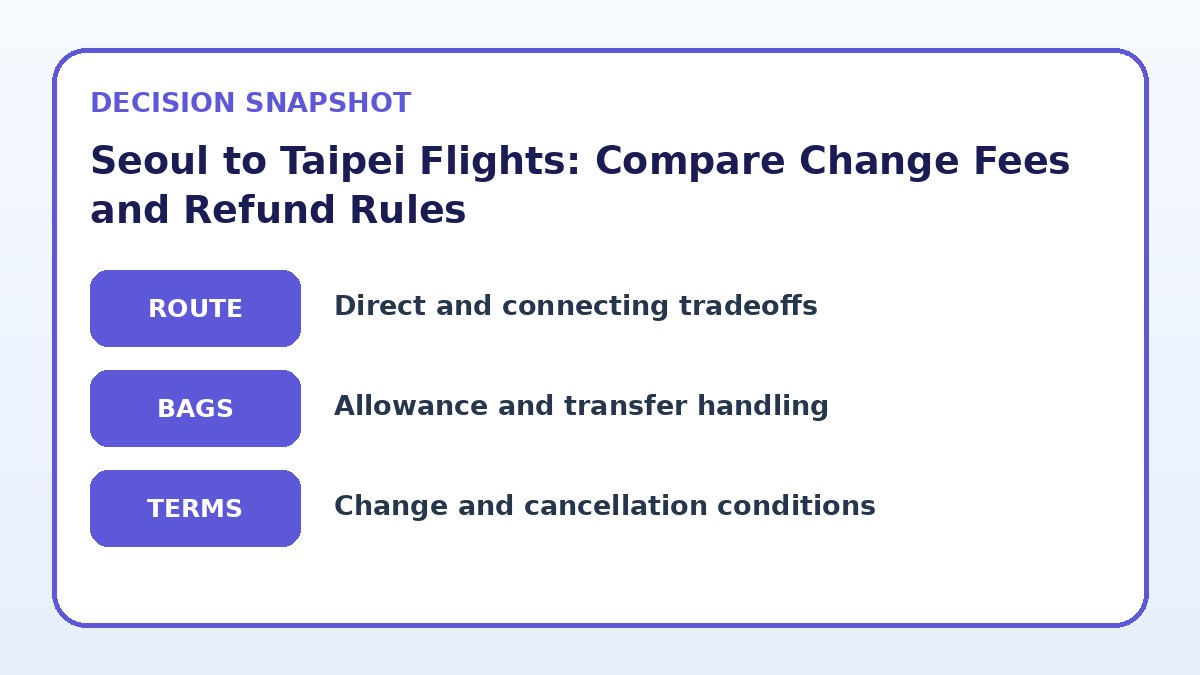
Route type affects your flexibility. A direct Seoul to Taipei itinerary may be simpler to change or refund because it involves a single carrier or a single booking code; connecting itineraries can complicate changes if different carriers are involved or if legs are issued on separate tickets. When you compare options, check whether the same fare class applies to both legs, whether the booking is protective across connections, and whether a change to one leg forces re-pricing of the entire itinerary. Connecting routes may offer cheaper headline fares but can expose you to higher overall rebooking costs if a single leg changes.
Also consider the transfer time and the effect of schedule changes on tight connections. Some carriers allow changes that preserve connections, while others treat each flight independently. For solo travelers, the simplest path is often worth a modest premium: a single, direct ticket reduces the administrative work if you need to change plans. If you choose a connecting itinerary for cost or schedule reasons, map out what fault lines exist — which carrier controls each change, whether domestic versus international rules apply, and how to request reissue or refunds for multi-carrier bookings.
Before you book
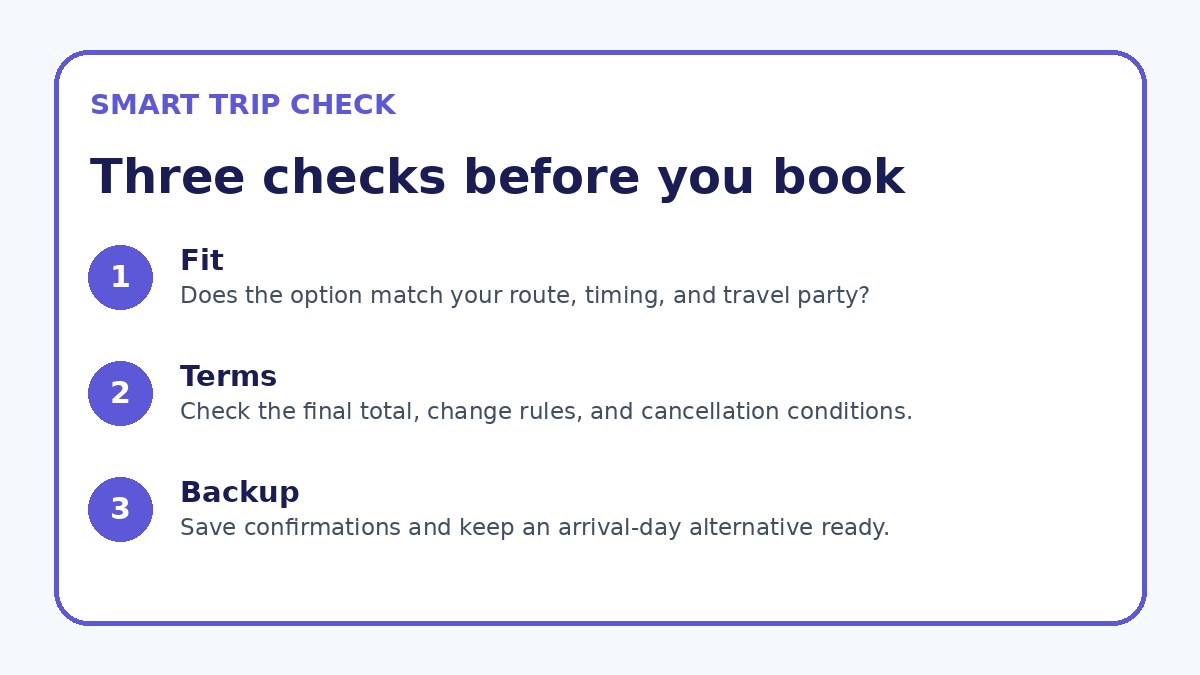
- Open the airline’s full fare conditions and read the sections on changes, cancellations, refunds, and reissue fees before checkout.
- Confirm whether refunds go to your original payment or only to airline credit/vouchers and note any expiration dates.
- Check the policy for airline-initiated schedule changes—does it allow free rebooking or a full refund?
- If choosing a connecting itinerary, verify whether all legs are on one ticket and which carrier’s rules apply to changes.
- Decide if you need cancel-for-any-reason insurance and confirm claim requirements, coverage limits, and deadlines.
- Save screenshots or PDFs of the fare rules and any communications from the airline or booking agent in case of disputes.
Use protections deliberately: fare class, insurance, and booking channels
Three protective levers matter: picking a flexible fare class, buying travel insurance that covers cancellations or interruptions, and choosing a reliable booking channel. Flexible or refundable fare classes cost more but simplify changes and refunds. Travel insurance can fill gaps, but read policy exclusions — many standard plans don’t cover voluntary schedule changes, pre-existing conditions, or certain political or public health events. If you want cancellation coverage for any reason, look for a policy that explicitly states that coverage and confirm the required proof and claim deadlines.
Booking channels differ in how they handle changes. Booking direct with the airline usually gives clearer routes to refunds and priority handling, while online travel agencies (OTAs) can be helpful for price comparison and consolidated information — but some OTAs add processing rules or limit the options for refunds. If you use an OTA, verify the fare rules on the airline’s official page and confirm the OTA’s change and cancellation process. Trip.com is one option to compare current availability and conditions; always follow up on the airline’s final booking page to confirm how fees and refunds are applied before you pay.
Frequently asked questions
Can I change a Seoul to Taipei flight without paying a fee?
Possibly, but it depends on your fare class and the airline’s current policies. Some fare families include free changes or one complimentary rebooking; many discounted fares apply a change fee plus any fare difference. If the airline makes a schedule change or cancels the flight, most carriers offer free rebooking or a refund — that’s separate from voluntary change rules. Always confirm the fare conditions on the booking page and, if applicable, request written confirmation from the airline or your OTA about whether a specific change will incur fees.
Will I get a refund to my card if I cancel my ticket?
Refunds to your original payment method are common for refundable fares and for flights cancelled by the airline, but many nonrefundable or promotional fares only return value as airline credit or vouchers. Taxes and government fees may be refundable even when the fare is not, depending on local rules. Before you cancel, check the refund policy in the fare rules and the airline’s refund procedure; if you booked through an OTA, confirm whether the OTA or the airline processes refunds and what documentation you’ll need.
Is booking direct with the carrier better for changes and cancellations?
Booking direct often simplifies communications and may speed up refunds or reissues, because you deal with the carrier that issues the ticket. OTAs can be convenient and sometimes offer customer service support, but they may add steps to the refund or change process and occasionally enforce their own service fees. Regardless of channel, always verify the airline’s official fare conditions and keep copies of the booking confirmation and fare rules. If you use an OTA, confirm where to file change or refund requests and whether they require you to go through the airline directly.
Final planning note
For solo travelers on the Seoul to Taipei route, the single most useful planning step is to prioritize change and cancellation terms over the cheapest headline fare. Decide how much flexibility you truly need: a slightly higher refundable or flexible fare can remove a lot of stress, while a strict low-cost ticket can be fine when dates are locked. Always verify the airline’s full fare conditions and any OTA terms, confirm how refunds are issued, and consider travel insurance to fill gaps. Keep records of the fare rules and any correspondence so you can act quickly if plans change — that preparation is what turns a potential disruption into a manageable reroute.
Continue planning
Check current options and final conditions
Use the provider page to confirm live availability, the final total, cancellation terms, and every condition that matters to your trip.
This evergreen planning guide was created with AI-assisted drafting and a structured quality review. It does not display live prices, schedules, availability, visa guidance, or provider rankings. Verify current details before booking. Some links are affiliate links; we may earn a commission at no additional cost to you.