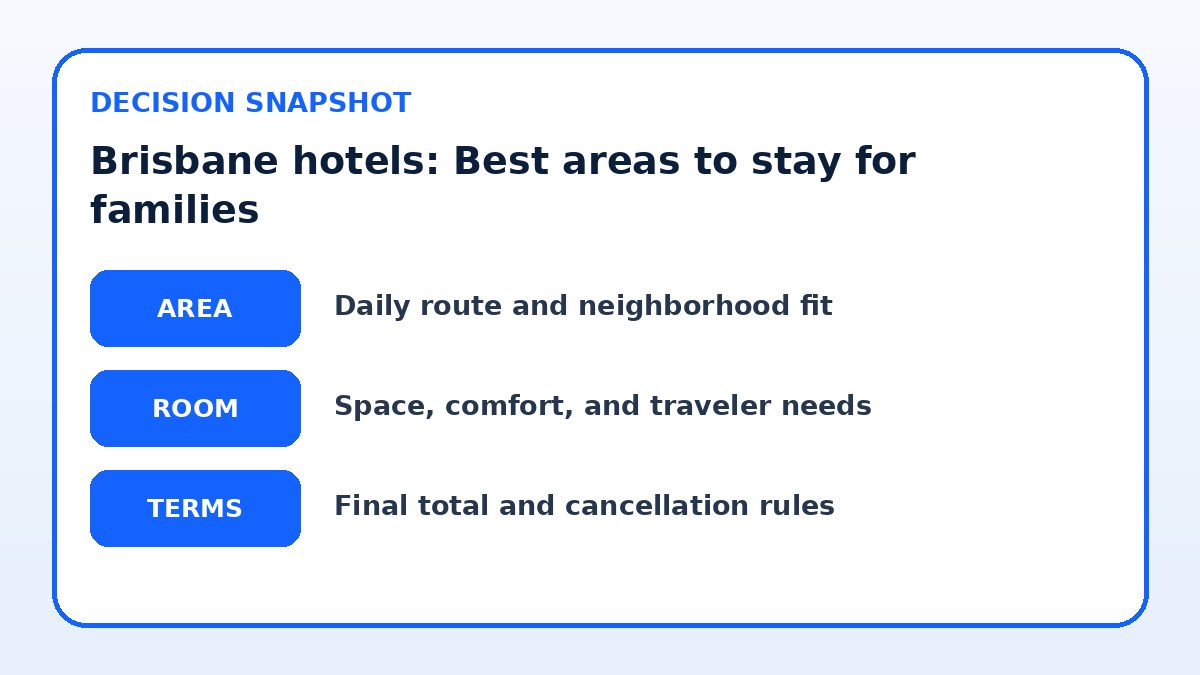
Pick the right neighbourhood first: it determines school-run-style logistics for kids, where breakfasts happen, and whether evenings are riverfront walks or quiet suburban calm. For families planning Brisbane, the choice usually comes down to: inner-city convenience (South Bank or CBD), kid-focused riverside living (Kangaroo Point or New Farm), quieter suburban comfort (West End or Paddington), or easy airport and theme-park access for short stays. This guide puts the decision up front, then walks through daily-route friction, room and party needs, plus the booking terms to verify before you pay. Read it to narrow to one or two areas, then open live availability — for example on Trip.com or a hotel site — to compare actual room types, cancellation rules, and family-rate terms.

Check live stays in the areas that fit
Use your dates and party size to compare current rooms after you narrow the neighborhood fit.
Which area fits your family’s rhythm?
Decide how you want your days to feel before you compare hotels. If your kids are early risers who thrive on open-play spaces, pick a riverside area with parks nearby so the first hour of the day doesn’t require driving. If museum visits, riverside dining and short taxi rides are key, the CBD or South Bank puts many activities within walking distance. For families who prefer slower-paced stays with more living space, inner suburbs with apartment hotels offer room layouts that make bedtime and snack prep easier without relying on room service.
Also consider age and mobility: toddlers need short walks and safe crossings; school-age kids benefit from nearby transit for day trips. Evaluate noise tolerance too — inner-city streets are lively at night while residential areas offer quieter evenings but longer trips to attractions. Match the neighbourhood vibe to your family’s daily rhythm to reduce friction and avoid backtracking across the city each day.
Choose an area-selection strategy
| Area approach | Best for | Tradeoff to check |
|---|---|---|
| Central city (CBD/South Bank) | Families wanting museums, riverfront dining and minimal transfers between attractions. | More pedestrian noise and higher walking traffic; less living-space per room compared with suburbs. |
| Riverside neighbourhoods (New Farm/Kangaroo Point) | Morning park time, flat stroller-friendly routes and scenic riverside walks. | Fewer late-night dining options within immediate walking distance; may need short drives for some attractions. |
| Quiet inner suburbs (West End/Paddington) | Families wanting apartment-style rooms, supermarkets close by and quieter evenings. | Longer travel into the CBD or to tourist hubs, increasing daily drive or transit time. |
| Transit-focused stays (near airport/motorway) | Short stays, early flights, or families planning day trips outside Brisbane. | Less of the city’s charm on your doorstep and more time spent driving rather than walking to attractions. |
Daily-route friction: transit, pickups and attractions
Map a typical day before you book: a morning park visit, midday museum or river cruise, and an afternoon rest before dinner. In central neighbourhoods you’ll trade shorter walks for more pedestrian traffic and occasional congestion; public ferries and buses are plentiful, reducing the need to park. Suburban choices may require car use for multiple short hops; that’s fine if you’re comfortable driving and prefer parking, but it adds time and parking checks to each outing. If you plan theme-park day trips or airport runs, factor in motorway access and realistic parking or drop-off options.
Stroller- and scooter-friendly routes are worth scouting on a map: flat streets, riverwalks and pedestrian bridges make moving small kids simpler. Check where childcare, pharmacies, and supermarkets sit relative to potential hotels so quick needs won’t force long detours. Finally, remember peak times: school pick-ups and commuting hours can lengthen travel between suburbs and the CBD, so plan hotel location around when you’ll be on the move most.
Now compare like with like
Keep the same dates, guests, room needs, and cancellation preferences while you compare the final choices.
Room and party needs: what to check before you book
Families need more than bed counts. Look for room configurations that allow adults to sleep while children nap separately — interconnecting rooms, separate living areas or suites help. Verify whether rollaway beds, sofa beds or extra cots are actually available for your travel dates and whether there are size or age limits. If you rely on kitchen facilities, confirm the exact layout: kitchenette, full kitchen or just a microwave and fridge. Photos show layouts but always read the room description and cross-check bed types and maximum occupancies on the booking page.
Also check policies that affect your packing and plans: whether hotels charge for extra guests, infant cots, or continental breakfast for children. If you have dietary needs, ask about kitchen access or food preparation rules. When mobility or allergy considerations matter, confirm whether hypoallergenic rooms, elevators and accessible bathrooms are available. These details are often updated, so verify them on the provider’s booking page before completing the reservation.

Hotel booking check before payment
- Map a typical day with morning, midday and evening stops and mark travel times from each shortlisted neighbourhood.
- Confirm specific room layouts, maximum occupancies, and whether interconnecting rooms or cots are available for your dates.
- Verify cancellation, modification and early/late check-in policies on the hotel’s final booking page before paying.
- Check where the nearest supermarket, pharmacy and medical clinic are relative to the hotel for quick family needs.
- Ask the hotel about parking availability and nightly rates, or public transport connections if you won’t drive.
- Compare breakfast inclusion and children’s meal policies so you know whether to budget for dining or self-catering.
Final booking terms: what to verify on the listing
Before committing, carefully review cancellation and modification terms for family flexibility. Make sure the rate you’re looking at includes the bed configuration you need and doesn’t assume an extra bed is available only by request. Check whether taxes, service fees, or parking charges are disclosed on the final booking page; these commonly appear at checkout. If you plan to arrive early or leave late, confirm check-in and check-out flexibility and whether luggage storage is available.
Confirm meals and extras: whether breakfast is included for children, whether in-room fridges are complimentary and whether any resort or facility fees apply to family amenities. If you found a room through a third-party site, double-check the cancellation policy and any special requests directly with the hotel, because policies can differ between channels. Trip.com is a useful place to compare current availability and terms, but always verify final conditions on the hotel’s official booking page before payment.
Hotel Guide questions travelers ask
Is South Bank or the CBD better for families with small children?
South Bank and the adjacent CBD both offer excellent access to playgrounds, museums and riverside promenades that suit small children. South Bank has more open green space and dedicated play areas, which makes spontaneous outdoor time easier. The CBD puts you closer to public transport hubs and more restaurant choices, but streets are busier. Choose South Bank for park-centric days and the CBD if you want maximum access to transport and short taxi rides.
Should we rent a car or rely on public transport in Brisbane with kids?
Deciding whether to rent a car depends on your chosen neighbourhood and itinerary. If you stay central or riverside, many attractions are within walking distance and public transport (ferries and buses) is practical, avoiding parking hassle. For suburban stays, airport-adjacent hotels, or day trips outside the city, a car gives flexibility but adds cost and parking logistics. Compare hotel parking options and likely daily routes before deciding whether a rental simplifies or complicates your days.
What hotel room features are most useful for families in Brisbane?
Look for separate sleeping areas, interconnecting rooms, or suites with a living area to keep evening routines calm. Kitchenettes or access to a communal kitchen reduce meal stress, while in-room fridges and microwaves are handy for snacks and baby food. Verify availability of cots, rollaway beds and child policies on the booking page. Also check for laundry facilities—either in-room or onsite—to make longer stays more manageable with children.
Final decision note
Narrow your search by the family lifestyle you want: choose central areas for walkable access to attractions, riverside neighbourhoods for relaxed park mornings, or quieter suburbs for larger-room comfort and self-catering. Once you have one or two areas shortlisted, compare specific hotel room layouts, cancellation rules, parking or transit options, and child policies on the provider’s final booking page. That step will turn your neighbourhood choice into an actual reservation that fits your family’s daily rhythm and reduces friction during the trip.
Continue planning
Check current options and final conditions
Use the provider page to confirm live availability, the final total, cancellation terms, and every condition that matters to your trip.
This evergreen planning guide was created with AI-assisted drafting and a structured quality review. It does not display live prices, schedules, availability, visa guidance, or provider rankings. Verify current details before booking. Some links are affiliate links; we may earn a commission at no additional cost to you.