For a first-time visitor planning Seoul to Singapore flights, the most practical departure airport is usually the one that balances total door-to-door travel time, ease of connections, and the fare conditions that match your tolerance for schedule changes. In Seoul, your main choices are Incheon (ICN) and Gimpo (GMP): each serves different routes and traveler priorities. Start your search knowing exact travel dates, the number of checked bags, and whether you prefer direct or one-stop routing. That allows you to compare actual itineraries rather than guess at which airport is “better.” This article gives a direct recommendation up front, then walks through routing, baggage and connection risk, schedule fit, and fare-condition tradeoffs so you can pick the departure airport that minimizes stress and unexpected costs when flying to Singapore.
See live routes for your exact travel day
Compare direct and connecting choices with the same baggage and traveler details.

Routing: direct versus connecting choices
When comparing Seoul departure airports for Singapore, start by listing direct and one-stop options from each airport for your specific dates. Direct flights remove transfer risk inside either Seoul or a transit hub, so if you find a direct option from Incheon that fits your schedule, it will usually reduce overall travel stress. One-stop itineraries that connect through a third city might depart from either Incheon or Gimpo depending on the carrier and alliance. For first-time visitors, weigh whether the time saved on the ground at departure is worth a longer transfer or an extra flight segment.
To compare routes practically, open separate searches for departures from Incheon and Gimpo using the exact passenger details and baggage needs you will have. Note total journey duration from your Seoul pickup point to your Singapore arrival, not just airborne time. If a one-stop option looks attractive, check layover length and whether the connection requires a terminal change or an airport transfer—those details can turn a promising itinerary into a stressful day of commuting between airports or terminals.
Baggage and connection risk
Baggage rules are a frequent source of surprises on mixed itineraries. If your journey includes an independent ticket segment—such as a domestic leg to another airport or separate carriers—you may need to collect checked bags and recheck them for the next flight. That increases the time you must allow for connections and the chance of missing a flight if delays occur. When comparing departures from Seoul, check whether the carrier offers through-checked baggage to Singapore and whether the fare class you choose allows a checked bag at all.
Also consider the practicalities of airport transfers inside Seoul if you switch between Gimpo and Incheon for a connecting flight. Transfers add complexity and can nullify any perceived savings if you must move between airports with heavy luggage. Verify on the booking page whether baggage will be interlined and, if not, calculate the minimum safe connection time including immigration, baggage reclaim, and domestic check-in to avoid tight handovers.
Compare flight-selection strategies
| Flight strategy | Best for | Risk to check |
|---|---|---|
| Prioritize shortest door-to-door time (choose closer airport) | Travelers staying near central Seoul who value quick local transfers and predictability. | Fewer nonstop international options and possibly longer airborne or connection durations. |
| Prioritize direct flights and route options (choose larger hub) | Passengers who want more nonstop or one-stop scheduling choices to match preferred arrival times. | Longer transfer to a bigger airport and potentially higher local travel time from your accommodation. |
| Prioritize cheapest available fare regardless of airport | Budget-focused travelers willing to accept longer transfers or stricter fare rules. | Increased risk of strict baggage limits, costly changes, and complicated connections between airports. |
| Prioritize minimum connection risk (book single-carrier through-ticket) | Travelers who want baggage interlining and lower chance of missed connections. | Less flexibility on schedule and possibly higher fares compared with piecing separate tickets. |
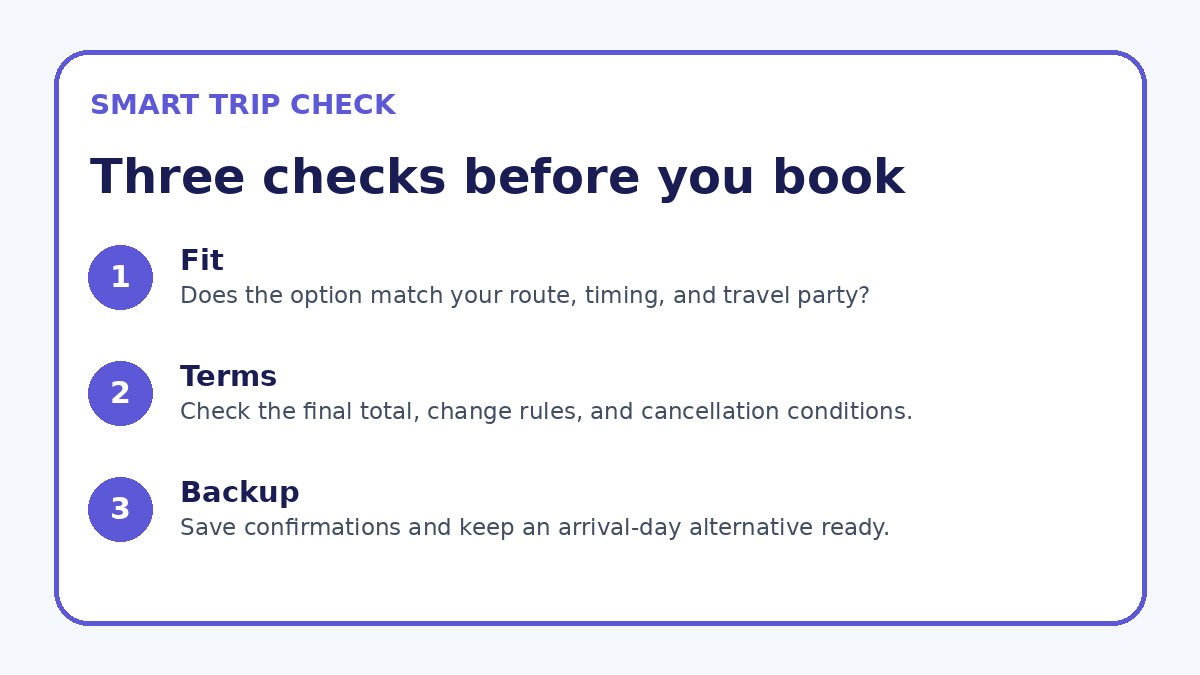
Recheck the complete itinerary
Confirm airports, connection handling, baggage, and change conditions before deciding.
Schedule fit and door-to-door time
Beyond flight duration, prioritize door-to-door time: the time it takes to get from your lodging in Seoul to the departure gate and from arrival gate in Singapore to your final destination. Gimpo is often closer to central Seoul neighborhoods, which can reduce taxi or public transit time; Incheon has more long-haul departures and a wider time spread of flights, which can help you match preferred departure or arrival hours. For first-time visitors, consider local rush-hour traffic, public transit schedules, and how early you want to arrive at the airport for international departures.
When assessing schedule fit, factor in your tolerance for early or late departures. If you need a morning arrival in Singapore for business or an event, compare the earliest arrival times achievable from each Seoul airport rather than the cheapest fare. Write down your preferred time windows and eliminate itineraries that force all-day travel or excessive overnight waits. Having clear requirements before you search will make it easier to spot the departure airport that best preserves your schedule.
Flight details to verify
- Write down your exact travel dates, number of passengers, and whether you will check baggage before starting searches.
- Search separately for departures from Incheon and Gimpo using identical passenger and baggage details to compare true door-to-door times.
- On each candidate itinerary, open the carrier’s final booking page and confirm baggage allowance, change/cancellation fees, and minimum connection times.
- If an itinerary includes a transfer between Seoul airports or independent tickets, calculate extra transit time and add at least two hours buffer for baggage and immigration.
- Note preferred arrival time in Singapore and eliminate options that force late-night or all-day travel that clashes with your plans.
- If comparing multi-leg tickets, confirm whether baggage is through-checked and whether both flight legs are operated by the same carrier or alliance.
Fare conditions and what to verify before booking
Fare conditions vary widely and can affect which airport makes sense. Cheaper fares may come with strict change, cancellation, or baggage limits that can turn a small schedule change into a substantial expense. Before you book Seoul to Singapore flights, read the fare rules on the carrier or booking site for refunds, change fees, included baggage allowance, and upgrade options. If flying from a specific Seoul airport locks you into a tight single-carrier itinerary with little flexibility, make sure the fare reflects the risk you’re willing to take.
When provider-specific facts could change, check the final booking page for exact baggage inclusions, minimum connection times, and whether the ticket includes through-check for luggage on multi-leg journeys. Also verify whether an itinerary labeled ‘direct’ is nonstop or has a technical stop. Trip.com is one place to compare current availability and conditions, but always confirm the final ticket rules with the operating carrier shown on the booking page before completing payment.
Flight Guide questions travelers ask
Should a first-time visitor always choose Incheon for flights to Singapore?
Not always. Incheon often has more international flight options and wider schedule choices, which helps if you need a specific arrival time or prefer nonstop service. However, Incheon is farther from central Seoul than Gimpo for many neighborhoods, which increases local transfer time. If proximity to your accommodation, a short transfer, or an early departure from central Seoul matters more than extra flight choices, Gimpo may be the more practical option. Compare itineraries for your exact dates, factoring in transfer time and baggage rules before deciding.
How much extra time should I allow if I need to transfer between Gimpo and Incheon?
Allow significantly more time than a single-airport connection. Transfers between Gimpo and Incheon require ground transit or public transport and can be affected by traffic and luggage handling. For safety, plan at least a few hours beyond normal airport connection recommendations to accommodate transit time, immigration, and recheck of baggage if needed. Check live transit schedules, possible dedicated airport shuttles, and any provider notes about required minimum connection times on the booking page to calculate a comfortable buffer.
Can I rely on through-checked baggage when booking multi-leg Seoul to Singapore travel?
You should confirm through-checked baggage on the final booking page for each itinerary. Through-checking often depends on whether the flights are on the same ticket and operated by partner carriers that interline baggage. If you book separate tickets or mix carriers without an interline agreement, expect to claim and recheck bags during connections. For first-time travelers who want to avoid this uncertainty, prefer single-carrier or interline itineraries and verify baggage handling rules directly on the carrier’s booking confirmation.
Final decision note
Choosing the most practical Seoul departure airport for Singapore depends on what you value: a shorter local transfer or a broader selection of flight times and direct routes. Start by fixing your travel dates, passenger count, and baggage needs; then run parallel searches from Incheon and Gimpo. Compare total door-to-door time, whether baggage is through-checked, fare flexibility, and the arrival window in Singapore you need. Verify fare rules and baggage terms on the carrier’s final booking page before payment. With those details in hand, you can pick the airport that minimizes stress and hidden costs for your first trip to Singapore.
Continue planning
Check current options and final conditions
Use the provider page to confirm live availability, the final total, cancellation terms, and every condition that matters to your trip.
This evergreen planning guide was created with AI-assisted drafting and a structured quality review. It does not display live prices, schedules, availability, visa guidance, or provider rankings. Verify current details before booking. Some links are affiliate links; we may earn a commission at no additional cost to you.