
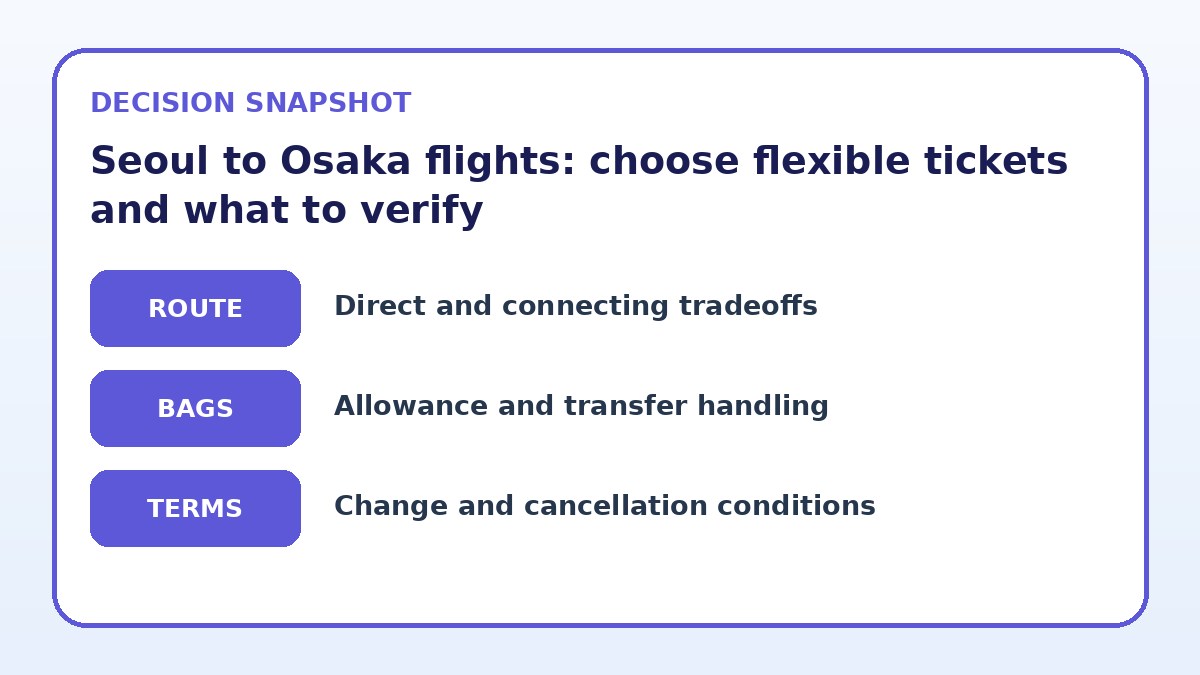
If you and your partner are planning Seoul to Osaka flights, the most practical thing to do first is pick the fare class and ticket source that match how flexible you need to be. Low-cost fares can be tempting for the headline price, but they often carry stricter change or cancellation rules and extra fees per passenger; full-service fares usually allow easier changes or carry a credit option. When traveling as a couple, extra fees multiply, and the pain of a single unexpected delay or a changed plan can quickly erase any savings. Before you book, decide how likely you are to change dates or names, whether you need refunds or travel credits, and whether you want the same carrier both ways to simplify handling. This guide walks through the tradeoffs, the checklist of what to confirm on the final booking page, and decision approaches for couples comparing options.
Understand the common ticket types and what they mean for couples
Airlines and third-party sellers typically offer several fare buckets: deeply restricted low-cost fares, standard economy with limited flexibility, and more flexible economy or premium fares. For couples, the key variable is whether change or cancellation terms apply per passenger or per reservation. Some carriers allow complimentary date changes within a fare family, while others charge flat fees per passenger plus any fare difference. When both partners are on one reservation, some airlines process changes together; on separate reservations, you may face two separate fees and more complicated coordination. Decide whether you and your partner will keep identical itineraries; synchronizing bookings can simplify managing changes, but check the carrier’s policy carefully.
Refundability, credits, and rebooking windows also vary. Refundable fares return money to the original payment method, while nonrefundable tickets often issue travel credits with expiry dates or limited use rules. If you expect a significant chance of canceling, a refundable ticket prevents the need to navigate credit terms later. Another consideration is transferability: most airlines do not allow name changes except in limited circumstances, so ensure passenger names match passports before purchase. For couples, small mistakes on names or mismatched documents can create costly last-minute fixes, so verify the exact name format the airline requires on the booking page.
Compare change fees, fare differences, and timing rules
When weighing options, separate the change fee (the administrative charge) from the fare difference (the price gap between old and new flights). An airline may advertise no change fee but still require the payment of any fare increase; conversely, a low fee plus a large fare difference can be more expensive than a flexible fare. For couples, multiply per-passenger fees by two when calculating worst-case costs. Check whether the carrier allows date-only changes, ability to move within the same day, or only permits rebooking to a different flight class. Also verify blackout dates, peak surcharges, and whether the fee schedule varies by how far in advance the change is made.
Timing rules matter: some fares allow free changes up to 24 hours after booking, or waive fees within a specific window before departure. Others impose increasing penalties as travel approaches. If one partner’s schedule might shift close to departure, choose a fare with lenient last-minute change terms or buy travel insurance that specifically covers change costs. On the final booking page, read the exact wording on “change policy” and “refunds” sections; if language is ambiguous, use the airline’s help chat or phone line to get a written confirmation or screenshot of the policy before finalizing payment.
| Approach | Best for | Tradeoff to check |
|---|---|---|
| Both partners buy fully flexible or refundable fares | Couples with high uncertainty or who value stress-free last-minute plans | Higher upfront cost but easier to change or refund without penalty |
| One flexible ticket, one basic ticket | When only one partner’s plans are likely to change | Lower combined fare but potential for one partner to face change fees |
| Both buy low-cost restricted fares | Couples with fixed plans and tight budgets | Lowest price up front but risk of large fees or nonrefundable credits later |
| Buy basic fares and add travel insurance covering changes | Couples who want a middle ground on cost and protection | Insurance cost and claims process may not cover every type of change |
How to handle cancellations, credits, and refunds as a couple
Cancellations are where couples most often discover hidden complexity. If a ticket is refundable, the refund process is straightforward: funds return to the original form of payment, though processing times vary. For nonrefundable tickets, carriers typically offer travel credit, sometimes issued only for future travel with restrictions. Verify whether credits can be used by either passenger or only the original ticket holder; some credits are nontransferable, meaning the partner who cancels must be the one using it. Also check credit validity windows and whether taxes and fees are refundable separately.
When booking via an online travel agent, cancellation and refund handling may go through the agent rather than the airline—this can add steps and different rules. If you want the option of a refund rather than a credit, book directly with the airline where possible and confirm the refundability on the airline’s final booking page. For couples, consider making a back-up plan: either buy flexible fares on both tickets, or book one flexible and one cheaper ticket if only one person’s plans are uncertain. Document any policy statements you rely on in case you need to reference them later.
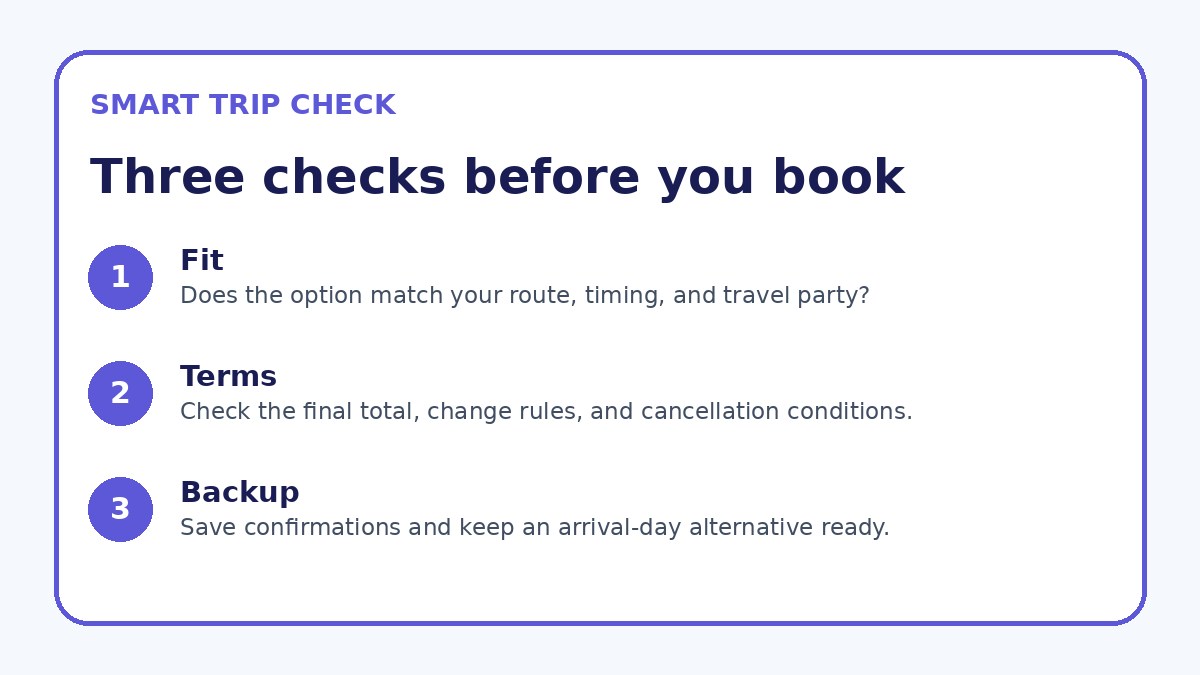
Before you book
- Confirm whether changes are charged per passenger or per reservation and calculate the full worst-case fee for both travelers.
- Verify if the fare is refundable or will only issue travel credits; note any credit expiry or transfer restrictions.
- Check baggage and seat-change rules separately—confirm whether paid seats and bags transfer automatically after rebooking.
- If booking through an agent, ask who handles cancellations and refunds and whether extra administrative fees apply.
- Take screenshots or save the exact policy wording from the carrier’s final booking page before completing payment.
- Set calendar reminders for any free-change windows and travel-credit expiry dates to prevent unexpected losses.
Practical booking checklist and decision approaches for couples
Start by deciding how much flexibility you need: both flexible, one flexible/one cheap, or both lowest-cost. If both partners have similarly uncertain schedules, flexible or refundable fares may cost more upfront but reduce stress and unexpected fees later. If only one partner’s plans are uncertain, compare the cost of buying one flexible ticket versus paying potential change fees for two restricted tickets. Consider adding seat selection and checked baggage to the calculation, since these ancillaries can be nonrefundable and may not move automatically with a rebooked ticket.
Before clicking purchase, open the airline’s full terms for changes and cancellations and screenshot the policy or copy the exact wording into a note. Verify whether the fare allows changes per passenger or per reservation, whether credits are transferable, the processing window for refunds, and any expiry dates for travel credits. If booking through an agent, confirm who processes refunds and whether the agent charges an additional administrative fee. Finally, keep all confirmation emails and make a calendar reminder for any credit expiry dates so you don’t lose value later.
Frequently asked questions
Should couples book two linked reservations or separate bookings for Seoul to Osaka flights?
Linking both travelers on one reservation simplifies coordinated changes and ensures the carrier treats you as a party, which can be helpful if you want identical itineraries. However, separate bookings can allow different fare strategies — for example, one passenger on a flexible fare and the other on a low-cost fare. The tradeoff is administrative: separate reservations mean two change fees and separate management. If you choose separate bookings, be disciplined about tracking both tickets and confirm transferability rules if you ever need to swap names or use credits.
How do I compare advertised ‘‘no change fee’’ policies between airlines when booking?
Read beyond the headline: verify whether ‘‘no change fee’’ still requires payment of any fare difference, and whether that waiver applies to the specific fare class you’re considering. Look for exclusions and timing limits (for example, only applies within 24 hours of booking or not for award tickets). On the airline’s final booking page, find the exact change policy language, and if unclear, contact the airline to get written confirmation. For couples, double any per-passenger costs when modeling worst-case changes to ensure the waiver actually provides the protection you expect.
Can travel credits be used by the other partner or combined into one booking?
Policies differ: some airlines issue nontransferable credits tied to the original passenger’s name and record locator, while others allow more flexible use. Before relying on credits, verify on the airline’s booking page whether credits can be applied to another traveler or another reservation, and check whether the credit has restrictions like blackout dates or seat-class limitations. If credits are nontransferable and only one partner cancels, consider whether that partner can realistically use the credit for future travel, or whether a refundable ticket would be safer for your couple’s plans.
Final planning note
For couples traveling Seoul to Osaka, the key decision is whether to prioritize lower upfront fares or flexibility that prevents costly changes later. Assess each person’s schedule uncertainty and compare full change fees plus fare differences, not just the headline ticket price. Use the checklist to confirm per-passenger versus per-reservation rules, refundability, credit transferability, and ancillary policies before you pay. If still unsure, booking at least one flexible fare or contacting the airline for a written policy clarification reduces risk. Finally, keep evidence of the stated rules and set reminders for change windows and credit expiries so you don’t lose value later.
Continue planning
Check current options and final conditions
Use the provider page to confirm live availability, the final total, cancellation terms, and every condition that matters to your trip.
This evergreen planning guide was created with AI-assisted drafting and a structured quality review. It does not display live prices, schedules, availability, visa guidance, or provider rankings. Verify current details before booking. Some links are affiliate links; we may earn a commission at no additional cost to you.