If you’re traveling from Seoul to Jeju with extra luggage, the core decision is a tradeoff: pay more for convenience and predictable baggage handling, or accept tighter schedules and connections to save time or money. For many baggage-heavy travelers, a slightly higher fare for a direct flight or generous checked-bag allowance reduces stress and risk — especially when transfers or last-minute schedule shifts would force re-packing or additional fees. This guide gives a practical comparison of routing choices, how baggage policies and connection risk interact, and which fare conditions to verify before you commit. Read it with your travel dates, number and weight of bags, and traveler details at hand so you can use the checklist to confirm live options on airline booking pages or comparison sites like Trip.com.

See live routes for your exact travel day
Compare direct and connecting choices with the same baggage and traveler details.

Routing choices: direct versus connecting options
On Seoul–Jeju routes you’ll commonly see direct departures from metropolitan airports and occasional itineraries that route through other domestic hubs. For a traveler with extra luggage, a direct itinerary usually wins because it removes one point where bags can be delayed, rerouted, or assessed for additional fees. Direct service also cuts the number of boarding and security transitions, which lowers handling risk for large or nonstandard items. When searching, filter for nonstop options first and note whether the itinerary requires a terminal change; terminal transfers can add time and complexity even if the flights are listed as a single booking.
If nonstop seats are unavailable or inconvenient, consider connecting itineraries only after assessing the minimum connection time and the transfer experience at the intermediate airport. Short layovers increase the likelihood you’ll need to recheck or rush heavy luggage between gates, and tight connections may be rebooked during disruptions. When connections look necessary, check whether the carrier protects through-checked baggage and whether the connection is on one ticket. These booking details directly affect whether your bags move automatically or you must manage them yourself.
Baggage rules and connection risks explained
Baggage allowances and surcharges vary by fare class and carrier; the critical step for travelers with extra luggage is to verify final baggage rules on the booking page before you pay. Look for the exact number of checked pieces allowed, maximum weight per piece, and any dimensional limits. Also check whether the fare includes priority or gate-checked options that reduce the need to gate-check oversized items. If you’re bringing sports equipment, musical instruments, or large suitcases, read the carrier’s special items policy and note whether advance reservations are required.
Connection risk compounds baggage uncertainty. If your itinerary includes flights on separate tickets or different carriers, your bags may not be transferred automatically, which would require you to collect and recheck them during the layover. Even on single-ticket connections, very short layovers or irregular operations increase the chance of delayed baggage. Before booking, confirm on the carrier’s page how they handle through-checked luggage, and whether they provide guarantees or rebooking assistance if a missed connection causes a bag delay.
Compare flight-selection strategies
| Flight strategy | Best for | Risk to check |
|---|---|---|
| Book a nonstop flight with included checked bags | Travelers who prioritize low handling risk and door-to-door simplicity | May cost more and offer fewer schedule change options or refund flexibility |
| Choose a connecting itinerary on one ticket with generous layovers | Those balancing lower fares with manageable transfer time and through-checked baggage protection | Longer total travel time and possible extra intra-airport movement with heavy luggage |
| Buy a cheap basic-fare nonstop and add baggage à la carte | Travelers who want convenience but are cost-conscious about occasional extra bags | You must carefully add the correct bag allowance before arrival to avoid high airport fees |
| Use multi-ticket connections to access many schedule combos | Highly flexible travelers who can recheck bags during long layovers or self-manage baggage | High risk of separate baggage handling, missed transfers, and no through-checked baggage guarantees |
Recheck the complete itinerary
Confirm airports, connection handling, baggage, and change conditions before deciding.
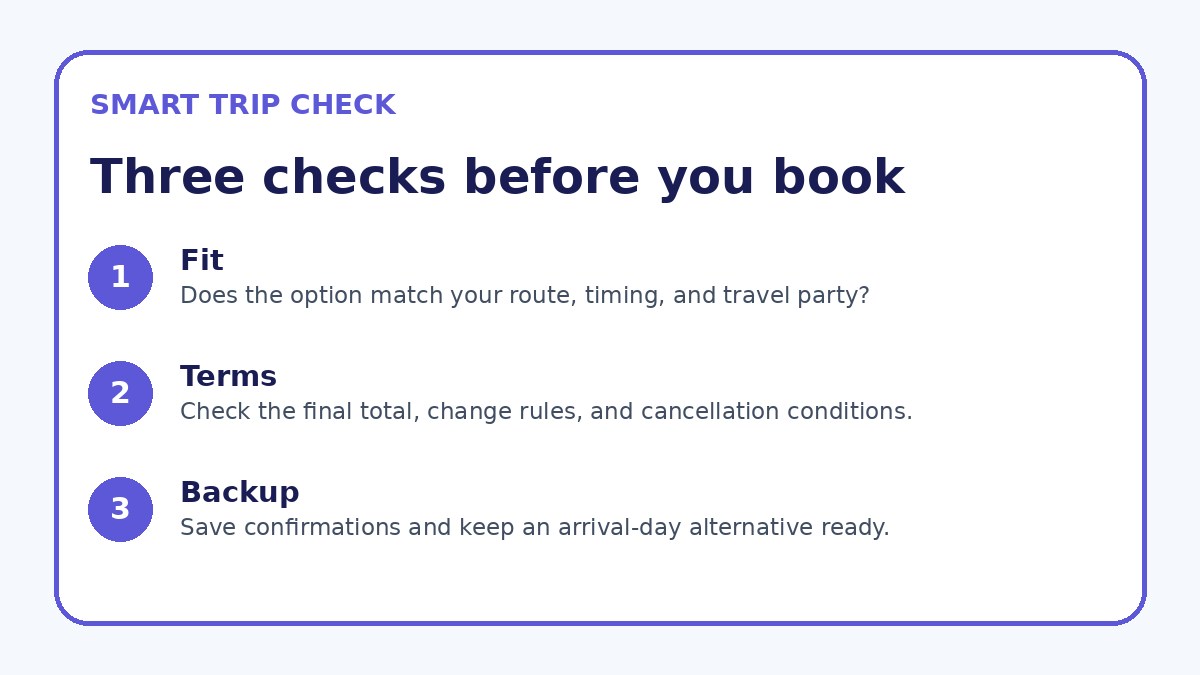
Schedule fit: balancing flexibility with convenience
Think about how fixed your travel dates are and how tolerant you are of schedule changes. If you must arrive or depart at specific times — for example, to meet a ferry, tour, or event — prioritize direct flights with strong on-time performance and sufficient buffer before critical appointments. Flexible schedules are more tolerable when you can shift plans without large consequences; in those cases, choosing an itinerary with a later or earlier connection might open cheaper or more baggage-friendly options.
If your schedule might change, choose fare conditions that permit changes with reasonable penalties and clearly state whether any reissue will preserve your original baggage allowance. Some low-fare options limit how many changes you can make or whether fare differences apply, and they may also change included baggage. Before paying, verify exactly which change or cancellation fees apply, how rebooking affects baggage entitlements, and whether you can buy a bundled fare or add-on that locks in larger baggage allowances across possible flight changes.
Flight details to verify
- Collect exact travel dates, full names as on IDs, passenger ages, and any connections or ferries that depend on your arrival time.
- Measure and weigh every suitcase and large item; record piece counts, weight per piece, and exact dimensions before searching fares.
- On each carrier’s booking page, verify the number of free checked pieces, weight and size limits, and any special-item reservation requirements.
- Confirm whether your itinerary is on a single ticket and if the operating carrier will through-check luggage for all segments.
- Check the exact change, cancellation, and reissue conditions for the fare you plan to buy and whether those rules preserve baggage entitlements.
- Note contact details and baggage claim procedures for the operating carrier and screenshot the final fare breakdown that lists baggage inclusions and fees.
Fare conditions and what to verify on booking pages
Fare rules determine the real cost of convenience. When you compare fares, don’t just look at the base price: check the fare class code, change and cancellation terms, and whether checked baggage is included or must be added for each traveler. Many carriers display baggage fees and optional add-ons only on later screens, so pause to review the full fare breakdown before you confirm. Confirm whether the quoted baggage allowance applies per passenger or per booking, and whether infants or children have separate rules.
Also verify how rebooking works for the specific fare: some classes allow free date changes but not seat reassignments, while others impose a fee plus any fare difference. If your itinerary crosses separate fare classes on a multicity ticket, the baggage allowance of each segment may differ; ask the airline or check the final receipt to ensure you won’t face an unexpected fee at check-in. Finally, confirm who is the operating carrier for each segment and whether the carrier’s final booking page protects through-checked luggage and lists contact information for baggage claims.
Flight Guide questions travelers ask
How do I decide whether to prioritize a nonstop flight or a cheaper connecting itinerary for Seoul to Jeju?
Decide by weighing your luggage needs against schedule risk. If you're traveling with many heavy or bulky items, a nonstop flight reduces handling risk and the chance of missed baggage. Compare the time cost of direct service against any fare difference and the flexibility you need: if your dates are fixed, convenience often outweighs small savings. If you’re flexible and confident you can manage rechecking bags, a connecting option on one ticket with a long layover can lower cost while keeping through-checked baggage protections.
What should I double-check about baggage rules before I book a Seoul to Jeju flight?
Before booking, verify the exact number of included checked pieces, the maximum weight per piece, dimensional limits, and special-item rules (sports gear, instruments). Look for whether allowances apply per passenger or per booking, and whether infants have separate rules. Also check whether the fare shows mandatory add-ons later in the booking flow and whether online purchase of extra baggage is cheaper than paying at the airport. Screenshot the final price breakdown that lists baggage inclusions and fees to avoid surprises at check-in.
If my itinerary includes a short connection, how can I reduce the risk that my luggage will be delayed or mishandled?
To reduce risk on short connections, pick a single-ticket itinerary with the same carrier or with carriers that have interline agreements that explicitly protect through-checked luggage. Allow at least the carrier’s recommended minimum connection time and prioritize flights that arrive and depart from the same terminal when possible. Pack critical items and at least one change of clothes in your carry-on. Verify the operating carrier will through-check bags by checking the booking details and call the airline if the booking flow doesn’t clearly state the policy.
Final decision note
For travelers with extra luggage on the Seoul to Jeju route, the practical choice comes down to where you accept risk: pay for convenience and simplified baggage handling with a nonstop, or accept connections and extra planning to save time or money. Use the checklist to gather exact travel dates, passenger details, and bag measurements before searching. On the carrier’s final booking page, verify included checked pieces, weight and size limits, operating carrier for each segment, and exact change or cancellation rules that affect baggage entitlements. If you want one place to compare live availability and final booking conditions, include a comparison search on Trip.com but always confirm the same baggage and rebooking terms on the airline’s own final booking screen.
Continue planning
Check current options and final conditions
Use the provider page to confirm live availability, the final total, cancellation terms, and every condition that matters to your trip.
This evergreen planning guide was created with AI-assisted drafting and a structured quality review. It does not display live prices, schedules, availability, visa guidance, or provider rankings. Verify current details before booking. Some links are affiliate links; we may earn a commission at no additional cost to you.