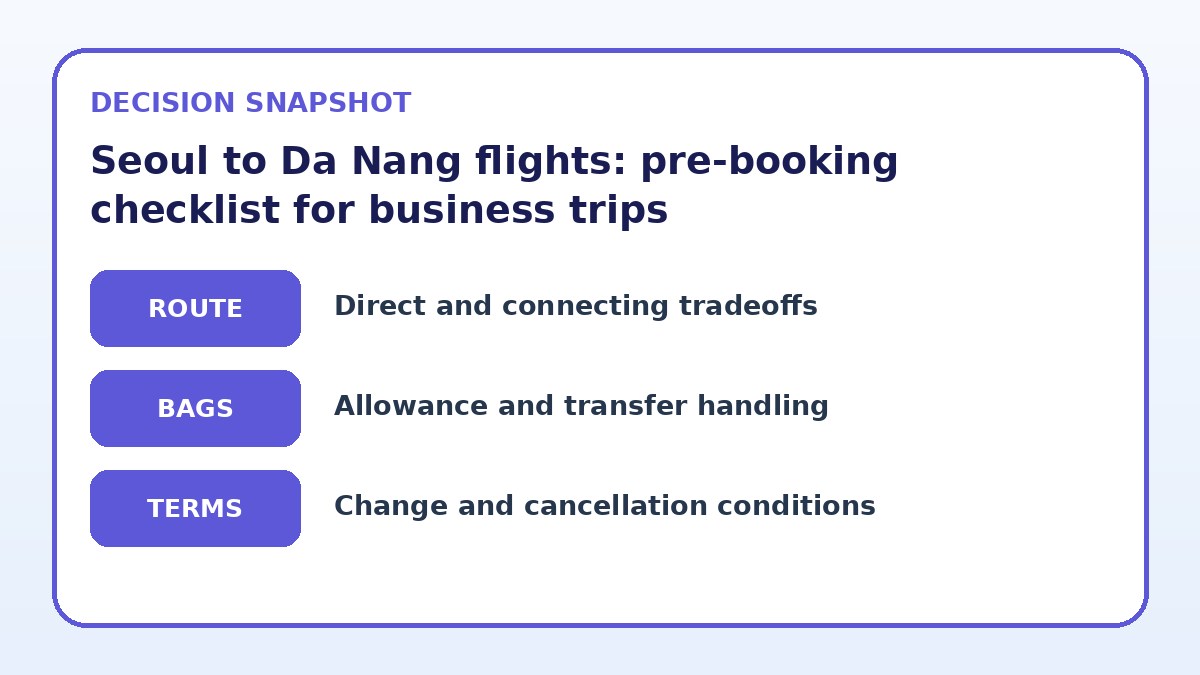
If you're booking Seoul to Da Nang flights for business, focus first on four things: total door-to-door time, layover risk, fare rules that affect changes, and seat/connection reliability. Begin by estimating total travel time including transfers in Seoul and Da Nang, then decide whether you value schedule certainty (shortest total time) or lower fares with a connection. For routes with possible connections, plan buffer time that covers immigration, security, and the local transfer process because flight schedules can shift. Finally, check the fare’s change and refund policy, any seat-selection and baggage inclusions, and what you must verify on the airline’s final booking page before paying.
See current options before you compare the details
Availability and final conditions change. Open Trip.com now or keep reading for the practical comparison.
Decide your priority: speed, price, or schedule flexibility
Business travelers often trade between fastest travel time, lowest fare, and flexibility to change plans. Start by listing what matters most for this trip: is arriving earliest to attend meetings your top priority, or can you accept a longer journey in exchange for lower cost? Fastest itineraries usually reduce layover risk and can mean fewer late-night arrivals, but they tend to be less flexible and sometimes cost more. Conversely, options with connections may cut ticket cost but introduce variables—missed connections, additional security lines, or an overnight layover—that can disrupt tight schedules.
When comparing options, calculate total travel time from your office or hotel in Seoul to your final meeting location in Da Nang. Include transit to and from airports, recommended arrival lead time for international departures, and potential wait time for luggage and customs on arrival. If you have a single, immovable meeting, favor itineraries with larger connection buffers and clear rebooking policies. If your schedule can flex, a cheaper connection could be acceptable but verify change terms and local support before you buy.
How to evaluate connections and transfer risk
Never assume flights labeled as “connecting” are equivalent: some connections are through the same terminal with fast transit, others require changing terminals or going through immigration. For Seoul departures you might use Incheon (ICN) or Gimpo (GMP); each has different transfer logistics. On arrival into Da Nang, consider that ground transportation and local traffic can add unpredictable delay to your schedule. When reviewing itineraries, note layover length and whether the connection is on a single ticket; single-ticket connections give airlines more incentive to reaccommodate you if the first leg is late.
If an itinerary requires changing airports, buying separate tickets increases risk significantly because the second carrier is not responsible for missed connections. For business travel, prefer single-ticket itineraries or build generous buffer time when mixing carriers. Check whether the airline or online booking platform specifies minimum connection times, and verify on the airline’s final booking page whether the connection is protected. If you rely on a short transfer, consider travel insurance that covers missed connections or choose a later domestic leg to reduce stress.
| Approach | Best for | Tradeoff to check |
|---|---|---|
| Direct or shortest-total-time itineraries | Travelers with fixed meeting windows who need to minimize travel disruption | Usually higher fares and less flexibility for last-minute changes |
| One-stop, single-ticket connections | Cost-conscious travelers who still want some protection if the first leg is delayed | Longer total travel time and potential for tighter on-the-ground transfers |
| Separate tickets or mixed-carrier bookings | Those optimizing price and willing to assume connection risk | Higher risk of missed connections and extra costs if flights are delayed |
| Flexible or refundable fares | Business travelers whose schedules frequently change | Higher upfront cost but simpler rebooking and lower change fees |
Ready to check the option that fits your plan?
Use your exact dates and traveler details so the provider page can show the current total and conditions.
Fare rules, seats, and baggage—what to confirm before you pay
Fare conditions directly affect your flexibility. Before booking, read the exact change and refund policy on the airline’s final booking page—don’t rely on summaries from comparison sites. Look specifically for fees tied to voluntary changes, the deadline for making free changes (if any), and whether the fare is eligible for a full or partial refund. For business travelers, a slightly higher fare that allows fee-free changes within a timeframe that matches your meeting schedule can save time and money if plans shift.
Also confirm seat selection options and included baggage allowance. Seat choice matters more on overnight or long flights where comfort affects productivity on arrival. Some lower fares exclude checked baggage; if you need a suitcase for meetings, factor the baggage fee into the total cost. Verify the carrier’s boarding priority and lounge access rules if you value quiet space to prepare. If details are unclear, contact the airline or check the final booking page where the carrier’s terms, aircraft type, and baggage specifics are listed.
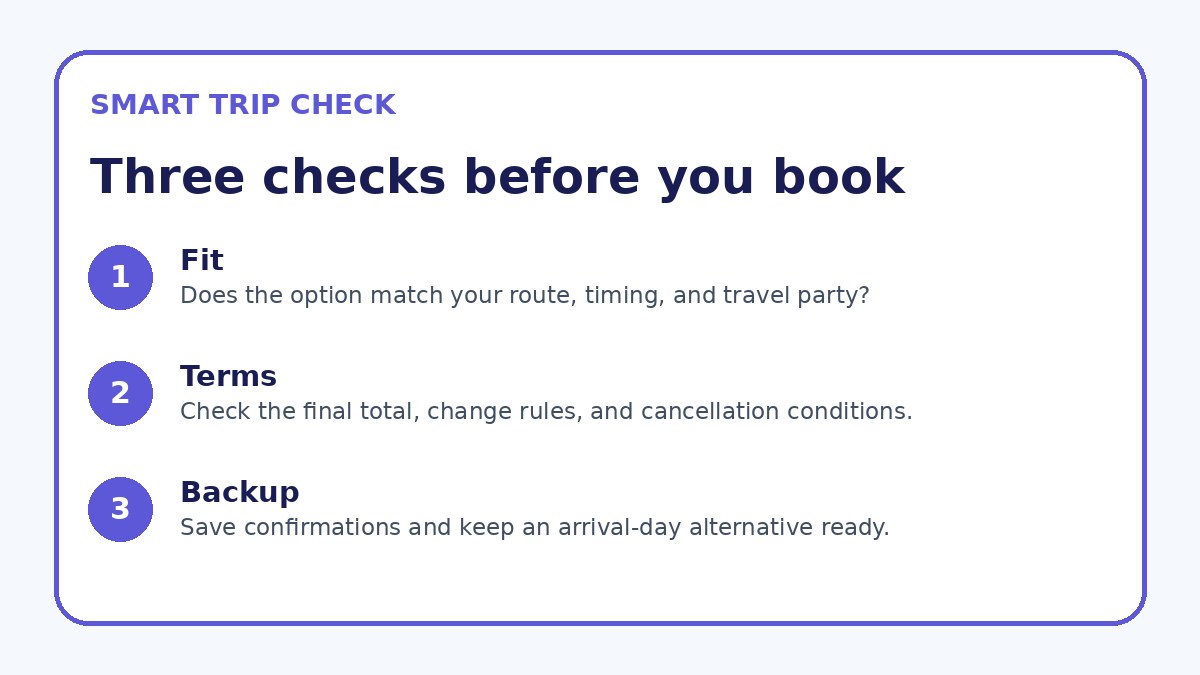
Before you book
- Confirm total door-to-door time (commute to Seoul airport + recommended check-in + scheduled flight time + Da Nang arrival processing + transfer to your meeting location).
- Verify whether the itinerary is single-ticket or separate tickets; prefer single-ticket connections for protected transfers unless you can absorb the risk.
- Read the airline’s exact fare rules on its final booking page: change fees, refundability, and how name corrections are handled.
- Check baggage allowance and included seats on the carrier’s booking page; add paid baggage or preferred seats before purchase if required.
- Ensure your passport name, frequent flyer number, and contact details are entered correctly and save a copy of the final confirmation and fare rules.
- Plan ground logistics on both ends: which Seoul airport, Da Nang arrival terminal, transfer options, estimated travel time to your meeting, and backup onward transport.
Practical booking checks and on-trip logistics
Before you hit purchase, gather and double-check the practical details: passport name must match exactly, frequent flyer number if you want credit, correct travel dates and times, and contact phone or email for real-time updates. Confirm which airport in Seoul your flight departs from and where the flight arrives in Da Nang because ground transfer times differ. If your arrival schedule is tight, pre-arrange an airport transfer or check reliable taxi and ride-share options in Da Nang to avoid delays for meetings.
Finally, verify the provider’s change and cancellation process and what documentation they require if you need to change. Keep a screenshot or PDF of the final booking confirmation and the fare rules shown on the carrier’s site. If you use an online aggregator, consider cross-checking the same itinerary on the airline’s site before finalizing. Trip.com can be used as a comparison point for availability, but always confirm the final terms on the airline’s official booking page prior to payment.
Frequently asked questions
Should I prefer a direct flight from Seoul to Da Nang if available?
If a direct flight is available on your date, it often reduces transfer risk and shortens total travel time—useful for fixed schedules. However, direct options can be less frequent and sometimes cost more; they may also have fewer rebooking options on restricted fares. Compare the direct itinerary’s departure and arrival times against your meeting schedule, then check the fare’s change and refund conditions on the airline’s booking page. If schedule certainty outweighs cost savings, a direct flight is often worth choosing.
How much connection time is safe when transiting through Seoul?
Safe connection time depends on whether you stay within one terminal or must change terminals or airports. For international-to-international transfers in the same terminal, allow at least the airline’s published minimum plus an extra buffer—two hours is a practical baseline for business travel. If you need to leave the secure area, clear immigration, or change airports (for example, between Incheon and Gimpo), build several hours. Always verify minimum connection times on the airline’s site and choose longer buffers for unpredictable local traffic or strict meeting schedules.
Can I rely on an online aggregator’s summary of baggage and change rules?
Aggregators are useful to compare options quickly, but summaries can omit important restrictions. Before finalizing, open the airline’s official booking page linked from the aggregator and read the fare conditions, baggage allowance, and change penalties there. The carrier’s site is the authoritative source for what is enforceable at check-in and during rebooking. You may use Trip.com or other platforms for initial searches, but confirm all policy specifics on the airline’s final page prior to purchase.
Final planning note
Booking Seoul to Da Nang flights for a business trip becomes straightforward if you work from a clear checklist: define whether speed, price, or flexibility matters most; evaluate connections and ticketing type; verify fare rules, seating, and baggage on the carrier’s booking page; and confirm ground logistics at both airports. Prioritize itineraries that align with your meeting windows and build buffers for transfers and local travel. Keep the booking confirmation and fare terms accessible, and consider flexible fares or protected single-ticket connections when schedule disruption would be costly.
Continue planning
Check current options and final conditions
Use the provider page to confirm live availability, the final total, cancellation terms, and every condition that matters to your trip.
This evergreen planning guide was created with AI-assisted drafting and a structured quality review. It does not display live prices, schedules, availability, visa guidance, or provider rankings. Verify current details before booking. Some links are affiliate links; we may earn a commission at no additional cost to you.