If you’re leaving Seoul for Da Nang and traveling with extra luggage, pick the airport that keeps transfers simple and reduces surprise fees. In greater Seoul you can fly out of Incheon (ICN) or Gimpo (GMP), and each airport affects your door-to-door time, checked-bag handling, and the number of airline choices. The most practical departure depends on where you’re staying in Seoul, whether you prefer a direct flight or don’t mind a connection, and how comfortable you are paying for checked or oversized baggage. This article gives a clear recommendation up front, then walks through the tradeoffs—transfer time, airline baggage policies, airport facilities for oversized items, and how to compare options when booking. I’ll also include a short, actionable checklist to use before you buy a ticket and what to verify on the airline’s booking page (and on Trip.com if you want to compare live availability).
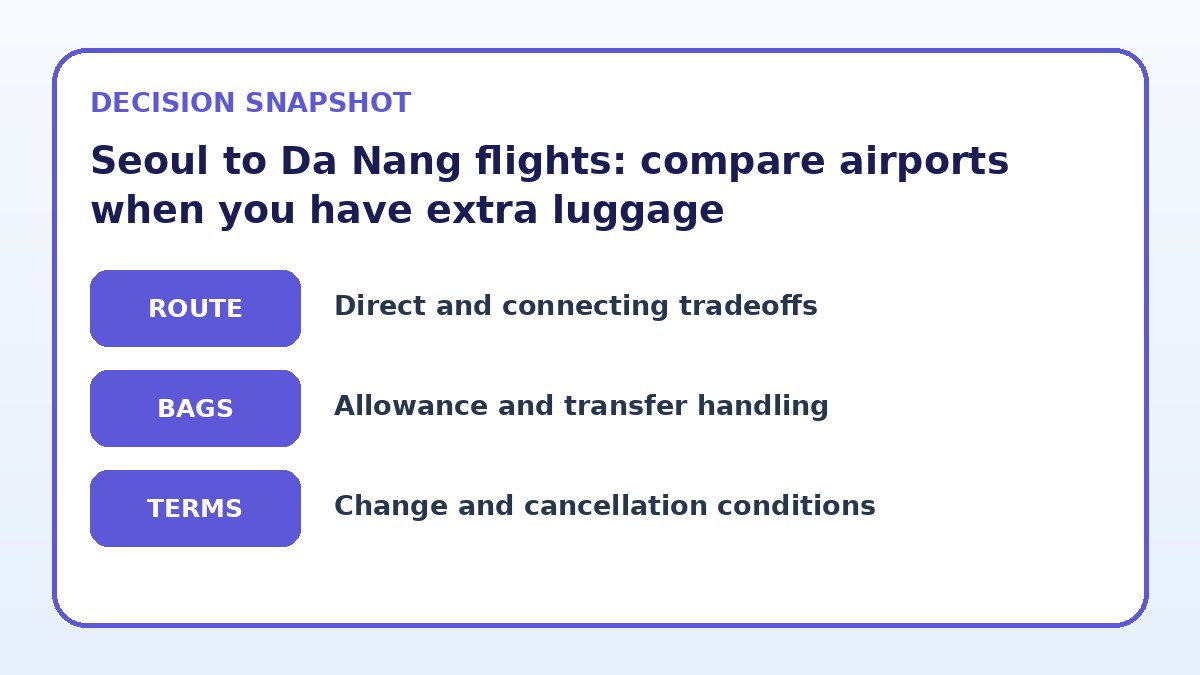
See current options before you compare the details
Availability and final conditions change. Open Trip.com now or keep reading for the practical comparison.
Practical recommendation up front
If convenience for extra luggage is your priority, depart from Incheon (ICN) when possible. Incheon is South Korea’s largest international airport and handles the bulk of long-haul services; that generally translates to more widebody aircraft with larger standard checked baggage allowances, dedicated oversized-baggage counters, and ground-handling experience for non-standard items. Choosing ICN often reduces the risk of last-minute gate or aircraft changes that force you to repack or pay surprising fees.
That said, pick Gimpo (GMP) when it meaningfully shortens your city transfer and you can confirm a flight whose baggage policy matches your needs. For travelers staying in western Seoul or for certain low-cost carriers with transparent larger-bag options at GMP, the shorter transit and lower local taxi fares can offset the smaller airport’s limitations. Ultimately the practical pick is the airport that minimizes total hassle: transfer time, handling of oversized pieces, and clearly stated airline baggage allowances.
How baggage policy and aircraft type affect your choice
Airlines publish different checked-bag allowances depending on route and aircraft. Larger aircraft on international routes generally include higher free allowances or offer more reasonable paid upgrades for extra weight or pieces. When comparing flights, look for aircraft type and the checked-bag maximum by fare class on the airline’s final booking page; do not rely on third-party summaries alone. If a carrier lists a generous checked-bag allowance for the Seoul–Da Nang routing, that can be a decisive factor favoring that airport and carrier combination.
If your baggage is oversized or unusually heavy, the airport’s ground-handling capabilities matter. Incheon’s larger cargo and handling operations are typically better equipped for oversized items and can provide clearer instructions for declaring and paying for special handling. Confirm whether you need to pre-declare oversized items during booking and whether the airline requires presentation at a dedicated counter. If the carrier’s baggage policy is unclear, contact the airline directly before buying a ticket.
| Approach | Best for | Tradeoff to check |
|---|---|---|
| Depart from Incheon (ICN) | Travelers prioritizing larger baggage allowances and handling facilities | Longer city transfer and potentially higher surface travel cost |
| Depart from Gimpo (GMP) | Travelers wanting the shortest transfer time within Seoul | Fewer long-haul options and sometimes stricter baggage limits |
| Book a direct flight | Minimizing baggage handling and the risk of recheck or misrouting | Often fewer schedule options and possibly higher fares |
| Choose a connecting itinerary | Finding more carriers or cheaper fares with acceptable baggage rules | More transfers increase handling complexity and potential fees |
Ready to check the option that fits your plan?
Use your exact dates and traveler details so the provider page can show the current total and conditions.
Transfer time, airport access and door-to-door cost
Consider the entire transfer—how long it takes to get from your accommodation to the airport and the cost of that journey with extra baggage. Incheon is farther from central Seoul and can take longer by public transit or taxi, which matters if you’re hauling multiple heavy bags. Factor in the cost of an airport limousine bus, AREX train plus taxi, or a private transfer; when you add those costs and transfer time, a nearer Gimpo departure may be more practical for short trips or when you want to minimize surface travel time.
Also weigh the convenience of check-in and baggage drop at your chosen airport. Larger airports typically have longer staffed hours at check-in counters and better facilities for storing or reweighing bags before the flight. If you need to maximize time or avoid tight connections, choose the airport where you can comfortably arrive early and find staff to assist with oversized items. Confirm arrival-time recommendations and counter opening times on the carrier’s booking page before finalizing your plan.
Before you book
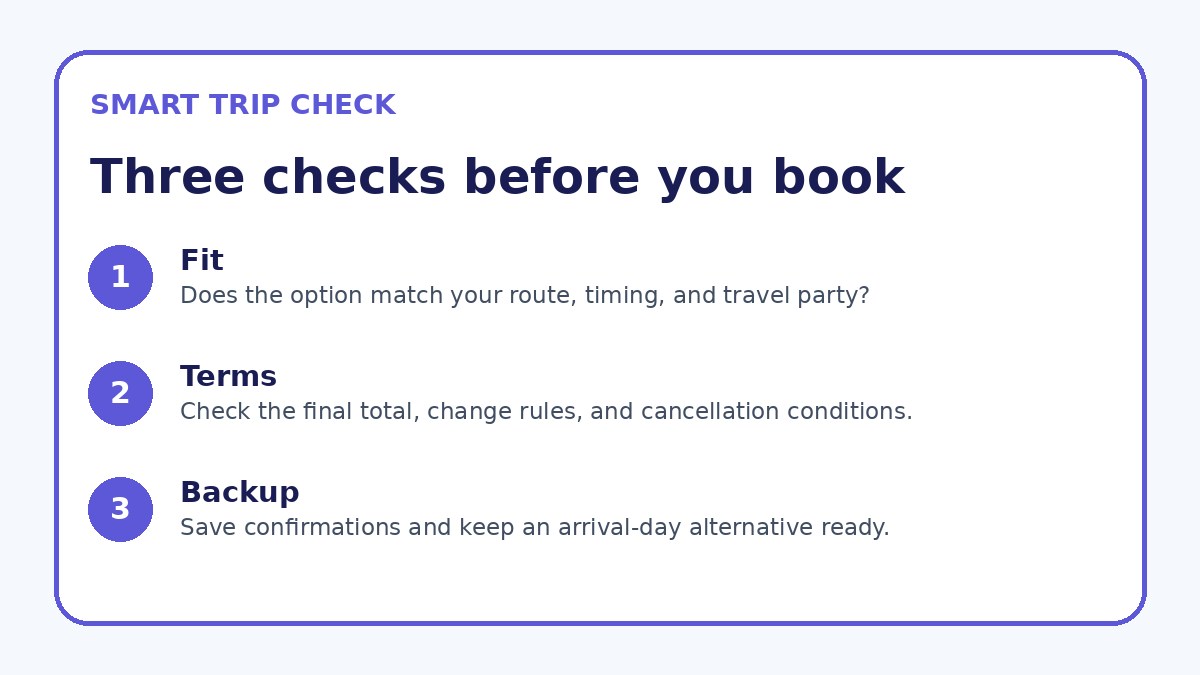
- Measure and weigh every bag, including straps and wheels, so you can compare against airline limits precisely.
- Check the airline’s official booking page for the checked-bag allowance and oversized/overweight fee schedule for your exact fare class.
- Confirm whether a connection requires baggage recheck and how many minutes are recommended between flights for baggage transfer.
- Compare door-to-door transfer time and cost to each airport from your accommodation, including taxis with trunk space or private transfers.
- If you have oversized or fragile items, call the airline to confirm handling procedures and whether pre-declaration is required.
- Keep copies of receipts and take photos of checked bags before handing them to the airline at check-in in case of damage or loss.
Comparing direct versus connecting flights and what to verify
Direct flights remove one layer of baggage transfer and the risk of mis-routed bags—important when you have extra or fragile items. If a direct route from Incheon to Da Nang is available, it often simplifies gate-to-baggage-claim logistics, even if the fare is higher. When direct options are unavailable or more expensive, a single connection might be reasonable, but remember each connection increases the chance of extra handling fees, recheck requirements, or missed connections impacting your bags.
When weighing options, check these items on the airline’s final booking page: exact checked and oversized baggage allowances for your specific fare class; whether you must collect and re-check bags during a connection; the aircraft type; and the airport terminals involved in any connection. If you use an online travel agency such as Trip.com to compare schedules, always confirm the baggage policy on the airline’s official site before purchasing the ticket.
Frequently asked questions
Is it cheaper to fly out of Gimpo if I have heavy or extra bags?
Gimpo can reduce surface travel costs because it’s closer for many Seoul neighborhoods, but that doesn’t automatically make checked-bag fees cheaper. Baggage fees are set by the airline and fare class rather than the airport. Before assuming savings, compare total door-to-door costs: add any taxi or transfer savings at Gimpo to the airline’s extra-baggage charges you’ll incur there, and compare that against an Incheon departure where the airline’s allowance or upgrade options might be more favorable. Always verify baggage rules on the carrier’s booking page.
Will a connecting flight increase my chance of lost luggage on the Seoul to Da Nang route?
Each connection adds handling steps, which statistically increases the potential for delays or misrouting, especially with tight connection windows. If the itinerary requires you to collect and re-check baggage at a transit airport, your risk rises further. To reduce that risk, allow longer connection times, choose itineraries where the same airline or partner handles both legs, and confirm baggage-through policies when booking. Photographs of your bags and itemized contents can help if you need to file a claim.
How early should I arrive at the airport with extra luggage?
With additional or oversized bags, give yourself extra time for check-in, baggage drop, and any special handling processes. Arrive earlier than the standard recommendation for the airport and carrier you chose—this often means adding 30–60 minutes to typical guidance. Check the airline’s suggested arrival time on its booking page, and verify when the baggage counters open. If you need special handling or inspection for oversized items, having extra time reduces stress and lowers the risk of missing check-in deadlines.
Final planning note
For travelers carrying extra luggage on a Seoul to Da Nang itinerary, the practical choice usually favors Incheon for its broader international services, larger aircraft, and ground-handling resources that make oversized baggage easier to manage. Gimpo remains a useful alternative when it meaningfully shortens your transfer and you can confirm baggage allowances that meet your needs. Always verify the exact checked and oversized baggage rules, required arrival times, and any recheck requirements on the airline’s official booking page before paying. Use the checklist above at booking and double-check details if you compare options on Trip.com or other aggregators to avoid surprises at the airport.
Continue planning
Check current options and final conditions
Use the provider page to confirm live availability, the final total, cancellation terms, and every condition that matters to your trip.
This evergreen planning guide was created with AI-assisted drafting and a structured quality review. It does not display live prices, schedules, availability, visa guidance, or provider rankings. Verify current details before booking. Some links are affiliate links; we may earn a commission at no additional cost to you.