
For couples deciding how to fly from Seoul to Bali, the practical choice usually comes down to a simple trade: do you want firm convenience — shorter overall journey time and fewer variables — or the freedom to change plans without penalties? The right balance depends on how fixed your dates are, how much sleep loss or jet-lag tolerance you and your partner have, and whether you prioritize arrival time over cost and flexibility. Start by comparing a few key variables: total door-to-door travel time, number and length of connections, fare change/refund rules, and baggage allowances. Once you know which combination matters most to your trip — stress-free arrival, weekday-night savings, or the ability to shift dates easily — you can narrow options quickly and book with the confidence that the ticket matches your priorities.
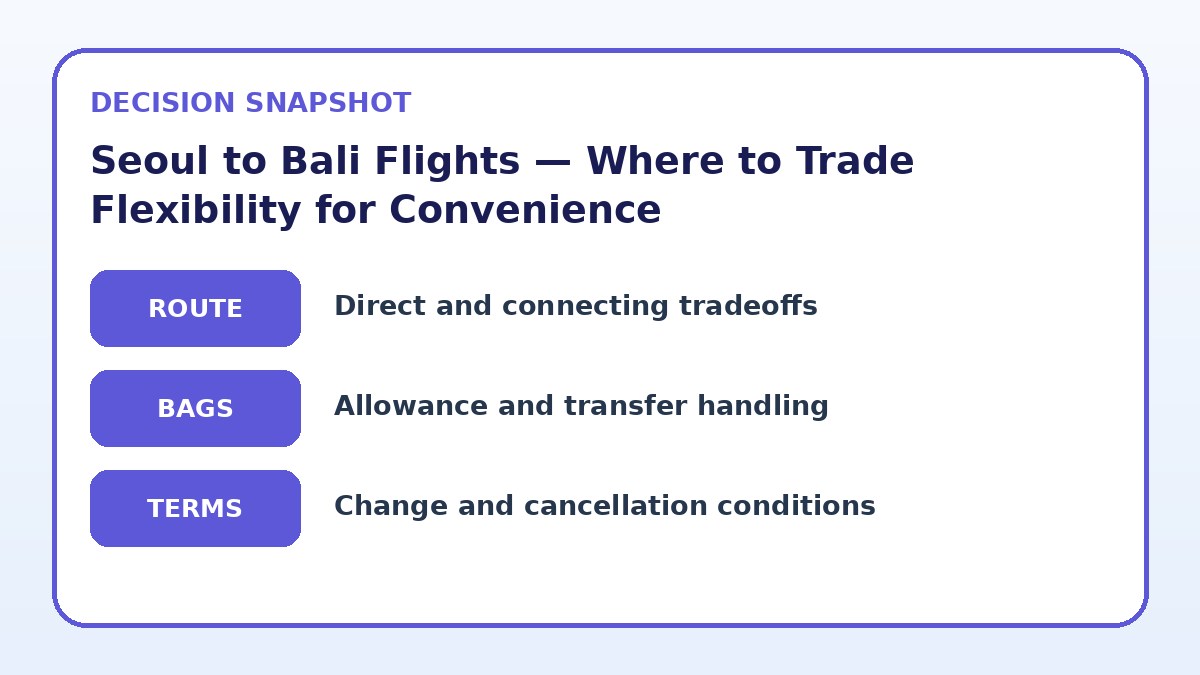
See current options before you compare the details
Availability and final conditions change. Open Trip.com now or keep reading for the practical comparison.
How to frame the convenience vs. flexibility decision
Start by defining your non-negotiables as a couple: are you traveling for a fixed event, like a wedding or anniversary, where dates can’t move? Or is your schedule open, letting you chase cheaper or more comfortable flights? Convenience typically means minimizing connections and total travel time — that’s appealing when time together is limited. Flexibility means paying either a higher base fare or a ticket with looser change rules so you can adapt plans without stress. Talk through likely scenarios together (illness, extra work, weather) and decide how much you’re willing to pay to avoid the administrative friction of changing tickets later.
Next, rank the secondary factors that affect comfort and convenience: departure/arrival times that suit your sleep patterns, the number of transfers and terminals, and whether you prefer daytime flying to avoid jet lag or red-eye flights to save daylight for activities. Consider how baggage and seat assignments influence your experience as a pair — having seats together, luggage allowances, and checked-through connections can be worth a moderate fare premium. Once priorities are clear, you’ll have a decision framework that turns a long list of fares into a short, actionable shortlist.
Comparing itinerary types: direct vs. connecting choices
If direct flights are available between Seoul and Bali, they simplify the trip: one check-in, one aircraft change, and fewer moving parts. For couples who value convenience and reduced travel stress, a direct or single-connection itinerary often wins because it lowers the chance of missed connections or lost bags. But direct flights can depart at less convenient hours or cost more; if your schedule is flexible, a well-timed connection can save money or get you a better overall departure and arrival time. Always look at the full door-to-door travel time, not just airborne hours — include transfer times, airport transit, and the time required for immigration and customs.
Connecting itineraries introduce decisions about layover length and airport choice. Short layovers increase risk and anxiety, especially when transferring between terminals or airlines that do not interline baggage. Long layovers give breathing room and buffer against delays, and can even allow a short city visit if you have a long stopover. For couples who want flexibility, flight combinations with generous change rules or the option to build extra time between legs are preferable. If you book separate tickets on different carriers, verify baggage transfer rules and allow extra time to re-check bags and clear security.
| Approach | Best for | Tradeoff to check |
|---|---|---|
| Direct or single-connection itinerary | Couples prioritizing convenience and minimal transit stress | Often higher price and less scheduling flexibility if dates change |
| Lower-fare multi-connection tickets | Couples with fixed dates who tolerate longer travel for savings | More transfer risk and longer door-to-door time |
| Flexible fare with low/no change fees | Couples who need the freedom to adjust dates or plans | Higher upfront cost but lower penalty risk if plans shift |
| Cheap basic fare plus paid add-ons | Couples who want to control exact services they pay for | Must manage add-ons carefully; final cost and convenience can vary |
Ready to check the option that fits your plan?
Use your exact dates and traveler details so the provider page can show the current total and conditions.
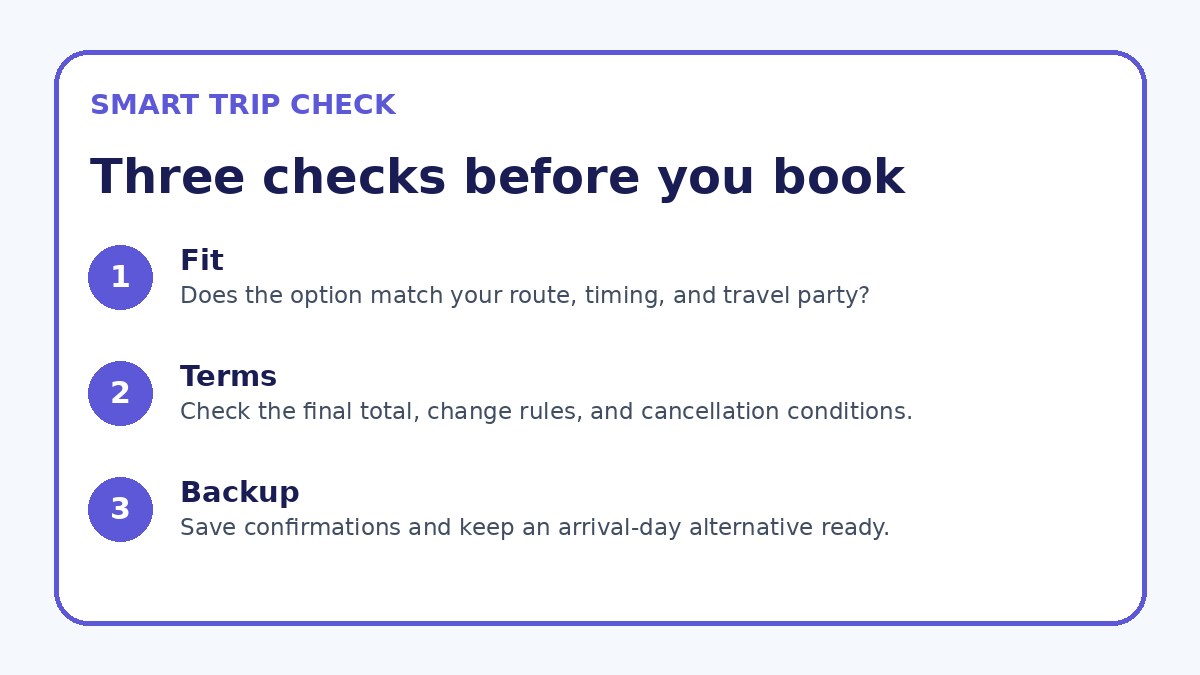
What to verify on the booking page before you commit
Always check the fare conditions and the exact rules shown on the airline or travel agent’s final booking page before payment. Important items to verify: change and cancellation fees (or whether changes are free within a time window), baggage allowances for each passenger and each segment, whether seats together are guaranteed or require paid selection, and whether connections are protected by the carrier. If booking through an OTA or aggregator, confirm which carrier’s contract of carriage applies and where refunds and changes must be requested, since policies can differ between seller and airline.
Also confirm arrival logistics: which airport you’ll land at in Bali (if the destination region has more than one), terminal assignments for key legs, and whether visas or arrival forms are needed at your destination — check official government guidance rather than relying only on booking pages. If you have mobility needs, dietary requirements, or special requests, verify whether the airline supports them and whether there’s a contact number to reconfirm closer to travel. Trip.com can be used as one place to compare availability and conditions, but verify final fare rules and baggage details on the carrier’s official booking interface as well.
Before you book
- Confirm total door-to-door travel time (home to accommodation) for each flight option before comparing prices.
- Verify change and cancellation terms on the airline’s final booking page, including any timelines or fees.
- Check baggage allowance per passenger and per segment; factor paid baggage into the total fare.
- Reserve seats together as early as allowed or budget for seat selection to guarantee adjacent seating.
- Compare layover duration and terminal transfer requirements; add buffer time for unconnected tickets.
- Save digital and printed copies of itineraries, passports, and contact numbers for both carriers and your accommodation.
Couples’ comfort tips for the long-haul segment
Plan seating and sleep strategy together: decide in advance whether you’ll sit together at the window and aisle, or split seats to maximize legroom and personal space. If a red-eye works for one partner but not the other, consider booking adjacent rows or upgrading one seat to a premium option to reduce disturbance. Bring shared comfort items like a compact blanket, earplugs, and a small pillow, and coordinate in-flight meals and hydration to reduce jet-lag effects. Pre-select seats as early as allowed to secure pairs or adjacent seats, and check the carrier’s policy for reserve and paid seating during booking.
For connections, reduce stress by aiming for slightly longer layovers when you’re unfamiliar with an airport’s layout, and choose airports with easy transit between gates when possible. If you expect to arrive tired, book an overnight near your Bali arrival airport for the first night so you can recover before starting your activities. Keep travel documents, medication, and a change of clothes in carry-on luggage so either of you can assist if one person needs immediate access. A shared digital folder with copies of bookings and passports helps both partners stay informed during the trip.
Frequently asked questions
Should couples always choose flexible fares when booking Seoul to Bali flights?
Not always. Flexible fares are valuable if your dates might change or if unexpected commitments are likely. They reduce stress because you can modify travel without heavy penalties. However, flexible fares typically cost more upfront. If your trip dates are firm and you can accept a tighter itinerary or longer travel time, a standard fare—or combining a low fare with travel insurance—may be more cost-effective. Weigh the premium against the probability and potential cost of needing a change, and inspect the exact change rules shown at checkout before you buy.
How long should connecting layovers be for a comfortable transfer as a couple?
Aim for layovers that provide a comfortable buffer based on the airport and whether you need to switch terminals or recheck baggage. For same-airline or protected connections, 60–90 minutes can be sufficient at efficient airports; longer, 2–3 hour connections are safer if you must clear immigration or change terminals. If you’re booking separate tickets or using an unfamiliar hub, add extra time to account for baggage recheck and security lines. Consider your tolerance for rushing, and choose layovers that let both partners move at a relaxed pace rather than sprinting between gates.
What practical items should couples pack in carry-on to reduce connection anxiety?
Pack essentials that let either partner manage unexpected delays: passport copies and digital backups, a change of clothes, basic toiletries, necessary medications, chargers and a power bank, and snacks. Include a small pouch with travel documents and confirmation numbers for both flights and accommodation. Noise-cancelling earbuds or earplugs, a lightweight blanket or scarf, and a refillable water bottle (empty through security) improve comfort during waits. These items let you handle most common hiccups without scrambling or having to access checked luggage.
Final planning note
For couples flying from Seoul to Bali, there’s no single right answer — only the balance that fits your priorities. If convenience and minimal transit stress matter most, prioritize direct or single-connection itineraries, reserve seats together, and accept a possibly higher fare. If flexibility or lower upfront cost is the goal, buy a flexible fare or select a cheaper itinerary with mindful add-ons and generous layover times. Always verify fare rules, baggage allowances, seat policies, and terminal details on the final booking page before payment. Discuss your tradeoffs as a couple, pick the itinerary that minimizes your main stress points, and you’ll start the trip together on the same page.
Continue planning
Check current options and final conditions
Use the provider page to confirm live availability, the final total, cancellation terms, and every condition that matters to your trip.
This evergreen planning guide was created with AI-assisted drafting and a structured quality review. It does not display live prices, schedules, availability, visa guidance, or provider rankings. Verify current details before booking. Some links are affiliate links; we may earn a commission at no additional cost to you.