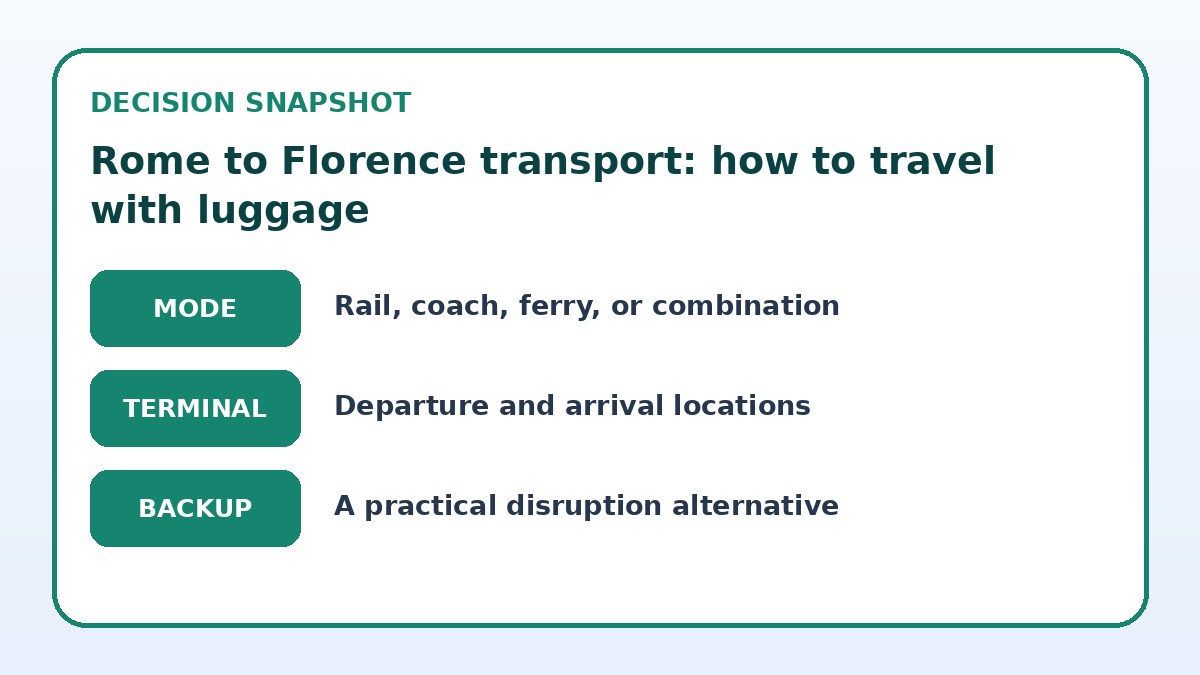
Practical answer: for most solo travelers carrying one large suitcase plus a daypack, take a direct high-speed train from central Rome to central Florence, board with luggage accessible, and walk or take a short taxi to your Florence door. If your bags are oversized or you prefer door-to-door ease, book a private transfer or a luggage shipping service and take a slower train or bus. Decide by balancing convenience (carry-on style and short transfers), cost, station-to-hotel distance, and how much you want to avoid stairs or cobbled streets.
Tradeoffs matter: trains maximize speed and city-center arrival but require managing bags in stations and on platforms; private transfers reduce handling but add time in traffic and usually end up at your hotel rather than the station. Before booking, check whether a chosen train is direct or requires a change, platform access and step-free routes at stations, and luggage policies on the operator’s booking page. You can compare current availability with Trip.com, but always verify final baggage details and platform arrangements on the provider’s site.
See current options before you compare the details
Availability and final conditions change. Open Trip.com now or keep reading for the practical comparison.
Choosing between trains, buses, and transfers
Start by matching your luggage profile and comfort needs to the transport type. If you travel with one suitcase and a daypack and can lift your bag onto an overhead rack or into a luggage bay, high-speed trains are usually the smoothest city-center option. Trains eliminate last-mile driving and get you to Florence’s main station close to hotels and public transport. However, stations can be busy, involve stairs or long platforms, and you’ll need to manage your luggage during boarding and alighting.
Buses and regional trains can be cheaper but often have limited space for large suitcases and may require storing bags in underfloor holds you can’t access during the trip. Private transfers or taxis remove the station challenge by collecting you at your accommodation and delivering you to your destination, which is helpful if you have mobility concerns, extra luggage, or an early/late schedule. Always weigh door-to-door convenience against possible traffic delays and check whether transfers use vans or cars and how much luggage they allow.
Station logistics and luggage handling tips
Plan how you’ll move through Roma Termini or Roma Tiburtina and Firenze Santa Maria Novella before you arrive at the station. Look for step-free routes, lifts, and escalators on official station maps and on the operator’s booking page. Bring luggage with wheels that can be tilted and pulled; wider cobbled streets and narrow sidewalks in Florence are easier to navigate with durable wheels. Keep essentials with you in a daypack so you don’t have to rummage through checked bags during short transfers or restroom stops.
Boarding often requires walking down long platforms and, at busy times, standing while people load luggage into provided racks. For peace of mind, choose a carriage with a luggage area or reserve a seat in a coach where large luggage can be stowed nearby. If your train has limited storage, consolidate items into one manageable bag when possible. On arrival, move promptly to station exits or the taxi rank; crowds can make stopping to reorganize luggage difficult and may increase stress for solo travelers.
| Approach | Best for | Tradeoff to check |
|---|---|---|
| High-speed train (city center to city center) | Travelers with one large suitcase who prioritize speed and central arrival | You manage luggage across stations and platforms and may need to lift bags onto racks |
| Regional train or coach (lower cost) | Budget-conscious travelers willing to trade comfort for savings | Less luggage space, possible underfloor holds, and slower overall journey |
| Private transfer or taxi (door-to-door) | Passengers with oversized baggage, mobility needs, or heavy gear | Higher cost and potential delays from road traffic; arrival depends on city access |
| Luggage shipping or same-day delivery | Travelers who want to move unencumbered between cities | Requires scheduling pickup/drop-off windows and trust in handling and tracking |
Ready to check the option that fits your plan?
Use your exact dates and traveler details so the provider page can show the current total and conditions.
Packing and gear choices that make travel easier
Optimize your luggage for mobility. A single medium-large rolling suitcase plus a secure daypack is the most versatile setup for Rome to Florence. Use packing cubes to compress and separate clothing, keep important documents and valuables in a theft-resistant pouch, and choose luggage with 360-degree wheels for smoother movement across different surfaces. Consider a compact travel lock and a luggage strap to make identification quick; reflective or brightly colored straps help you spot your suitcase on a busy platform or luggage bay.
If you often travel with heavier items or fragile gear, a soft-sided duffel with a shoulder strap can be easier to squeeze into tight spaces than a rigid suitcase. A lightweight folding trolley or bag with a dedicated laptop pocket reduces unpacking when you reach cafes or coworking spots. For solo travelers who want hands-free movement, a sling-style daypack or a hip pack for documents and phone keeps essentials close and reduces the risk of leaving something behind when re-boarding or hailing a taxi.
Before you book
- Measure and weigh your bags to confirm they fit train luggage bays and transfer vehicle limits.
- Check whether your chosen train is direct or requires a change and note platform transfer details.
- Locate step-free routes and elevator availability at departure and arrival stations on official maps.
- Reserve seats or carriages with dedicated luggage areas when that option is available.
- Confirm pickup/drop-off windows and tracking if using a luggage shipping or delivery service.
- Save provider contact numbers and the operator’s baggage policy screenshot in case you need onsite clarification.
What to check before you buy tickets
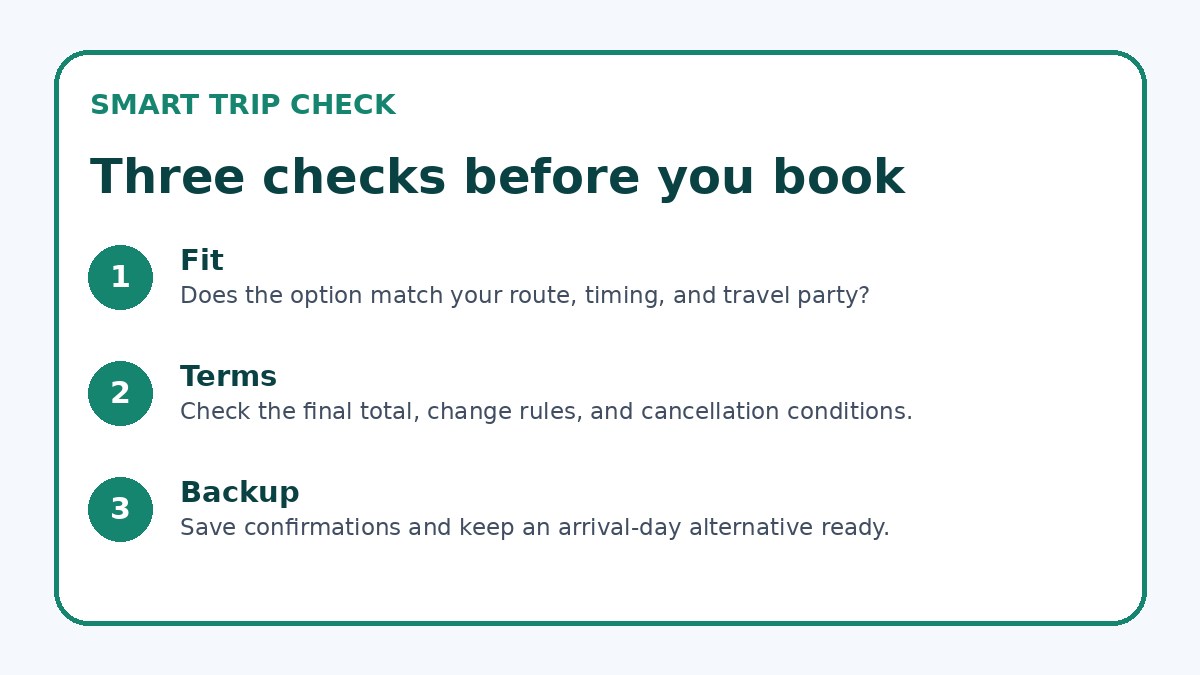
Verify direct versus connecting options and what ‘direct’ actually means on the booking page: some trips branded as direct may still change trains with short platform transfers. Confirm platform access, step-free routes, and whether luggage storage is guaranteed on your chosen train type. For private transfers, check pickup location flexibility, vehicle size, and exactly how many pieces of luggage are included. If you plan to ship luggage, read pickup windows, drop-off points, and tracking details carefully.
Check cancellation and change policies that relate to luggage—some lower-cost tickets restrict exchanges and refunds, which is important if your travel plans are fluid. Also confirm arrival station proximity to your accommodation and taxi or bus options if you don’t want to walk with suitcases. If you compare multiple carriers or services, write down the provider’s luggage rules and contact info so you can verify any discrepancies on the provider’s final booking page before you commit. Trip.com can be a place to compare current availability, but always confirm baggage-specific details on the operator’s official site.
Frequently asked questions
Is it easier to take a train or a private transfer from Rome to Florence with large luggage?
Trains are generally easier if you value speed and arriving in Florence’s city center, but they require handling baggage through stations and onto the train. Private transfers remove most of the lifting and station navigation by collecting you from your door and delivering you directly to your destination, which helps with oversized items or mobility concerns. Consider how comfortable you are lifting or moving bags across platforms, the distance between stations and your accommodations, and whether road traffic during your travel window might add significant time to a transfer.
Can I bring oversized items or sports equipment on Italy’s trains between Rome and Florence?
Many trains accept larger items, but the ease of stowing them varies by train type and carriage layout. If you have skis, bicycles, or unusually large cases, check the operator’s baggage rules and whether reservations or special handling are required. Some services have designated spaces for bulky items but limited availability, or they suggest booking a specific carriage. Always verify the exact conditions and any booking procedures on the provider’s final booking page before you travel, as policies can differ between operators and ticket types.
How can a solo traveler reduce stress when moving luggage at busy stations?
Plan ahead: arrive at the station with time to spare, use a compact, wheeled suitcase and a secure daypack, and choose a carriage with visible luggage space by reserving a seat if possible. Identify step-free routes and elevator locations on station maps, keep important documents and a change of clothes in your daypack, and use bright straps or tags to spot your bag quickly. If you prefer to avoid station handling, arrange a transfer or luggage shipping service in advance and confirm pickup/drop-off slots to minimize waiting.
Final planning note
For most solo travelers carrying reasonable luggage, a direct high-speed train is the practical balance of speed, city-center arrival, and cost-effectiveness. If lifting bags, navigating platforms, or walking cobbled streets is a concern, a private transfer or luggage shipping service reduces physical handling and stress—at the expense of potential traffic delays or precise scheduling. Before booking, prioritize what matters most for your trip: minimizing walking and stairs, arriving in the heart of Florence, or avoiding roadside delays. Verify direct versus connecting options, luggage allowances, and station accessibility on the provider’s final booking page, and use comparison tools like Trip.com only as a starting point to confirm current availability and terms.
Continue planning
Check current options and final conditions
Use the provider page to confirm live availability, the final total, cancellation terms, and every condition that matters to your trip.
This evergreen planning guide was created with AI-assisted drafting and a structured quality review. It does not display live prices, schedules, availability, visa guidance, or provider rankings. Verify current details before booking. Some links are affiliate links; we may earn a commission at no additional cost to you.