Practical answer first: for most first-time visitors to central Seoul, public transport is the simpler, faster, and lower-stress way to get around; renting a car only clearly helps if your itinerary includes extended day trips outside the metro area or you have mobility needs that public transit cannot handle. Seoul’s subway, buses, and taxis cover the major tourist neighborhoods and many suburban attractions efficiently. But driving can make sense when your plan includes several dispersed sites in Gyeonggi or a flexible rural route where transit connections are slow. Below I’ll explain what you gain and give the decision criteria to use now—route value, insurance language, pickup/return friction, and a non-driving fallback—so you can choose confidently for your trip.
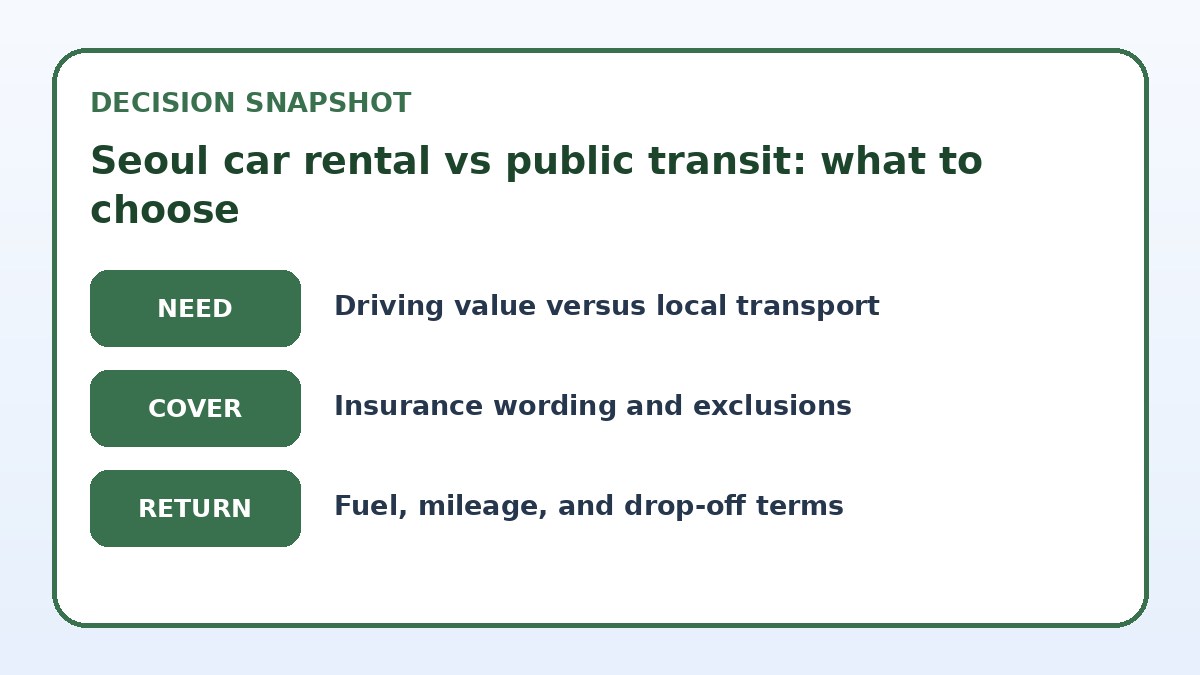
Route value: when driving actually improves your Seoul itinerary
Start by mapping your planned destinations and comparing door-to-door times for driving versus public transport. In central Seoul areas like Gangnam, Hongdae, Itaewon, and Jongno, the subway is typically faster during peak hours because it avoids surface congestion and parking hunts. Driving adds time for parking, payment, and walking from lots to sites. By contrast, if your days include several widely separated stops in Gyeonggi-do, the West Sea coast, or mountain parks where direct trains or frequent buses don’t exist, a car can save time and let you reach remote spots on a flexible schedule. Consider how many kilometers between stops, whether you’ll carry gear, and whether roads to your destinations are straightforward or narrow and winding.
Also weigh timing and season. Night travel, early-morning departures, or visits to places with limited public schedules shift the balance toward driving. If your itinerary requires arriving before the first train or staying late after the last bus, a car removes those constraints. But factor in Seoul traffic patterns: congestion can be heavy during weekday commutes and large holiday weekends. Compare sample routes in your mapping app both by car and transit at the times you expect to travel so you see realistic durations—the difference will clarify whether the drive adds genuine value or just complexity.
Decide whether driving earns its place
| Mobility strategy | Best for | Cost or friction to check |
|---|---|---|
| Rely on Seoul public transport only | Visitors staying and sightseeing within the metro area with predictable daily routes. | Less flexibility for remote day trips; you avoid parking, rental contracts, and most driving stress. |
| Rent a car for the whole trip | Travelers with multi-day rural or coastal routes and a need for flexible timing and luggage space. | Higher logistics overhead: pickup/return, parking, insurance details, and heavy traffic at peak times. |
| Use taxis and app rides selectively | Short trips, airport transfers, late-night returns, or when transit routes are inconvenient. | Costs can add up compared with transit, and surge/pricing rules vary; you still avoid parking hassles. |
| Hybrid: public transit plus short-term or single-day rental | Visitors who want transit convenience in the city but need a car for one or two specific excursions. | Requires extra planning to schedule the rental days and handle pick-up logistics, but minimizes total driving time. |
Check live rental choices only after the route test
Use the exact driver, dates, pickup point, and return plan to compare current conditions.
Insurance and liability: what rental wording really means for visitors
Insurance language in rental contracts matters because coverage limits, excess amounts, and excluded scenarios change the real cost and risk of driving. Basic collision damage waivers and third-party liability are common, but the named limits and whether theft or glass damage are covered vary by company. For non-Korean residents, check whether your domestic auto insurer or credit card provides supplemental coverage for rentals in Korea; if so, verify the exact intersection with the rental company’s waivers and whether the rental firm requires you to purchase their own protection regardless. Always read the final booking page and the rental agreement PDF to confirm what excess applies, whether roadside assistance is included, and any deductibles you would be expected to pay.
Another frequent issue is driver eligibility wording: minimum age, additional driver fees, international driving permit (IDP) requirements, and whether your home license is accepted. Confirm on the rental provider’s final page whether an IDP is required alongside your national license and whether translation or notarization is necessary. Also check whether cross-border travel is allowed if you plan to cross into nearby countries or territories; many suppliers exclude it. These are contract-level facts that change risk and convenience, so verify them at booking rather than relying on general summaries.
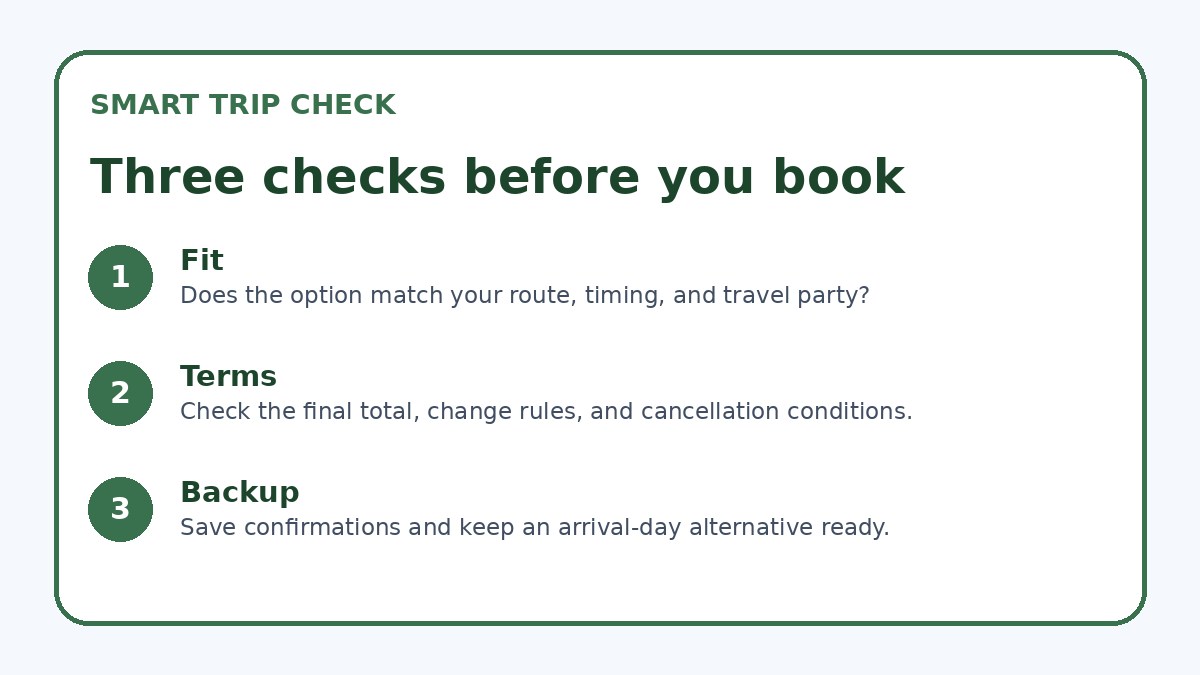
Compare the full rental conditions
Confirm insurance wording, exclusions, deposit, fuel, mileage, and return terms on the final page.
Pickup, parking, and return friction: realistic logistics to expect
Picking up and returning a car in Seoul involves more friction than grabbing a subway pass. Airport counters can be convenient but sometimes require shuttle rides to off-site depots or long check-in waits. City-center pickups may claim curbside convenience but can still require navigation of one-way streets and limited loading zones. Before booking, compare the pickup location address, whether a shuttle or walk is needed, the provider’s documentation and check-in time requirements, and whether after-hours returns are supported. On the booking page, look for clear instructions on where to meet, what forms of ID and payment are accepted, and whether the supplier inspects the vehicle with you and documents existing damage.
Parking is another key cost and time factor. Seoul has paid parking zones and frequent underground lots; rates and enforcement are set by local agencies and lot operators. Some tourist areas have scarce short-term parking, meaning you’ll spend time circling or walking from remote lots. If you plan to use the car for day trips, research parking availability at your intended stopping points—temple complexes, trailheads, and coastal viewpoints often have limited paid lots. Finally, factor in return logistics: returning a car late, with fuel rules or cleanliness expectations, can create extra charges. Verify fuel policies and after-hours return instructions on the final confirmation page.
Car rental terms to verify
- Map each day’s start and end points and compare door-to-door travel time by car and by public transit using a live mapping app.
- On the rental provider’s final booking page, confirm age limits, IDP requirements, covered territories, and declared deductibles or excess amounts.
- Check pickup and return instructions including depot address, shuttle need, operating hours, and after-hours return policy before you confirm.
- Research parking options and likely costs at your accommodation and primary attractions to avoid unexpected daily fees.
- Download local transit apps, arrange a T-money card, and save nearby subway lines and key bus routes as backups.
- If renting for a single day trip, compare local car-rental vs. private driver/van services and confirm cancellation and fuel policies.
Fallback options if you decide not to drive
Designing a non-driving fallback prevents a rental from becoming a sunk-cost headache. Identify the nearest subway station to each accommodation and landmark, note the main bus lines that serve the outer neighborhoods you want to visit, and install a local transit card app or buy a rechargeable T-money card at arrival. For flexible last-mile travel, download a local taxi app or identify reliable taxi stands near major stations. Keep a separate budget for occasional taxis for late-night returns or for carrying luggage between stations and hotels.
For day trips beyond Seoul’s core, research express intercity buses and regional trains that reach popular destinations; many rural sites are served by timed buses even when local transit is sparse. Reserve tickets or check schedules soon enough to ensure seat availability on busy travel days. If you foresee a single multi-stop excursion outside the transit network, consider renting a car just for that day or hiring a licensed driver/van service instead of keeping a rental for your whole stay. This hybrid approach often captures the flexibility of driving while minimizing pickup and parking friction in the city.
Car Rental & Road Trip questions travelers ask
Do I need an International Driving Permit (IDP) to rent and drive in Seoul?
Many rental companies require an International Driving Permit in addition to your national driver’s license, but requirements vary. Before booking, check the rental provider’s final page and the rental agreement PDF for exact documentation rules, including whether translations are accepted. Some countries’ licenses are accepted without an IDP under specific bilateral agreements; confirm whether your nationality is covered. Also verify minimum age and additional driver rules so you don’t arrive without the correct paperwork.
How should I weigh parking costs and availability when deciding whether to rent?
Parking affects both budget and daily convenience. Identify likely parking locations near your hotel and main attractions and check their payment methods and typical occupancy—some areas have many coin-operated lots, while others rely on scarce metered street spaces. Account for overnight hotel parking charges and any restrictions on large lots. If you’ll spend most days inside subway-served neighborhoods, you’ll likely avoid these fees; when planning rural drives, factor parking into the total door-to-door time and expense estimates.
If I don’t rent, how can I handle late-night or remote transfers safely?
Prepare a short list of taxi apps and the phone numbers of reputable local taxi companies; install and set up the apps before you need them. Identify the nearest subway station to each accommodation and note the subway’s last train time for your return nights. For remote transfers, consider booking a private transfer in advance or checking scheduled bus departures—reserve seats if possible. Keep compact cash and a digital map offline in case of connectivity limitations, and share route or driver details with someone you trust for added safety.
Final decision note
Most first-time visitors to Seoul are best served by public transit for daily sightseeing: it’s efficient, widely available, and avoids the friction of parking and rental contracts. Choose a rental when your plan clearly includes multiple remote sites or irregular hours that transit can’t accommodate; otherwise consider a hybrid approach—use transit in the city and rent a car for targeted day trips. Whatever you decide, confirm insurance language, pickup/return logistics, and paperwork on the provider’s final booking page. Plan a non-driving fallback that lists nearby stations, key bus lines, and a taxi option so your travel remains smooth even if plans change.
Continue planning
Check current options and final conditions
Use the provider page to confirm live availability, the final total, cancellation terms, and every condition that matters to your trip.
This evergreen planning guide was created with AI-assisted drafting and a structured quality review. It does not display live prices, schedules, availability, visa guidance, or provider rankings. Verify current details before booking. Some links are affiliate links; we may earn a commission at no additional cost to you.