Decide right away: if your Las Vegas trip hinges on hauling extra suitcases, cameras, or equipment to locations outside the Strip, renting a car usually improves flexibility — but only if you check fuel and mileage rules first. Cars give you direct door-to-door access to trailheads, Hoover Dam sides, or scattered hotel pickups, and they spare you multiple rideshare fees. However, unexpected mileage caps or refueling policies can erase savings and add friction at drop-off. This guide tells you which fuel and mileage contract terms matter most, how extra luggage affects vehicle choice and fees, and what to verify on the rental provider’s final booking page before you commit.

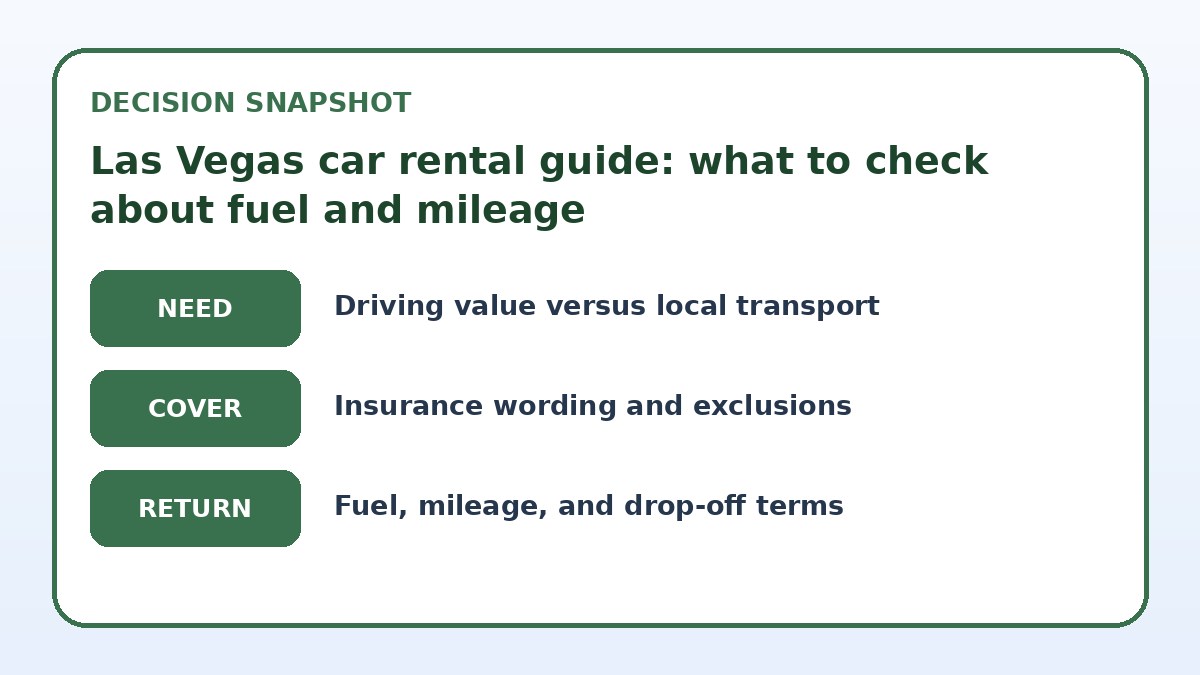
Does driving add value for travelers with extra luggage?
Driving adds clear value when your schedule includes multiple stops outside central Las Vegas or when you’re transporting bulky gear that would be expensive or awkward on taxis or rideshares. Consider how many pick-ups and drop-offs you’ll do each day, whether your itinerary includes early-morning or late-night departures, and whether you’ll need room for carry-on bags plus specialty items like golf clubs, musical instruments, or photo equipment. For door-to-door trips with unpredictable timing, a rental can be more reliable and sometimes cheaper than repeated rideshare trips once you factor in time and convenience.
On the other hand, if your plans revolve around the Strip, short transfers between nearby casinos, or a single airport transfer, driving may add unnecessary complexity: parking fees, navigation stress, and refueling rules can outweigh benefits. Think beyond trunk space: hauling heavy or oddly shaped luggage can affect fuel consumption and may push you into a larger vehicle category with different mileage rules. Decide by mapping your typical day: if multiple mid-length drives or out-of-town destinations appear, driving likely helps; if not, consider non-driving options.
Decide whether driving earns its place
| Mobility strategy | Best for | Cost or friction to check |
|---|---|---|
| Rent a larger car for the whole trip | Travelers needing consistent cargo space and autonomy for day trips beyond Las Vegas | Higher daily rates, possible stricter mileage rules, and larger fuel consumption with potential refueling penalties |
| Rent compact for city days, book a separate larger car only for multi-stop days | Those with mixed itineraries who value cheap city parking but occasional heavy-haul capacity | More pickups/returns and potential drop-off fees; coordinate luggage transfers between vehicles |
| No car: use rideshares, shuttles, and local deliveries | Visitors staying mostly on the Strip or with minimal day trips who dislike parking and refueling duties | Can become expensive for frequent or long-distance trips and awkward for bulky luggage or fixed schedules |
| Hybrid: one-way rental or short-term hire for specific excursions | Travelers who need a vehicle only for planned longer drives like Hoover Dam or desert outings | Requires careful timing and coordination; one-way fees or mileage limits may still apply |
Check live rental choices only after the route test
Use the exact driver, dates, pickup point, and return plan to compare current conditions.
Fuel policies and how extra luggage influences costs
Fuel policies vary and are one of the biggest ways extra luggage can change the math. The two common models are full-to-full, where you return the car with the same fuel level, and pre-purchase, where you pay for a tank up front. Full-to-full is usually fair if you refuel yourself at a nearby station before return; pre-purchase can be convenient but often charges you for unused fuel. Heavy or wind-resistant loads can increase fuel use, so estimate additional consumption if you’re carrying bulky items and factor that into whether pre-purchasing is worth it.
When comparing offers, verify the provider’s exact refueling charge formula on the booking page: per-gallon replacement at retail price, flat penalty fees, or administrative surcharges. Also look for clauses about returning the car with the fuel cap open, wrong fuel type, or evidence of towing or roof-rack use—these can trigger extra fees. If you anticipate frequent short hops, fuel consumption may be higher due to city driving; for longer highway drives, mileage rules matter more than fuel policies.

Compare the full rental conditions
Confirm insurance wording, exclusions, deposit, fuel, mileage, and return terms on the final page.
Mileage allowances, limits, and wording to check
Mileage rules are another decisive factor for trips leaving the metropolitan area. Some rentals include unlimited mileage, which removes worry when you plan day trips to Red Rock, Valley of Fire, or Hoover Dam. Other contracts set a daily or trip mileage cap with per-mile charges for overage; those can be substantial if you underestimate your route. Look carefully at how the provider defines the mileage period—calendar day, 24-hour blocks, or per-rental—and whether any mileage included resets at each rental day or accumulates.
Pay attention to wording about cross-border travel, one-way rentals, and region-based restrictions; mileage allowances might change if you cross state lines or return the vehicle to a different location. Also check procedures for documenting odometer readings at pickup and return; disputes over mileage are easier to resolve when you record the initial reading and confirm it on the rental agreement. The final booking page should state per-mile overage charges and any caps clearly—if it doesn’t, ask the agent and get confirmation in writing.
Car rental terms to verify
- Record the odometer reading and fuel level on the rental agreement and take photos at pickup to prevent mileage and fuel disputes.
- Confirm whether the rental uses full-to-full fuel, pre-purchase options, or charges per-gallon replacement and note the exact return fuel-level requirement.
- Read the mileage section for daily caps, per-mile overage fees, and any geographic or cross-border restrictions that could change the allowance.
- Verify insurance wording for personal effects and roof-rack or towing coverage; check your credit card’s rental insurance terms for baggage protection.
- Ask where the nearest refueling stations are to the return location and confirm whether off-site drop-off has special fuel or administrative charges.
- If carrying oversized luggage, request vehicle dimensions or trunk capacity and ask whether roof boxes or rack use will change fees or coverage.
Insurance, pickup/return friction, and a non-driving fallback
Insurance wording is crucial when carrying valuable or fragile luggage. Basic rental coverage often excludes damage to personal effects; check whether the rental company’s waivers or your credit card insurance cover items in the cabin or trunk. Read the conditions for loss or damage to luggage, roof boxes, or installed racks; some policies void coverage if you exceed vehicle load limits or use non-approved mounting. Before driving off, take time to photograph the vehicle’s condition and storage areas—this reduces disputes at return and helps when filing claims.
Pickup and return friction can erode driving benefits: airport counters, off-site shuttles, and long queuing times add stress, especially when you have extra bags. Ask about curbside baggage assistance, overnight drop-off procedures, and where to refuel nearby. If driving looks like too much hassle, plan a fallback: combine a one-way airport transfer with local rideshares or shuttles for short hops, or reserve a larger vehicle for only the days you need it while using hotels and pickups for other days. Trip.com can be used to compare current vehicle availability and booking terms, but always verify fuel and mileage clauses on the provider’s final page before you book.
Car Rental & Road Trip questions travelers ask
Will excess luggage affect fuel surcharges or mileage charges on my Las Vegas rental?
Excess luggage can increase fuel consumption, which matters if you prepay for fuel or if fuel penalties are assessed at return. It usually does not directly change mileage allowances unless the rental company classifies vehicle use differently when roof racks, trailers, or heavy loads are present. Some providers include clauses that void certain waivers or impose additional fees for roof-rack use or towing, so check the final booking page for wording about cargo equipment and load limits. If in doubt, ask the agent to confirm whether your gear requires a different vehicle class.
How do I avoid surprise refueling fees when returning the car in Las Vegas?
To avoid surprises, choose full-to-full where possible and refuel at a nearby public station before return; keep receipts if you refuel just before drop-off. If you buy fuel from the rental company, understand how they calculate charges—often higher than retail rates—and whether you'll be refunded for unused fuel. Also confirm whether the provider inspects fuel level visually or via the fuel gauge, and whether administrative charges apply for missing the agreed level. The final booking page should state the refueling policy; if it’s unclear, request written clarification.
What mileage limits should I expect for common day trips from Las Vegas?
Mileage limits vary by company and vehicle category; some rentals include unlimited mileage while others set daily caps. For common day trips—Red Rock Canyon, Valley of Fire, or Hoover Dam—calculate round-trip distances and add buffer for local driving. If your planned excursions exceed the daily allowance or accumulate over the rental period, per-mile overage fees can add up quickly. Always confirm the per-mile charge for overage on the booking page and note whether mileage resets daily or applies to the entire rental period; document the odometer at pickup to avoid disputes.
Final decision note
For travelers carrying extra luggage in Las Vegas, the practical choice depends on where you plan to go and how often you’ll move your bags. If your itinerary includes multiple out-of-town drives or early departures, a rental with generous cargo space and clear unlimited or high-mileage allowances will reduce stress. If most activities are on the Strip or you prefer to avoid parking and refueling chores, use local transfers and rent a vehicle only for specific excursions. Before booking, verify fuel return rules, mileage caps and overage rates, insurance wording for personal effects, and any cargo-related fees on the provider’s final booking page to avoid surprises.
Continue planning
Check current options and final conditions
Use the provider page to confirm live availability, the final total, cancellation terms, and every condition that matters to your trip.
This evergreen planning guide was created with AI-assisted drafting and a structured quality review. It does not display live prices, schedules, availability, visa guidance, or provider rankings. Verify current details before booking. Some links are affiliate links; we may earn a commission at no additional cost to you.