If you’re arriving in Rome with several large suitcases or bulky items, the practical choice often comes down to how much you value convenience, cost control, and door-to-door ease. For most travelers whose top priority is minimizing handling and walking with heavy bags, a private transfer (prebooked taxi or shuttle) usually wins for ease; public transport can work well if you’re traveling light enough to manage stairs, transfers, and platform gaps. This article walks you through the decision criteria so you can pick what matters most for your trip: time at the airport, how many times you’ll change vehicles, luggage handling, and your budget flexibility. Read the quick points, then use the checklist and comparison grid to choose confidently and verify final details on the provider’s booking page before you confirm.
See current options before you compare the details
Availability and final conditions change. Open Trip.com now or keep reading for the practical comparison.
Assess your luggage and mobility needs
Start by taking an inventory of what you’re bringing and who’s traveling. Count hard suitcases, soft bags, carry-ons, and any odd-sized items like sports equipment or child seats. Note who will carry or wheel the luggage—travelers with limited mobility, small children, or solo travelers with multiple heavy suitcases will face different tradeoffs than a pair sharing the load. Also consider whether you plan to leave large bags at your accommodation later that day or will need easy access to items during a multi-stop itinerary.
Next, evaluate how comfortable each traveler is with stairs, cobbled streets, and public-transport transfers. Rome’s historic center has many streets that are uneven and not always wheelchair- or suitcase-friendly; metro stations and suburban rail stops may require stairs or elevators whose availability you should verify. If you’ll be moving between terminals or platforms, add extra time. Once you know the number and size of bags and the travelers’ mobility, you can better compare whether a single private vehicle or multiple public legs make sense.
Practical advantages of private transfers
Private transfers reduce the physical effort of travel: drivers load and unload luggage, pick you up inside or at specified meeting points, and deliver you to your building’s door or lobby. This eliminates corridor maneuvers, multiple platform changes, and lifting between bus ramps and train cars. For groups, families, or travelers with oversized sports equipment or instruments, a prebooked van or taxi can be arranged with the right capacity, which simplifies arrivals and departures and makes tight schedules or early-morning flights much less stressful.
However, private service requires careful prebooking choices. Confirm the vehicle category and the provider’s luggage policy on the final booking page—how many suitcases fit, whether extra fees apply for oversized items, and precisely where pickup occurs (inside arrivals, curbside, or a designated meeting point). Also check cancellation and waiting-time terms so you don’t face surprise charges if flights are delayed. Use Trip.com or the provider’s site to compare current availability, but always verify final vehicle specs and pick-up instructions before paying.
| Approach | Best for | Tradeoff to check |
|---|---|---|
| Prebooked private transfer (car or van) | Travelers with many or oversized bags, families, or those valuing door-to-door ease | Higher upfront cost; must confirm vehicle size and luggage limits before booking |
| Taxis from airport ranks | Small groups or single travelers seeking direct travel without prebooking | Potential waits, variable luggage space, and possible extra charges for large items |
| Airport express train or shuttle | Light packers going directly to major stations with a short final leg | May require transfers and handling of bags on platforms and during crowds |
| City metro and local buses | Budget-conscious travelers with small, manageable luggage and flexible timing | Stairs, crowds, and uneven streets can make this the most physically demanding option |
Ready to check the option that fits your plan?
Use your exact dates and traveler details so the provider page can show the current total and conditions.
What to expect with Rome public transport
Rome’s public options—regional trains, city metro, buses, and airport shuttles—can be very efficient for lighter packers and those on a tighter budget. Trains and express shuttles connect major airports to central stations, and from there you can transfer to metro lines or buses heading closer to your hotel. Public transport is typically frequent, but you should plan for walking between platforms, potential stair climbs, and negotiating crowds at busy stops. During peak hours, space for large suitcases on trains and buses can be limited, so traveling outside rush hours or choosing less crowded services helps.
To use public transport effectively with extra luggage, plan the full door-to-door sequence. Map out station entrances, elevator or escalator availability, and any last-mile walk from the final stop to your accommodation. Check whether your hotel is near a metro station or requires a taxi for the final stretch; sometimes a hybrid approach—public transit to a central station, then a short taxi—balances cost and convenience. Always verify ticketing rules and how to validate or buy passes before boarding to avoid fines.
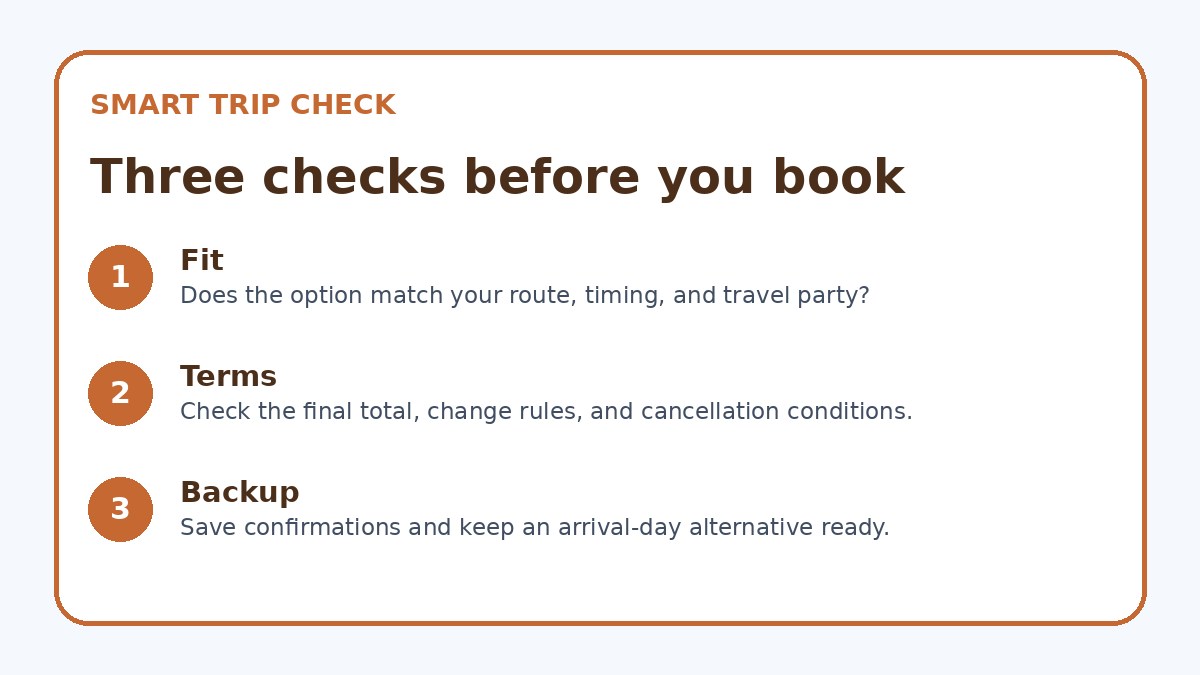
Before you book
- Count all bags and measure the largest one; compare against vehicle luggage capacity listed on the provider’s booking page.
- If choosing private, confirm exact pickup point, driver contact method, and waiting-time policy before finalizing the booking.
- If choosing public transport, map elevator/escalator locations and the step-free route from the airport to your hotel.
- Check service frequency for your arrival hour and account for possible delays when estimating door-to-door time.
- Ask providers about oversized item fees or extra-suitcase charges and get any size/weight limits in writing on the booking page.
- Have a backup plan: know nearby taxi ranks and an approximate taxi route from the airport to your neighborhood in case scheduled options fail.
How to compare total cost, time, and stress
When deciding, compare total door-to-door time, not just the scheduled duration of individual legs. For private transfers, estimate the time from baggage claim to the vehicle to your hotel door, including possible waiting time for the driver and parking access. For public options, add walking time between platforms, expected waits for the next connection, and the last-mile walk. If you have a tight schedule or early/late flights, factor in service frequency and whether public transport runs at the hour you need it.
Evaluate stress and hidden effort as part of the cost. A cheaper public route may mean multiple lifts, crowded platforms, and heavy-handed baggage handling—especially with long cobbles and steps. Conversely, a private transfer’s higher outlay can be offset by saved time and reduced physical strain, which may be worth it for senior travelers, families, or anyone with oversized luggage. Make the choice by weighing real-world handling and transfer complexity alongside monetary cost, and confirm all operational details on the provider booking pages before making a commitment.
Frequently asked questions
Can I take oversized sports equipment or instruments in a private transfer to Rome city center?
Yes, many private transfer vehicles can accommodate oversized items, but this varies with vehicle type and provider. Before booking, check the vehicle category and the provider’s stated luggage policy on their final booking page. If you need a van or estate car rather than a sedan, request that explicitly. Also confirm whether carriers or tie-downs are provided and whether any additional fees apply for non-standard items. If the provider’s site is unclear, contact them directly and get written confirmation.
Is it cheaper to take public transport with heavy luggage into Rome?
Public transport can be less expensive in fare terms, but cost alone doesn’t reflect physical effort, time, or the risk of damage to luggage. With heavy or multiple bags you may face stairs, crowded platforms, and last-mile carries that increase stress and time. To decide, estimate door-to-door time and the value of your time and comfort. Sometimes a short taxi from a central station after a cheap express shuttle offers a good compromise—compare that total against a single private transfer’s price and convenience.
How do I verify that my chosen private transfer will have enough room for luggage?
On the provider’s final booking page, look for specific vehicle dimensions, allowed number of suitcases, and any statements about oversized items. If only ambiguous categories are shown (e.g., 'standard sedan' or 'minivan'), contact the company to request exact capacity or a vehicle model. Ask about whether child seats or extra equipment will reduce luggage space. Keep written confirmation—email or booking notes—so the driver cannot claim insufficient capacity on arrival.
Final planning note
Choosing between public and private transport for a Rome airport transfer when you have extra luggage is a tradeoff between money, time, and effort. Private transfers minimize handling, door-to-door walking, and transfer complexity—advantages that matter most for families, travelers with mobility limits, or oversized items. Public options can be more economical if you can handle stairs, platform changes, and cobbled streets, or if you combine them with a short taxi ride for the last mile. Use the checklist to confirm luggage limits, pickup points, and service frequency before booking, and verify all vehicle details on the provider’s final booking page. If you want to compare current options quickly, Trip.com is one place to check availability, but always confirm specifics with the supplier.
Continue planning
Check current options and final conditions
Use the provider page to confirm live availability, the final total, cancellation terms, and every condition that matters to your trip.
This evergreen planning guide was created with AI-assisted drafting and a structured quality review. It does not display live prices, schedules, availability, visa guidance, or provider rankings. Verify current details before booking. Some links are affiliate links; we may earn a commission at no additional cost to you.