If you’re traveling solo between Prague and Vienna, the practical choice usually centers on a direct daytime train or a fast coach—both minimise transfers and allow you to walk between city-centre terminals. Start by matching your priorities: door-to-door simplicity, predictable luggage handling, flexible timing, or the lowest number of unknowns in case of disruption. Trains often win for comfort and straightforward city-centre terminals, while coaches can be cheaper and have more evening departures. Combining modes (for example, a regional bus to a main rail hub) can make sense if you need a particular departure time or lower cost, but adds transfer friction and extra planning. Below you’ll find the quick answer, the tradeoffs to weigh, how to check specifics when booking, and a simple contingency plan to keep your trip moving if something goes wrong.
Terminal fit and door-to-door practicality
Where you start and finish matters more than the in-vehicle experience for a solo traveler. Prague’s main long-distance departures and Vienna’s principal arrivals are usually in central stations that connect easily to public transport, hotels, and taxi ranks. That central fit reduces last-mile stress: you can walk, take a short tram, or use a direct metro connection rather than arranging lengthy airport transfers. When comparing options, confirm the exact pick-up and drop-off points—some coach services use peripheral bus stations while major trains arrive in the heart of the city. For door-to-door practicality, lean toward options that minimise intermediate transfers and keep you inside familiar, easily navigable terminals.
Luggage handling is part of terminal fit. Trains typically allow you to keep bags with you or store them in obvious onboard racks, while coaches sometimes require loading into underfloor compartments and reclaiming at a shared bus terminal. If you’re travelling with a single carry-on or want to avoid repeated bag checks, that matters. Also check whether either terminal requires a long walk or an additional shuttle—especially late at night when public transport frequency drops. Make a short map-based check before you book to compare walking distances between your planned accommodations and the arrival terminal.
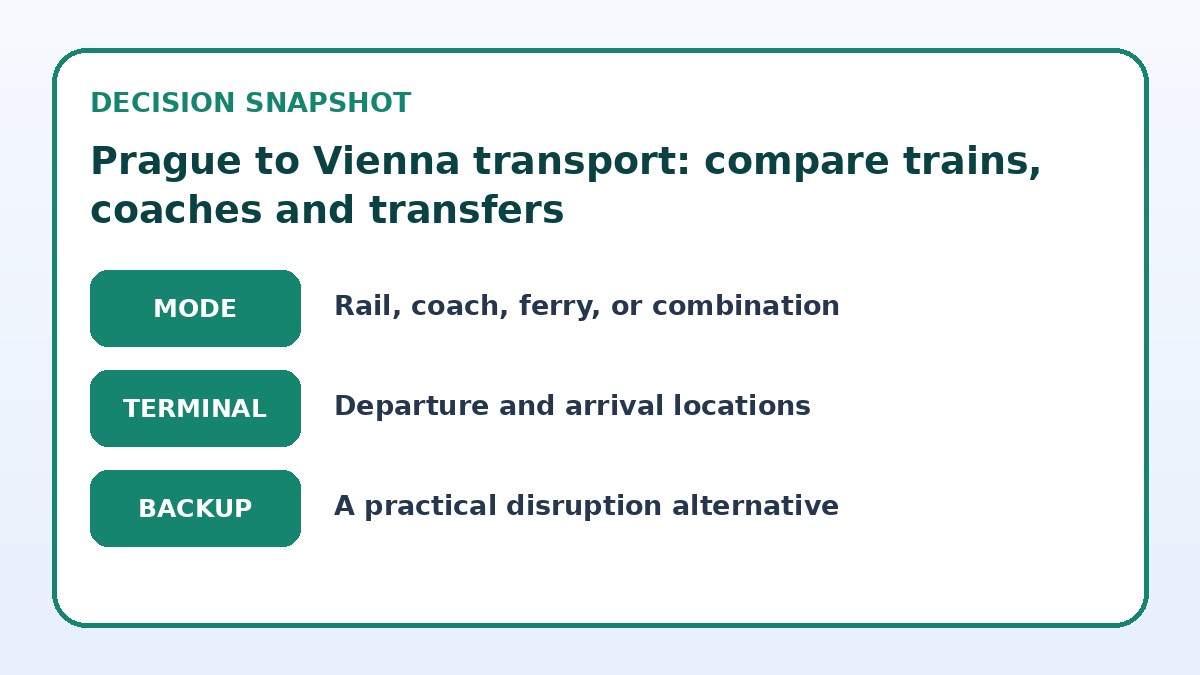
Choose the end-to-end journey plan
| Journey approach | Best for | Friction to check |
|---|---|---|
| Direct daytime train | Solo travelers prioritising simplicity, central stations, and low transfer counts | May have fewer late-night departures and sometimes higher base fares than basic coaches |
| Intercity coach | Those wanting more evening options or potentially lower-cost single-seat tickets | Can use peripheral bus stations and add luggage unloading/loading steps |
| Mixed-mode (regional bus + train) | Travelers matching specific timing needs or reaching smaller towns en route | Adds transfers and greater risk of missed connections without extra buffer time |
| Flexible backup-first planning | Solo travelers who accept slightly higher cost for guaranteed flexibility and fewer surprises | Typically requires checking multiple providers and possibly paying for refundable or open tickets |
Check live intercity options
Look beyond the ride itself and compare terminals, transfers, luggage, and arrival fit.
Luggage and transfer friction for solo travelers
Solo travelers should measure friction by counting physical moves: how many times you’ll lift, carry, or re-check a bag. Direct trains usually require the fewest such moves: you board, stow, and step off near exits that lead straight to taxis or metro lines. Coaches can add friction if they use out-of-centre terminals or impose strict luggage rules; you may need to wait while luggage is unloaded and reloaded. If you’re carrying heavy gear or valuable items, factor in how comfortable you feel managing them alone—choose direct, city-centre arrivals and departures when convenience and personal control matter most.
Transfer friction also includes time spent navigating unfamiliar stations and purchasing last-minute tickets. With trains, you can often reserve a seat and travel with a single booking reference; with mixed or budget coach options, you might face multiple tickets or separate provider sites. When connections are involved, plan at least 45 minutes for short transfers and closer to 90 minutes for more complex cross-station changes. Carry a portable charger, a small lock for your bag, and a printed or screenshot backup of any bookings to reduce stress when moving between modes.
Timing flexibility and how to compare schedules
Timing flexibility is where coaches sometimes outshine trains: more evening departures and staggered low-cost options can suit late arrivals or unpredictable schedules. Trains, conversely, tend to have clearer intervals during daytime peak travel hours and often more reliable journey times because they avoid motorway congestion. To compare schedules, list the departure windows that would suit your itinerary and then check both rail and coach options for those windows. Note any overnight or very early services—if you’re solo and arriving in a new city late at night, weigh the safety and accessibility of the arrival terminal and ground transport options.
When comparing direct and connecting services, don’t assume shorter advertised journey time equals lower door-to-door time. A faster train that arrives at a less convenient peripheral station or requires a long wait for local transit may feel slower in practice. Always simulate the complete trip: add estimated transfer time from arrival station to your accommodation, include likely wait times at night, and confirm last-mile public transport schedules. For real-time checks, verify schedules on operator booking pages or comparison sites like Trip.com, and read the provider’s terms about seat reservations and carriage of bicycles or large luggage.
Compare the practical alternatives
Use the final page to confirm what is actually offered on your dates and save a workable fallback.
Intercity travel checklist
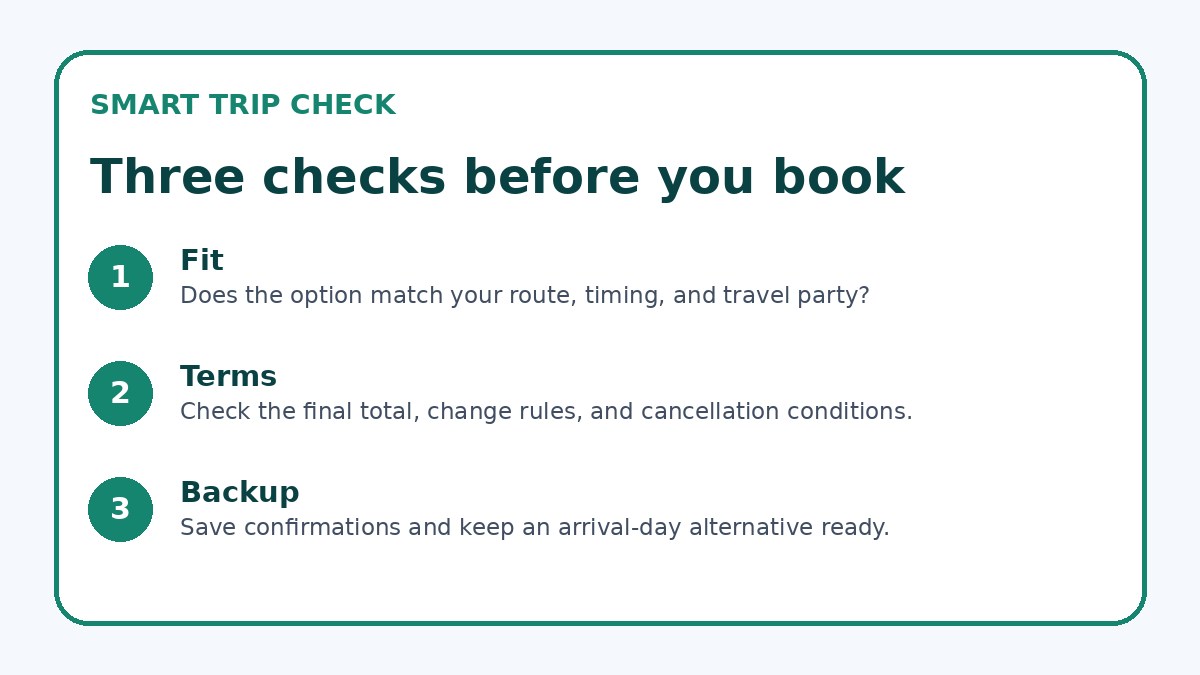
- Confirm the exact departure and arrival terminal addresses and map the walk or public-transit route to your accommodation.
- Check luggage rules and limits on both trains and coaches and plan packing so you can handle your bags alone.
- Compare total door-to-door time by adding estimated transfer times and local transit waits to the advertised journey time.
- Book a seat reservation if available and important to you, and screenshot the confirmation to access offline.
- Identify two later departures by train and coach as contingency options and note taxi/rideshare estimates between terminals.
- Verify refund, exchange, and disruption policies on the provider’s final booking page before committing to non-refundable tickets.
Disruption backup and last-resort options
Even on well-served European corridors, disruptions happen. Your backup plan should be simple: identify the next two departure options by train and coach and note a reliable taxi or rideshare route between stations. Keep an eye on the provider’s disruption notifications after booking, and set calendar reminders with departure details and a two-hour pre-departure check. If a connection is missed, avoid immediate panic purchases—compare the next scheduled train, the next coach, and the approximate taxi cost for the remaining leg. A short paid taxi for the final 30–60 minutes can be a pragmatic solo-traveler solution when replacing a missed service.
Also prepare documentation you might need when plans change: screenshots of bookings, a printed itinerary, and copies of contact phone numbers for your accommodation and the operator’s helpdesk. If you decide to buy a last-minute ticket, use the operator’s official booking page where possible so you have a verifiable record. In many cases, staying flexible with your departure time and choosing central terminals reduces the number of backup moves required and keeps you in safer, better-staffed environments should you need assistance.
Rail & Intercity Transport questions travelers ask
Is it safer for a solo traveler to take the train or the coach between Prague and Vienna?
Both trains and coaches operate on well-travelled international routes and are generally safe for solo travelers. Safety differences depend more on arrival time and terminal location than vehicle type: central train stations offer better staffing and late-night public transport links in many cities, which can feel safer than remote bus terminals. Choose daytime departures when possible, keep valuables on your person, and use staffed ticket counters or official operator apps. Also check local advice about late-night transit and have a trusted ride option for the final leg if you arrive after regular public transport hours.
How much buffer time should I leave between a connecting regional bus and a mainline train when travelling alone?
For a solo traveler, plan generously: allow at least 45 minutes for short, same-station connections and 60–90 minutes if you must change stations or navigate complex terminals. This accounts for delays, luggage movement, and time to find platforms or bus bays. If you’re unfamiliar with the stations, add extra time to orient yourself, buy any necessary tickets, and use restroom or refreshment breaks. When possible, choose connections on the same ticket or provider to simplify rebooking if a delay occurs.
What should I verify on provider booking pages before finalising a Prague–Vienna trip?
Before you complete a booking, verify the exact terminal names and addresses, luggage allowances and any special handling requirements, seat reservation details, and the provider’s disruption or refund policy. Confirm whether the fare includes reserved seating or requires on-board payment for extras. If you rely on a mobile ticket, check whether paper printing is accepted as a backup. For combinations of providers, ensure each leg’s terms are clear and note contact numbers for help; Trip.com can be used as one comparison tool, but always check the operator’s final page for current conditions and booking terms.
Final decision note
For most solo travellers, a direct daytime train between Prague and Vienna offers the best blend of door-to-door practicality, low transfer friction, and predictable luggage handling. Choose coaches when time-of-day options or cost considerations outweigh station convenience, and use mixed routes only when schedule constraints make them necessary. Whatever you select, plan the full door-to-door journey: map terminals to accommodation, account for luggage moves, and set a simple disruption backup with the next departures and a taxi alternative. Verify terminal locations, luggage rules, seat reservations, and refund policies on the provider’s booking page before you pay, and carry screenshots or printed copies to keep your solo trip smooth and manageable.
Continue planning
Check current options and final conditions
Use the provider page to confirm live availability, the final total, cancellation terms, and every condition that matters to your trip.
This evergreen planning guide was created with AI-assisted drafting and a structured quality review. It does not display live prices, schedules, availability, visa guidance, or provider rankings. Verify current details before booking. Some links are affiliate links; we may earn a commission at no additional cost to you.