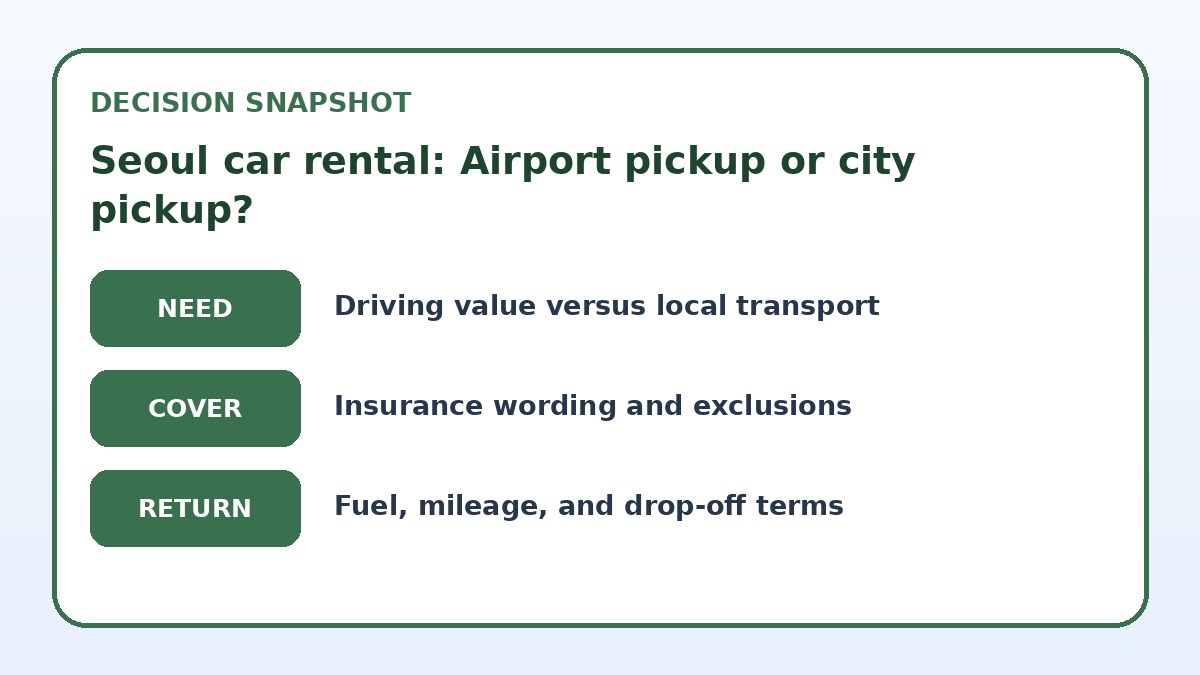
For most business travelers, the core question is simple: will having a car improve your Seoul itinerary enough to justify the time and paperwork it adds? If you plan multiple meetings across the metropolitan area, late meetings that run after public transit, or day trips to outskirts and nearby tech parks, driving can be a clear efficiency win. Conversely, if your schedule keeps you inside central Seoul — Gangnam, Jongno, Yeouido — heavy traffic, limited parking and plentiful subway and taxi options often make a rental more burden than help. This article gives the practical answer up front, then walks through route value, insurance wording to verify, pickup and return friction at airport versus city desks, plus solid non-driving fallbacks so you can finalize the booking with confidence.
Route value: when driving actually helps your schedule
Start by mapping the locations you must visit and timing constraints. Driving pays when your day links locations poorly served by the subway, when you need to transport bulky material or samples between sites, or when meetings run late into the night and taxis or late-night transit become limited or costly. For single-district itineraries with back-to-back downtown meetings, the subway often beats driving because it avoids rush-hour gridlock and parking searches.
Evaluate the marginal time saved versus the hassle: airport pickup saves the transfer from airport to city but may add check-in and inspection time; city pickup avoids airport queues but may require a taxi or subway ride to the rental office. For day trips outside Seoul (e.g., Incheon outskirts, Gyeonggi business parks), a car can shave hours from door-to-door journeys. Create a simple spreadsheet of door-to-door times for public transit, taxi, and driving for each meeting cluster to visualize where a rental is worthwhile.
Decide whether driving earns its place
| Mobility strategy | Best for | Cost or friction to check |
|---|---|---|
| Airport pickup and full-use car | Business travelers with out-of-city meetings or heavy luggage | Faster start after arrival but expect longer pickup queues and more inspection time |
| City pickup near your hotel for as-needed driving | Stays centered in Seoul who want a car only for specific days | Avoids airport wait but requires short transit to the office and smaller vehicle choice |
| No rental: subway plus taxis for all city movement | Back-to-back downtown meetings inside central districts | Lowest friction and parking hassle but limited for multi-district or late-night trips |
| Hybrid: short-term rental only for day trips | Those needing a car intermittently for specific off-site meetings | Gives flexibility with less paperwork overall but requires coordination of pickup/return windows |
Check live rental choices only after the route test
Use the exact driver, dates, pickup point, and return plan to compare current conditions.
Insurance wording: what to verify on the booking page
Insurance terminology varies; don’t rely on marketing blurbs. On the provider’s final booking page check exactly what the Collision Damage Waiver (CDW) covers, whether theft protection is included, and what the deductible (excess) amount is for collisions, theft, and glass or undercarriage damage. Confirm whether damage caused by third parties, single-vehicle accidents, or driving outside certain administrative boundaries is excluded. If you plan to use credit-card insurance, verify that the car category and countries are eligible and whether the rental company requires declining their own coverage first.
Also check driver qualifications and age limits, any named-driver fees, and written rules about tolls, parking fines, and traffic violations. Ask whether roadside assistance is included and which response times to expect; find the emergency phone number on the booking page. If a company mentions 'full coverage' or 'zero excess' in marketing copy, open the fine-print and ensure it lists specific covered items and clear exclusions on the checkout page before you finalize your reservation.
Compare the full rental conditions
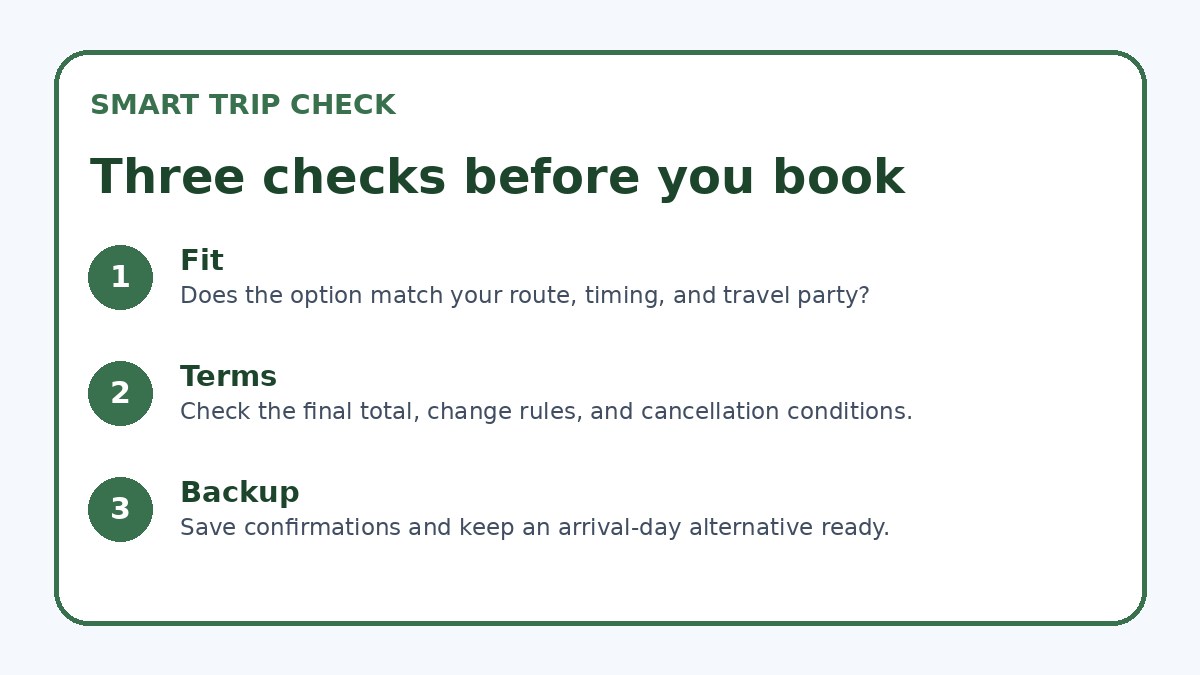
Confirm insurance wording, exclusions, deposit, fuel, mileage, and return terms on the final page.
Pickup and return friction: airport vs city desks
Airport pickup often feels convenient because the desk is near arrival and you can collect the car before heading into the city. But airport counters usually handle heavier traffic, so expect longer queues and vehicle inspection procedures that add 20–45 minutes even after immigration. Verify the provider’s shuttle arrangements, the exact terminal desk location, and whether staff can meet you at arrivals. At busy international arrival times, arrange a timed pickup or call ahead to avoid sitting in a rental line when you’d rather be en route to meetings.
City pickup avoids the terminal crowds and can be faster if the office is near your hotel, but it usually requires an extra short taxi or subway ride and may have smaller fleets so your preferred car class might be unavailable. Returns mirror those tradeoffs—airport return is convenient if you’re catching a flight the same day, but include buffer time for airport traffic and long car return queues. For both pickup types, confirm the company’s office hours, after-hours return procedures, and any airport or city surcharge that appears on the provider’s checkout page.
Car rental terms to verify
- Map all meeting addresses and estimate door-to-door times using driving, taxi, and subway for each trip.
- Open the rental provider’s final booking page and copy the exact insurance wording, deductible amounts, and exclusions.
- Confirm pickup and return office hours, after-hours procedures, and whether an airport shuttle or terminal desk is used.
- Check driver-age limits and any additional driver fees; ensure your license (and international permit if needed) meet requirements.
- Plan buffer time for airport pickup/return and potential rush-hour delays on routes between meeting locations.
- Arrange a reliable non-driving fallback (subway routes and taxi app) and pre-book transfers for critical airport or late-night legs.
Non-driving fallback: rely on Seoul’s transit and taxi network
Even if you plan to rent, build a reliable fallback. Seoul’s subway network covers most central business districts rapidly and predictably during peak hours; taxis are plentiful for point-to-point hops or late-night trips. For short intracity journeys, an app like Kakao T (or equivalent) gives easy dispatch and fare-estimates. Use the subway for fixed, tight schedules and taxis when flexibility or door-to-door service matters, and always factor in extra time for rush-hour road congestion.
If you're carrying equipment or expecting unpredictable meeting end times, consider combining modes: pick up a rental only for specific day trips and use transit otherwise. If you prefer to avoid driving altogether, arrange corporate car services for critical transfers and use ride-hailing or the subway for meetings inside central Seoul. Before canceling a reservation, check the provider’s cancellation terms on the booking page; some bookings may have fees or require notice to avoid penalties.
Car Rental & Road Trip questions travelers ask
Is driving in Seoul significantly harder for foreign business visitors?
Seoul driving is manageable for experienced drivers but has distinct challenges: heavy rush-hour congestion, frequent short-distance trips across multiple districts, and limited parking in core business areas. Road signage includes English in many places but you may encounter dense traffic patterns and aggressive lane changes unfamiliar to visitors. To reduce stress, choose a compact car, plan routes outside peak commuter corridors when possible, and verify toll rules and electronic toll-payment options on the provider’s booking page. Consider delegating driving when meetings are tightly scheduled or allow for extra time when planning.
Will arriving at Incheon versus Gimpo change the pickup decision?
Which airport you arrive at affects transfer time into Seoul and may change the convenience calculation. Incheon is farther from central districts than Gimpo, so an airport pickup at Incheon can be more attractive if you need a car immediately and have long onward drives. Gimpo is closer to central Seoul and may make city pickup comparatively quicker to reach. Check the rental company’s exact terminal desk locations, shuttle availability, and transfer times on the booking page to make the right call for your specific arrival airport.
How can I confirm insurance and roadside assistance before I collect the car?
Do not rely on summary claims; read the full insurance and roadside assistance sections on the company’s checkout or terms page. Look for explicit coverage lists, deductible amounts, exclusions (like single-vehicle accidents or off-road use), and the contact number for 24/7 roadside assistance. If using credit-card insurance, confirm with your card issuer that the coverage applies to the vehicle class and country and whether you must decline the vendor’s coverage at the counter. Print or save screenshots of the confirmed terms to show the desk agent if there’s any discrepancy at pickup.
Final decision note
For business travelers in Seoul, the decision to rent hinges on the geography of your meetings. If your schedule crosses districts, includes late finishes, or needs moving equipment, airport pickup and a full-use rental typically deliver clear time savings despite longer initial queues. If you remain central and prioritize frictionless movement, city pickup or no rental at all is often smarter—use the subway and taxis for predictable, fast trips. Whatever you choose, verify insurance wording, office hours, pickup and return procedures on the provider’s final booking page, and prepare a non-driving fallback. To compare current availability and options, you can check providers including Trip.com, but always confirm coverage and terms directly with the rental company before booking.
Continue planning
Check current options and final conditions
Use the provider page to confirm live availability, the final total, cancellation terms, and every condition that matters to your trip.
This evergreen planning guide was created with AI-assisted drafting and a structured quality review. It does not display live prices, schedules, availability, visa guidance, or provider rankings. Verify current details before booking. Some links are affiliate links; we may earn a commission at no additional cost to you.