If you’re a first-time visitor heading from Tokyo to Sapporo and want a comfortable long-haul connection, start by deciding whether a direct domestic flight or a routed connection via another airport works best for your priorities. For comfort, prioritize flight duration, seat type, and transfer experience over chasing the lowest fare: look for daytime departures, ample minimum connection time, and airlines that let you select preferred seats. Consider luggage policies, airport transit facilities, and how you’ll get between terminals if a connection involves a separate building. Before you book, verify the carrier’s final baggage allowance, seat map, airport transfer requirements, and any layover terminal changes on the airline or booking page. Trip.com can be one place to compare live availability and connection options, but always confirm the specifics on the airline’s site before finalizing plans.
See current options before you compare the details
Availability and final conditions change. Open Trip.com now or keep reading for the practical comparison.
Direct versus connecting Tokyo–Sapporo options
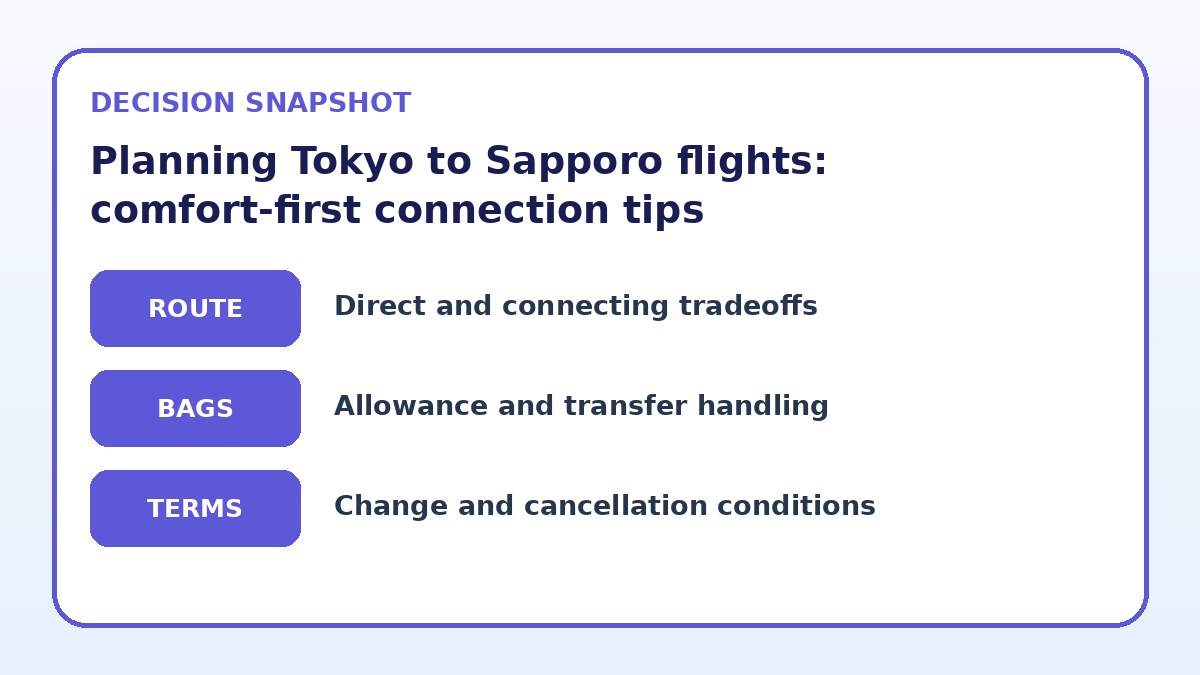
On this route you’ll typically weigh a direct domestic flight against a multi-leg connection. Direct flights minimize stress because you avoid re-clearing security, changing terminals, or rechecking luggage, which greatly reduces the chance of missed connections. If a nonstop option departs at a convenient hour and you can reserve a comfortable seat, this is usually the simplest way to keep the trip relaxed. However, nonstops may offer fewer seat types or less availability for premium seats on short notice, so don’t assume direct always means more legroom or amenities.
Connecting itineraries can be appealing when direct flights don’t line up with your schedule or when you want to combine a stopover in another city. The tradeoff is complexity: every extra segment adds risk and time spent in airports. If you consider a connection, prefer a single-ticket itinerary so the airline is responsible for transfers and misconnects. Check whether your checked luggage will be automatically forwarded or whether you must collect and recheck it—this changes how much time you should allow between flights.
Picking the most comfortable seats and timing
Seat choice has an outsized impact on comfort. For longer travel days or uncertain connections, an aisle seat eases movement for stretching and restroom visits; exit rows or bulkhead seats provide extra legroom but can come with restrictions or no under-seat storage. If you have the option to purchase a preferred or extra-legroom seat, compare the price to the total time spent — a modest upgrade is often worth it for longer transits. When selecting flights, aim for daytime departures to reduce the chance of disrupted sleep and to make airport navigation during layovers easier.
Flight timing also affects connection comfort. A slightly longer layover that gives you time to eat, freshen up, and move between gates is usually preferable to a tight schedule that causes anxiety. Conversely, an overnight layover may force you into booking a hotel if you value uninterrupted sleep, so check how the connection impacts your arrival time in Sapporo. Look at local airport facilities—lounges, quiet zones, and baggage storage—if you anticipate a long wait; some airports let you pay for lounge access even if you’re on an economy fare.
| Approach | Best for | Tradeoff to check |
|---|---|---|
| Direct nonstop flight | Travelers who want the simplest, fastest connection with minimal transfer stress | May have limited schedules or seat options compared with multi-leg itineraries |
| Single-ticket connecting flight | Those prioritizing protected transfers and checked-through baggage | Longer overall travel time but lower risk of losing checked luggage or missing the next flight |
| Independently booked segments | Flexible travelers seeking specific carriers or cheaper individual legs | You assume full risk for missed connections and must recheck baggage between segments |
| Overnight stopover with hotel | Passengers who need rest before continuing to Sapporo for comfort and recovery | Adds time and cost but improves rest and reduces stress on tight transfer days |
Ready to check the option that fits your plan?
Use your exact dates and traveler details so the provider page can show the current total and conditions.
Managing luggage, transfers, and airport logistics
Confirming luggage rules before you book is essential. Baggage allowances, fees, and policies for checked-through transfers differ by carrier and fare class. If you need your bag to be checked through to Sapporo, verify that the airline or itinerary explicitly allows it; if not, plan for the time and effort required to claim and recheck bags. Also verify whether you will need to change terminals or re-clear security—these steps can add 30–90 minutes depending on the airports involved, so build that buffer into your connection planning.
Pay close attention to how you will move between terminals or airports if your connection requires ground transfer. Some airports offer free shuttle buses, while others require public transport or paid transfers. Factor in the time for immigration or customs if your routing involves an international entry point, even if your final destination is domestic. Practically, carry essential items in your carry-on—chargers, medication, a quick-change outfit—so an unexpected delay during a connection doesn’t derail comfort or plans.
Before you book
- Verify on the operating airline’s site that your itinerary is single-ticketed and whether checked luggage will be transferred automatically.
- Confirm the minimum connection time recommended by the carrier and add a 30–60 minute personal buffer for airport navigation.
- Reserve your preferred seat (aisle, extra legroom, or bulkhead) as early as possible to secure comfort during longer travel periods.
- Pack a carry-on with a travel pillow, layered clothing, chargers, essential medications, and snacks for unexpected delays.
- Check terminal maps and ground transfer options between terminals or airports; prebook an airport shuttle if required for your connection.
- Download the airline and departure/arrival airport apps, enable notifications, and check gate and terminal details before leaving your accommodation.
Booking checks and on-the-ground comfort hacks
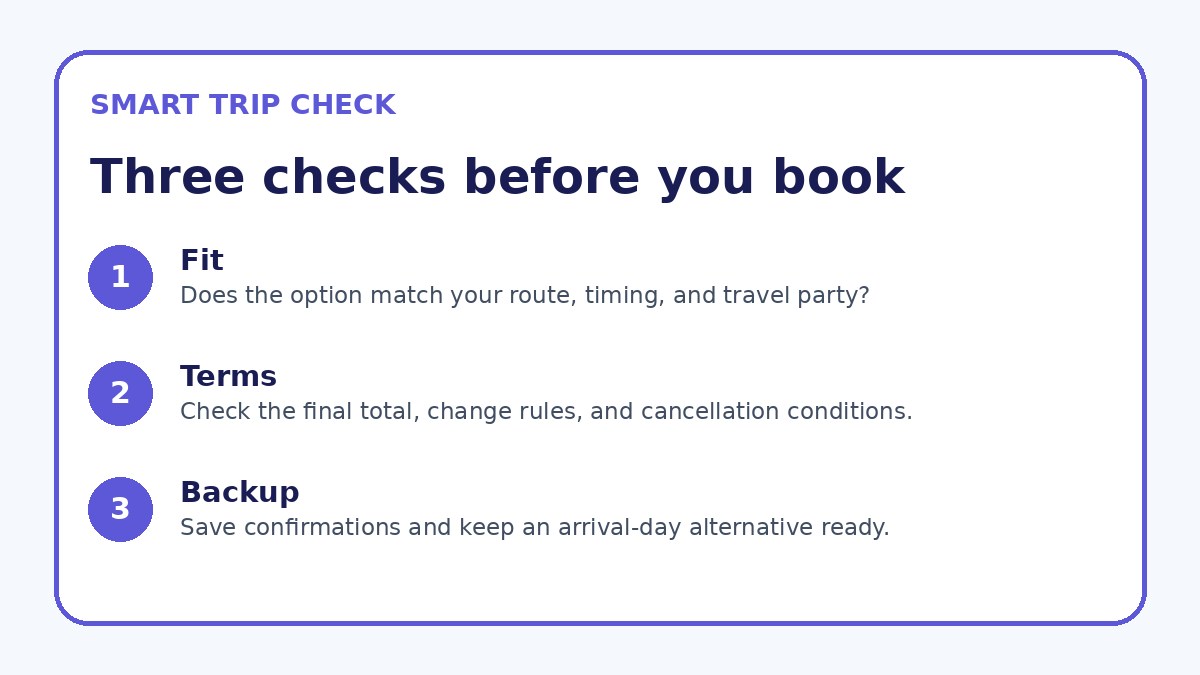
Before you finalize a booking, do a focused check of what will affect comfort on travel day: exact aircraft type (for seat width and pitch), seat map availability, baggage rules, minimum connection time, and whether the itinerary is single-ticketed. Don’t rely solely on third-party listings for these details; verify them on the operating airline’s booking page. If you use a travel agent or Trip.com to compare options, still click through to the carrier to confirm final seating, baggage, and transfer policies so there are no surprises at the airport.
On the day of travel, small habits improve comfort: arrive early to avoid rushing, download airline and airport apps for gate updates, and use packing cubes to find items quickly during layovers. Bring a compact travel pillow, noise-reducing headphones, and layers to adapt to varying cabin and terminal temperatures. If you expect a long airport wait, identify paid lounge options or quiet areas in advance—a short lounge pass can restore energy and privacy between segments without a large cost.
Frequently asked questions
Should I always choose a nonstop flight from Tokyo to Sapporo for comfort?
A nonstop flight usually reduces transfer stress and is simplest for first-time visitors because you avoid terminal changes and re-checking luggage. However, nonstops may depart at inconvenient times or lack preferred seat availability. If comfort for a long travel day is your top priority, weigh nonstop convenience against seat type and schedule: a slightly longer single-ticket connection with a confirmed extra-legroom seat and a relaxed layover can sometimes deliver a more comfortable experience than a cramped nonstop in an unfavorable time slot.
How much time should I allow between connecting flights to stay comfortable?
There’s no universal rule because airports and terminals differ, but start with the carrier’s stated minimum connection time and add an extra buffer—typically 30 to 60 minutes—if you value stress-free transfers. Consider additional needs like collecting and rechecking luggage, changing terminals, customs or immigration if applicable, and time to eat or rest. If you must move between separate airport buildings or use public transport, allow significantly more time to avoid rushing or missing your next flight.
What seating and packing choices most improve a long-haul connection?
Prioritize an aisle seat or an extra-legroom option for easier movement, stretching, and access to the lavatory during long travel days. Use a small, organized carry-on with essentials—medications, chargers, noise-cancelling earbuds, a travel pillow, and a change of clothes—so you remain comfortable even if your checked bag is delayed. Bring layered clothing to adapt to variable terminal and cabin temperatures, and pack compact entertainment or work items to make layovers productive or restful.
Final planning note
Planning a comfortable Tokyo to Sapporo flight connection boils down to three choices: how you balance nonstop simplicity against schedule and seat quality, whether you prefer a protected single-ticket connection over independently booked legs, and how thoroughly you verify luggage and terminal logistics before booking. Prioritize daytime departures when possible, reserve a seat that supports movement and rest, and give yourself extra buffer time for transfers. Use airline pages to confirm baggage rules, seat maps, and minimum connection times; consider a short paid lounge or a hotel stop if the itinerary strains your energy. With a few deliberate checks and the right seat and packing choices, you can turn a multi-leg journey into a comfortable, manageable transfer for your first trip to Sapporo.
Continue planning
Check current options and final conditions
Use the provider page to confirm live availability, the final total, cancellation terms, and every condition that matters to your trip.
This evergreen planning guide was created with AI-assisted drafting and a structured quality review. It does not display live prices, schedules, availability, visa guidance, or provider rankings. Verify current details before booking. Some links are affiliate links; we may earn a commission at no additional cost to you.