If you need to book Paris to Rome flights for business, start with a short, focused checklist that surfaces the tradeoffs that affect punctuality, connectivity, and productivity. Prioritize flight times, airport pairs, transfer reliability, seat and Wi‑Fi options, and refundable or changeable fare rules. Decide whether a direct flight, a slightly earlier connection, or an overnight option best protects your meeting schedule and aligns with risk tolerance. Use the checklist to avoid surprises on the booking page: verify exact layover lengths, baggage allowances, seat assignments, and change/refund terms before you enter payment details. This article gives the checklist up front, then explains how to weigh each item so you can book with confidence and minimal disruption to business plans.
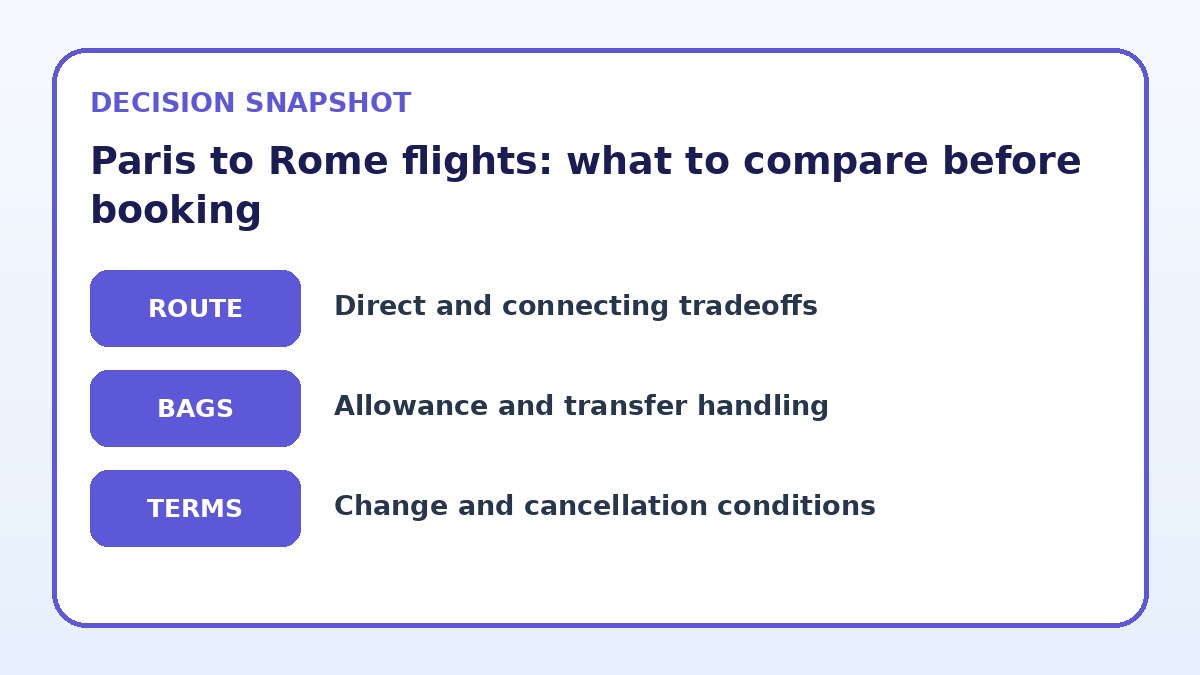
See current options before you compare the details
Availability and final conditions change. Open Trip.com now or keep reading for the practical comparison.
Choose the right airport pair for your schedule
Paris and Rome are served by multiple airports; picking the closest airport to your meeting end point can save time and stress. When evaluating options, treat the airport pair and the scheduled arrival/departure time as equally important. A morning flight into the airport nearest your meeting venue may be better than a later direct flight that lands farther away. Also factor in typical ground transfer modes — trains, shuttle buses, or taxis — and how those transfers align with rush hour or planned arrival buffers.
On a booking page verify the exact airport codes and terminals rather than assuming the city name is sufficient. Check the provider’s published guidance on transfer options and estimated transfer times, and measure door-to-door time including security wait and ground transfer. If you rely on public transit, confirm schedules for late or early arrivals because the last train or bus might not match your flight. For executive travel, account for hotel check‑in logistics if arrival times fall outside normal windows.
Balance direct flights versus connecting itineraries
Direct flights reduce the number of moving parts that can go wrong, but they aren’t always the fastest door-to-door option depending on airport locations and departure times. When comparing direct and connecting options, look at total elapsed time from your departure location to final meeting address, not just airborne time. Consider the robustness of the connection — are both legs on the same ticket with protection for missed connections, or are you booking separate tickets that shift risk onto you?
On the final booking page verify whether connections are protected and what support the carrier provides for missed connections or rebooking. If connection time is tight, check the minimum connecting time policy for the airports involved and read traveler reports about typical transfer distances and customs queues. For business trips where time is critical, a slightly longer direct choice that guarantees arrival buffer can be preferable to a cheaper itinerary with token connection time.
| Approach | Best for | Tradeoff to check |
|---|---|---|
| Book the earliest direct flight available | Minimizing connections and simplifying the journey | May involve less convenient airports or higher fares; ground transfer time still matters |
| Choose a connecting itinerary with longer layover | Lower cost or better departure/arrival airports | Adds risk of missed connections and increases total travel time |
| Pick a slightly earlier flight with buffer time | Protecting against delays and preserving meeting punctuality | You may spend more time waiting at the destination before meetings |
| Prioritize flexible/refundable fares | Changing plans without heavy fees or stress | Higher upfront fare compared with restrictive tickets |
Ready to check the option that fits your plan?
Use your exact dates and traveler details so the provider page can show the current total and conditions.
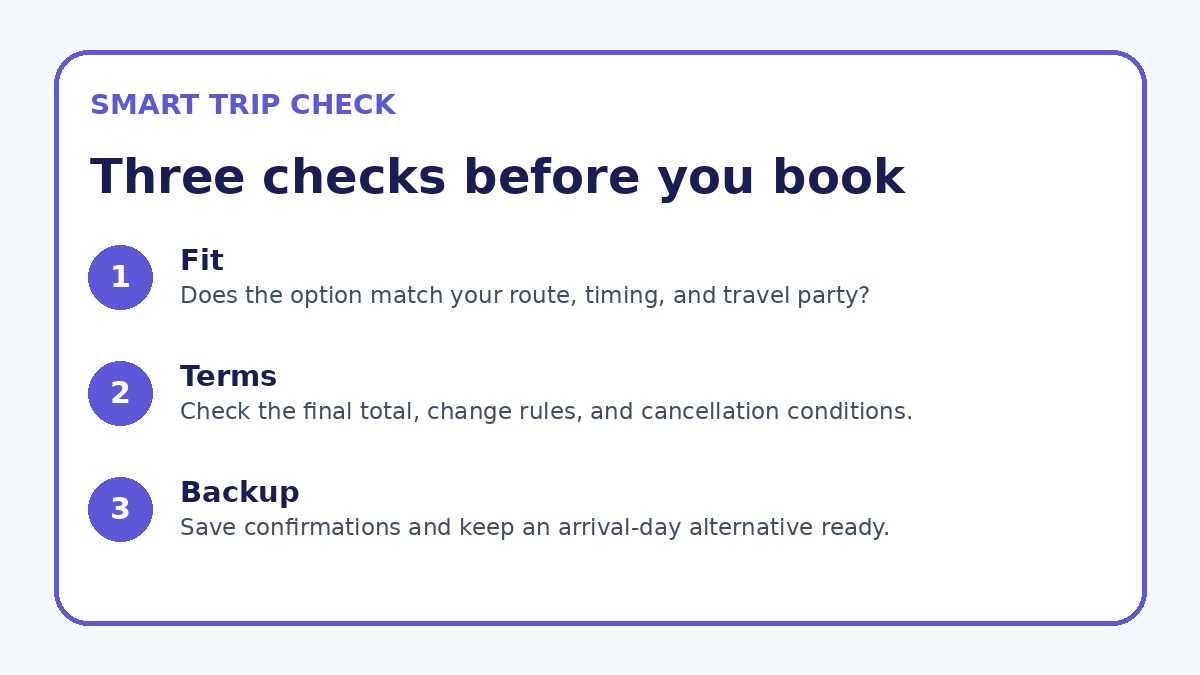
Prioritize fare rules, flexibility, and seat options
Business travelers often need flexibility more than rock-bottom fares. When comparing fares, inspect change and cancellation terms on the airline’s or booking provider’s final page: look for change fees, fare class limitations on rebooking, and how credit or refunds are issued. Also check whether a fare allows complimentary seat selection or requires a paid upgrade to secure a window, aisle, or exit-row seat useful for working onboard.
If working inflight is essential, confirm seat features like power outlets, seat pitch, and Wi‑Fi availability on the airline’s aircraft type page. Verify whether the airline sells Wi‑Fi by flight segment or cabin and whether it supports uninterrupted video calls. For corporate bookings, check whether your company’s fare rules or negotiated corporate discounts change flexibility or baggage allowances, and always validate those terms at the provider’s checkout before paying.
Before you book
- Confirm exact Paris and Rome airport codes and typical ground transfer times to your meeting or hotel before filtering flights.
- Compare total door-to-door times (including transfers and security) for direct and connecting itineraries rather than airborne time alone.
- On the airline’s checkout page verify fare rules: change fees, refund policy, and whether rebooking is protected for missed connections.
- Check baggage allowances and extra fees at the final booking step; decide whether carry-on only is feasible for the trip.
- Verify seat features and Wi‑Fi availability for the specific aircraft and cabin on the carrier’s page if in-flight work is required.
- Confirm check‑in deadlines, priority lane options, and the carrier’s irregular-operation support policies on the provider’s booking page.
Check baggage, check‑in, and operational guarantees
Baggage allowances and check‑in processes are practical levers for on‑time performance. Confirm the included baggage allowance and fees for additional bags at checkout, and assess whether carry‑on-only travel is feasible for your trip length and materials. For morning meetings, choose flights that allow online check‑in and boarding passes in advance so you can minimize time at the airport. If you have tight timelines, research priority check‑in or security lanes you can purchase.
Operational guarantees — such as rebooking assistance, lounge access, and compensation policy — vary and are critical when plans change. On the booking page review the airline’s guidance for IRROPS (irregular operations) and whether they provide hotel accommodation for long delays on protected itineraries. Trip.com can be a useful place to compare current availability and options, but always confirm baggage, check‑in cutoffs, and operational support details directly on the final provider page before completing a purchase.
Frequently asked questions
Should I always choose a direct flight from Paris to Rome for business travel?
Direct flights reduce the number of potential disruptions and save the hassle of a transfer, but they aren’t categorically superior. Compare direct options against connecting itineraries using total door-to-door time, airport proximity to your final destination, and schedule fit. Sometimes a single-connection flight that departs earlier and lands closer to your meeting location will be faster overall. Also weigh fare flexibility, seat features, and corporate policy. Ultimately choose the option that minimizes the risk to your critical commitments rather than simply minimizing airborne time.
How much connection time is safe when booking a one-stop itinerary?
There’s no universal safe number because safe connection time depends on airports, whether you change terminals, and if you need to pass through immigration. When booking, check the minimum connection time the carrier uses and add a buffer for security, passport control, or delays — especially if you have checked bags. If both legs are on one ticket and the airline protects connections, shorter layovers are often acceptable; when booking separate tickets, add substantial extra time. Verify exact transfer logistics on the airline or airport site before confirming the ticket.
What fare rules should I verify on the final booking page before paying?
On the provider’s checkout page confirm change and cancellation penalties, whether changes permit seat class upgrades, and how refunds or travel credits are issued. Check baggage inclusions, fees for extras like seat selection or priority boarding, and the validity period for any credit in case of cancellation. Also read the carrier’s operational assistance policy for missed connections and long delays — this determines whether you receive rebooking help or accommodation. If traveling on corporate fares, confirm how the company policy interacts with carrier terms.
Final planning note
When booking Paris to Rome flights for business, a short pre-booking checklist keeps decisions practical and defensible. Prioritize airport pair and total door-to-door time, then check whether a direct flight or a connecting itinerary better protects your meeting schedule. Verify fare rules, baggage allowances, and seat/Wi‑Fi features on the airline’s final booking page rather than relying only on summary search results. Use buffer time for transfers, and prefer protected itineraries or flexible fares when cancellations or late changes would be costly. A focused checklist eliminates guesswork and helps you book an itinerary that supports the job you have to do in Rome.
Continue planning
Check current options and final conditions
Use the provider page to confirm live availability, the final total, cancellation terms, and every condition that matters to your trip.
This evergreen planning guide was created with AI-assisted drafting and a structured quality review. It does not display live prices, schedules, availability, visa guidance, or provider rankings. Verify current details before booking. Some links are affiliate links; we may earn a commission at no additional cost to you.