If your Paris business trip includes meetings spread across the city and suburbs, driving may seem convenient—but often it doesn’t save time in central Paris. The practical answer: rent a car only when your itinerary requires travel outside central zones, frequent trips to suburban sites (business parks, conference centers), or large, flexible luggage transfers. For most inner-city meetings, taxis, ride-hailing, and commuter trains are faster and avoid Paris traffic, narrow streets, complex parking, and low-emission zone rules. When you do need a car, the pickup and return terms will shape the trip more than vehicle class: understand where you collect and drop the vehicle, fuel and mileage rules, cross-border permissions, and the exact insurance wording on the rental contract. Below I’ll walk through route value, the insurance phrases that matter, pickup/return friction, and a practical non-driving fallback so you can decide before you book.

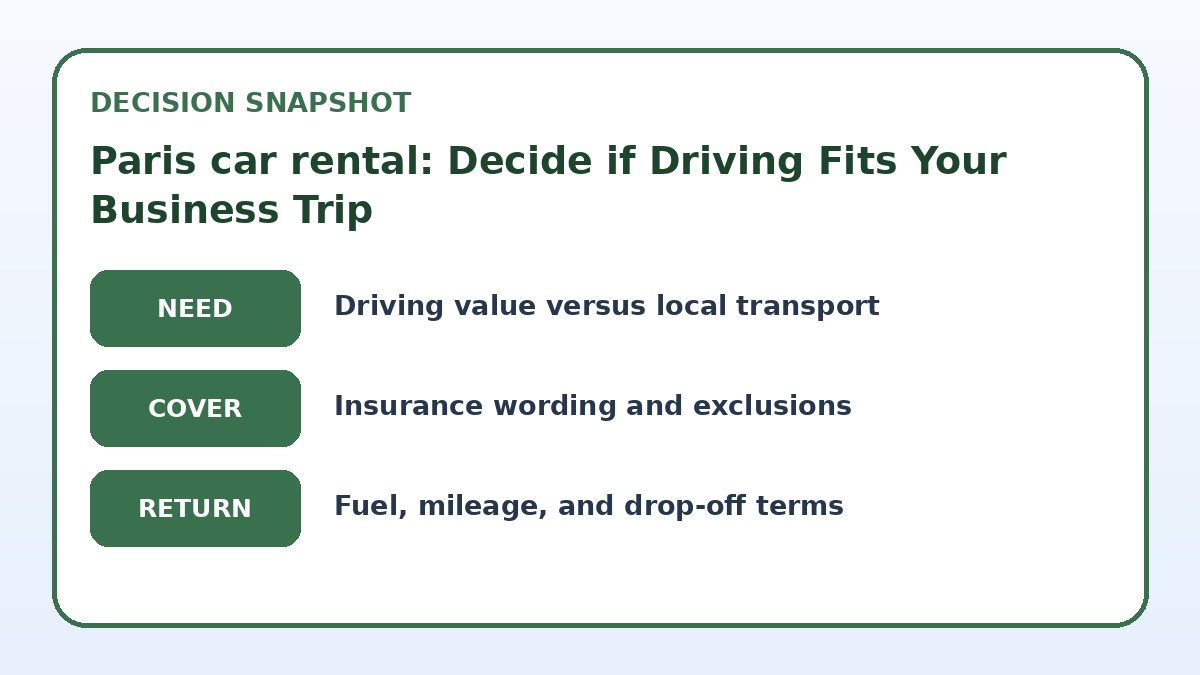
Route value: when a car actually improves a Paris business itinerary
Decide first whether a car will materially improve your schedule. Driving helps when meetings are dispersed across Île‑de‑France suburbs, when you must carry bulky equipment, or when connecting multiple sites in a single day without convenient rail links. For door-to-door coordination—clients in outlying industrial parks, airport-to-site shuttles, or remote hotel pickups—a car reduces transfers and gives control over departure times.
If most appointments sit inside Paris’s central arrondissements, or near Gare du Nord, Gare de Lyon, or Saint‑Lazare, public transport and taxis are usually quicker. To compare options, map each appointment’s travel time door-to-door by car and by train/taxi, and include typical walking and parking search time. Use these comparisons to judge whether the convenience of a rental offsets parking, congestion, and potential low-emission restrictions.
Decide whether driving earns its place
| Mobility strategy | Best for | Cost or friction to check |
|---|---|---|
| Rent a car for the whole trip | Multi-site suburban schedules, equipment transport, flexible departure times | Parking, congestion, fuel/toll costs, and stricter return procedures can reduce time savings |
| Drive only for specific days (short-term hire) | One or two days with heavy suburban travel or multiple client sites | Requires extra pickup/return logistics and potentially higher per-day rates or one-way fees |
| Public transit and taxis for city-focused schedules | Central Paris meetings and predictable station-to-station travel | Less control for outlying meetings, luggage handling, and off-hour runs to suburbs |
| Chauffeur or private transfer on demand | High-value meetings requiring punctuality and minimal local navigation | Higher cost than self-drive and requires reliable advance booking and clear cancellation terms |
Check live rental choices only after the route test
Use the exact driver, dates, pickup point, and return plan to compare current conditions.
Insurance wording: what to read on the booking page
Insurance is where small words change big costs. On the final rental page, verify the types of cover listed (collision damage waiver, theft protection, third‑party liability), the excess/deductible amount, and whether any damage reporting or police report requirements are mandatory for a claim. Also confirm whether the deductible is refundable if you buy the supplier’s reduction product, and whether a credit card provider will supplement or replace the supplier’s cover.
Watch for geographic exclusions and named drivers wording. Check whether cross-border travel (to Belgium, Germany, Switzerland) is permitted and whether specific roads, ferries, or airports are excluded. If you rely on corporate card or personal insurance, compare wording line-by-line against the supplier’s contract and request written confirmation on the booking page that those external policies are accepted.
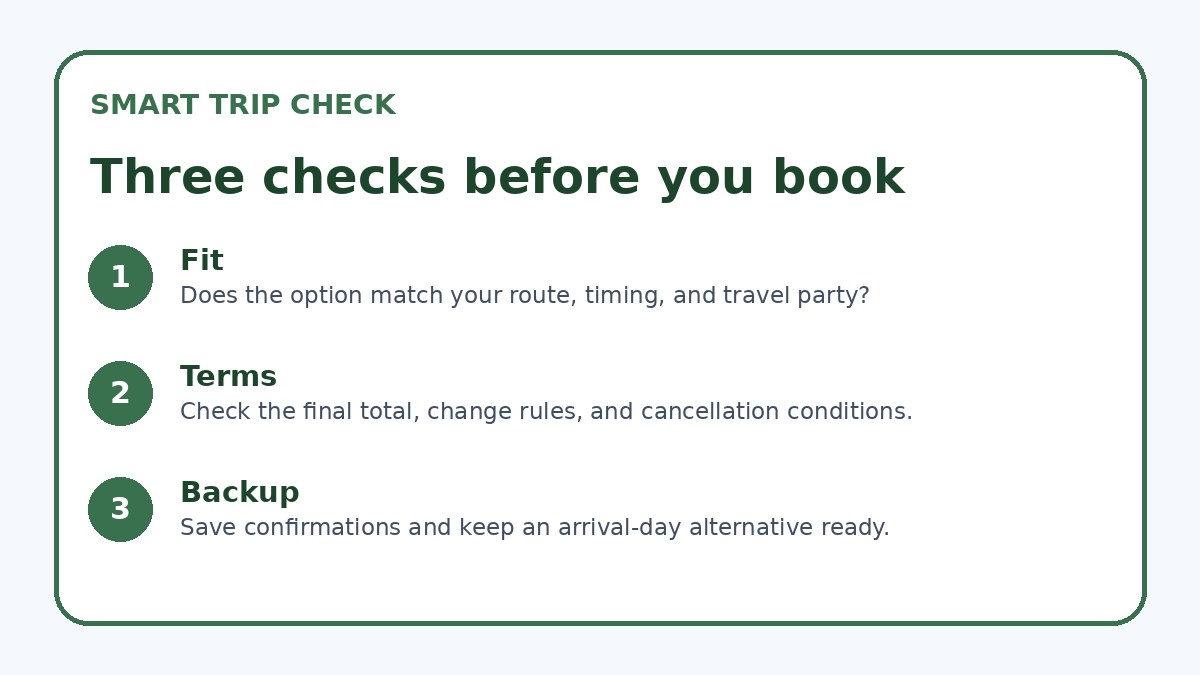
Compare the full rental conditions
Confirm insurance wording, exclusions, deposit, fuel, mileage, and return terms on the final page.
Pickup and return friction: logistic costs that affect your day
Pickup and return logistics determine whether a rental is a time sink or a productivity tool. Confirm the pickup location’s exact address and opening hours, any out-of-hours drop-off process, shuttle requirements from terminals, and whether the rental desk is inside the airport terminal or at an offsite lot with transfer time. On the booking page, look for language about early/late returns, missed return penalties, and whether a timed or full-day charge applies for partial-day usage.
Also check fuel, mileage, and cleanliness policies that create practical friction. Is the car supplied with a full tank and required to be returned full? Are there prepaid fuel options with refund rules? Look for wording about toll transponders, fines handling, and cleaning fees for excessive dirt or smoking. These operational terms often create unexpected charges that affect the net convenience of driving.
Car rental terms to verify
- Map each meeting’s door-to-door travel time by car and by transit to see where driving saves time.
- On the rental booking page, confirm pickup address, exact opening hours, and out-of-hours return procedure in writing.
- Read the insurance section on the final page: note deductible amounts, required documents after incidents, and any geographic exclusions.
- Check fuel and mileage policies: whether the vehicle is supplied full, return requirements, and prepaid fuel refund rules.
- Verify toll transponder rules, who pays fines, and whether the supplier records fines to the renter’s account.
- Prepare a fallback plan listing nearest train stations, expected taxi wait times, and contact details for local chauffeur services.
Non-driving fallback: plan a fast, reliable alternative
Always plan a fallback that keeps your schedule smooth if you opt out of driving or if a rental problem arises. Build an itinerary using rail for intercity or suburban legs, taxis or ride-hailing for first-and-last-mile connections, and short-term hourly car hires or chauffeur services for single-site suburban needs. Check train frequencies, typical taxi wait times at your arrival stations, and booking options for local chauffeur services so you can switch modes without reworking the whole schedule.
Before you finalize travel, create a simple backup card with one or two local transport options per meeting: nearest station and transit time, average taxi or ride-hail cost range, and a local desk or booking contact. If you prefer to compare current availability or pick up last-minute offers, Trip.com can be used as a place to view options, but always verify specific rental or service terms on the provider’s official page before booking.
Car Rental & Road Trip questions travelers ask
Do I need special insurance language or documents to rent a car in Paris for business?
You don’t usually need a special business insurance policy, but you must understand the supplier’s cover and your corporate or personal card protections. On the rental page, confirm collision damage waiver and theft protection terms, the excess amount, and any conditions for refunding the excess if you purchase reduction cover. Also check whether your corporate or credit-card insurance requires registering the rental or providing specific documentation after an incident. If in doubt, request written confirmation from the supplier that your external policy will be accepted; keep digital copies of policy pages and the rental contract while traveling.
What pickup and return terms most commonly cause extra fees?
Common fee triggers are late or out-of-hours returns, returning with less fuel than supplied, unreported damage, tolls and traffic fines, and failing to follow the return location’s drop-off procedure. Off-airport locations may add shuttle fees or penaltied timed charges. On the booking page, look for explicit language about partial-day charges, cleaning fees for smoking or heavy soiling, and how tolls are billed. If an out-of-hours drop requires using a key drop box, confirm whether a final inspection will be done immediately or if the supplier can later charge for discovered issues.
How do I decide between renting a car for a full trip or using taxis and trains?
Compare aggregated travel time and the value of schedule control. If your itinerary includes several suburban appointments with poor rail links, frequent equipment transfers, or unpredictable end times, a rental usually increases productivity. If most appointments lie inside central Paris or near major stations, trains plus taxis are typically faster overall and avoid parking hassle. Quantify: calculate door-to-door durations and multiply by the number of transfers or days. Also factor in parking availability and the administrative time to handle pickup and return; if those operational costs exceed time saved driving, choose transit and taxis.
Final decision note
For most business travelers whose meetings concentrate inside central Paris, driving adds friction rather than time savings: parking, congestion, and pickup/return rules often nullify the expected convenience. Rent a car when your schedule includes multiple suburban sites, heavy luggage, or the need for strict on-demand departures. Before you book, read the insurer and rental contract language on the final page—verify excess amounts, required incident procedures, cross-border permissions, and exact pickup/return addresses and hours. Keep a non-driving fallback planned with trains, taxis, and short-term hires so a change in plans won’t derail your schedule. With these checks you’ll know if a Paris car rental truly helps your business trip or if alternatives are the smarter choice.
Continue planning
Check current options and final conditions
Use the provider page to confirm live availability, the final total, cancellation terms, and every condition that matters to your trip.
This evergreen planning guide was created with AI-assisted drafting and a structured quality review. It does not display live prices, schedules, availability, visa guidance, or provider rankings. Verify current details before booking. Some links are affiliate links; we may earn a commission at no additional cost to you.