Practical answer first: driving in Paris can help if your itinerary includes day trips with heavy or bulky luggage—only after you confirm the rental’s fuel policy, daily or total mileage allowance, and how the company charges for refueling or excess kilometres. Many travelers assume free mileage and simple refuelling, but booking pages differ: some require you return the tank full, others offer prepaid fuel with no refund, and several place tight daily limits that trigger excess-mileage fees. That matters especially if you have suitcases, sports equipment, or oversized bags that push you toward a larger vehicle or multiple trips. This guide helps you decide whether to drive, what contract language to inspect, and how to compare non-driving alternatives so you don’t discover expensive charges when you return the car.

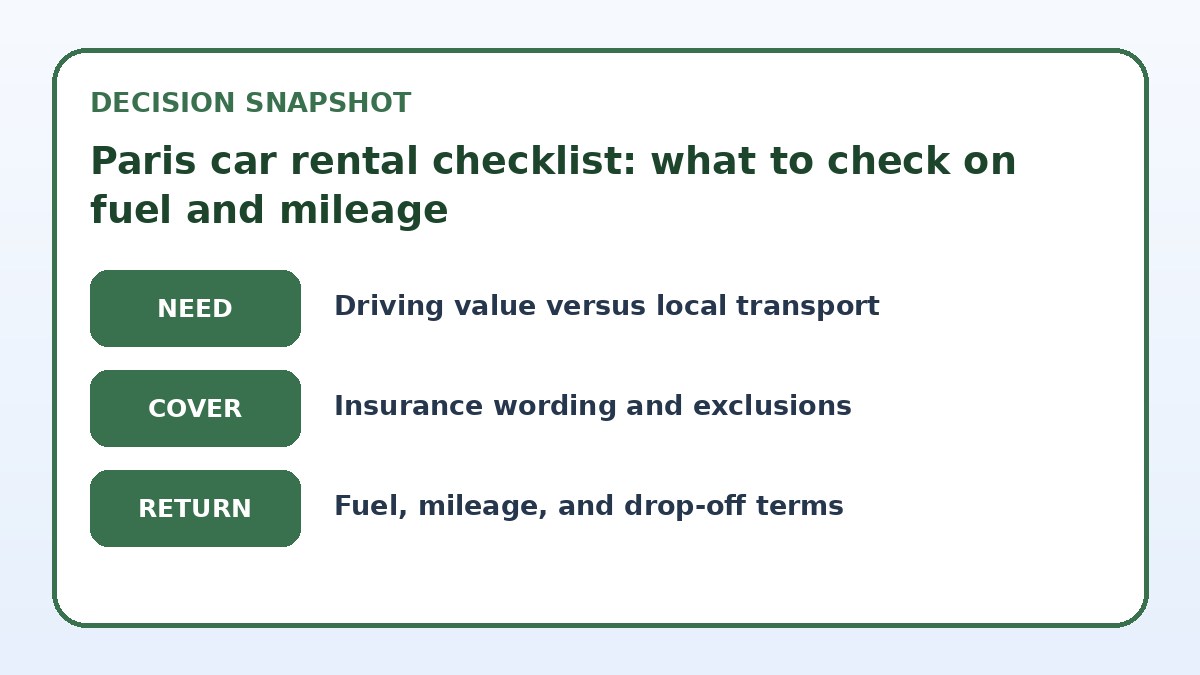
Does driving add clear value for a luggage-heavy Paris trip?
Start by mapping your plan. Driving is worth the trouble when you need to carry bulky items between dispersed destinations—airports to apartments with few elevators, day trips to regional wineries, or equipment-heavy activities outside central Paris. If most of your stay is within central arrondissements, narrow streets, limited parking, and optional low-emission restrictions can make taxis, trains, or luggage delivery services faster and less stressful than a car. Think about door-to-door convenience versus urban parking time and costs: a single long day trip to the countryside with heavy bags often justifies a rental, while multiple short hops inside the city rarely do.
Estimate how much extra space you need and whether a larger vehicle will push you into higher fuel and mileage bands. Bigger vehicles usually consume more fuel and might be assigned stricter mileage tiers or higher excess charges; they may also have different insurance or deposit rules. If your luggage needs are occasional—an oversized suitcase for airport transfers and otherwise light travel—compare a one-way airport pick-up plus trunk delivery service or a private transfer to the cost and complexity of a multi-day rental.
Decide whether driving earns its place
| Mobility strategy | Best for | Cost or friction to check |
|---|---|---|
| Rent a car for entire stay | Travelers with many off-city day trips and frequent luggage transfers. | Higher parking, fuel, and mileage exposure; more pickup/return friction and deposit requirements. |
| Rent for specific day trips only | Those who need a vehicle only for a couple of long-distance outings. | Requires coordination for one-way or same-location return; may lose savings from weekly rates. |
| Use trains plus luggage courier or taxi | Travelers prioritizing stress-free urban movement and avoiding parking hassles. | Courier fees or taxi fares can add up for very bulky items or multiple transfers. |
| Private transfers or organized tours | Groups with heavy equipment who want door-to-door service without driving. | Less flexibility on timing and routes; potentially higher per-trip cost than a self-drive if multiple stops are needed. |
Check live rental choices only after the route test
Use the exact driver, dates, pickup point, and return plan to compare current conditions.
Fuel policies and what to verify on the booking page
Fuel policy language determines whether you must refill before returning or will be charged a refuelling fee. On the provider’s final booking page, look for exact terms: full-to-full, full-to-empty (prepaid), fuel service charge per litre, and any minimum refuelling administration fee. Ask how the company measures fuel on return—visual gauge reading versus mileage-based estimates—and whether they round up to the next litre or charge a flat service fee. If the booking mentions prepaid fuel, verify whether unused fuel is refunded and how that refund is calculated.
For extra-luggage travelers, a larger tank or a hybrid/diesel option might be more efficient, but only if the pricing structure matches your planned kilometres. Check whether fuel type surcharges apply and whether the rental includes instructions for refuelling in France. If refuelling fees and administrative charges can exceed the cost of fuel at local stations, plan to fill the tank yourself nearby a checkout before returning, and save a receipt when allowed by the contract as proof.
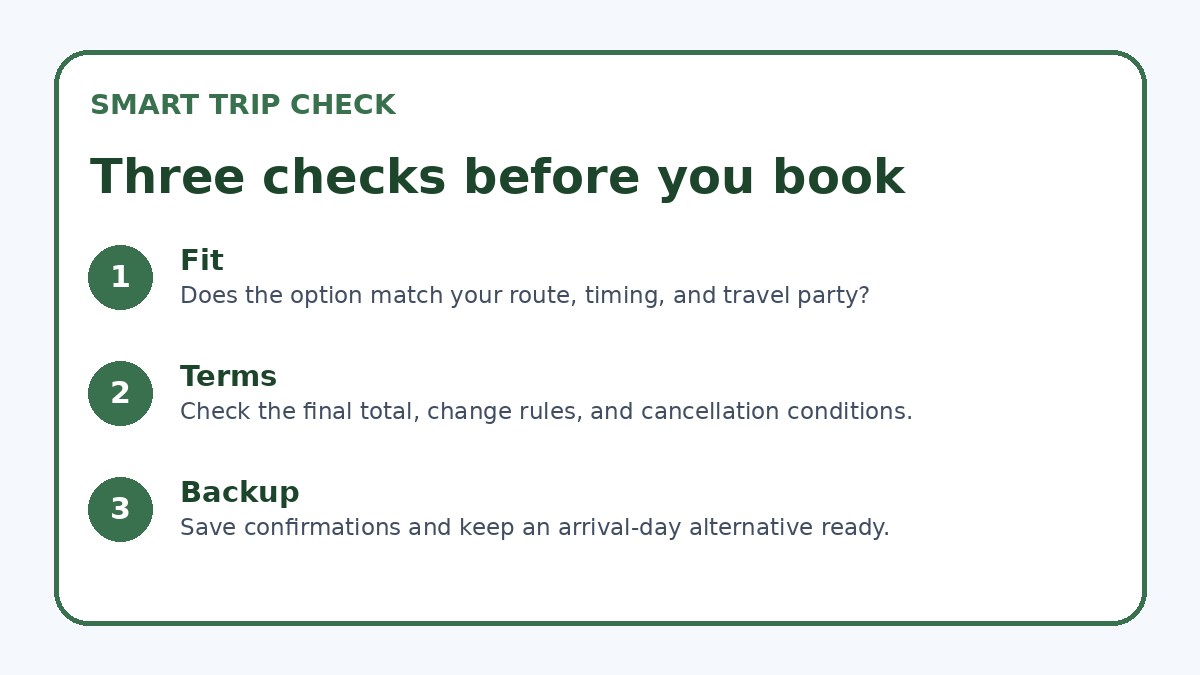
Compare the full rental conditions
Confirm insurance wording, exclusions, deposit, fuel, mileage, and return terms on the final page.
Mileage limits, excess-kilometre charges, and insurance wording
Mileage rules vary: some rentals include unlimited kilometres within a country or region, others set daily or total limits with per-kilometre penalties. On the booking page, check the exact limit (daily and total), how the company calculates excess (per km or per day), and whether certain roads or cross-border trips count differently. If you expect long loops outside Île-de-France—Normandy, Loire Valley, or ski areas—scan for regional caps. For travelers with lodging spread across distant locations, a small excess charge multiplied by many kilometres can quickly exceed public-transport alternatives.
Insurance wording intersects with mileage because some cover reductions or excess-waiver products may restrict kilometres or exclude certain uses (commercial transport of goods, towing, or sporting equipment). Verify whether the standard CDW/LDW, supplemental waivers, and roadside assistance apply when carrying large or heavy items, and whether they affect the liability for fuel or excess-kilometre fees. Always note the deposit amount and the conditions under which it is retained or refunded, and ask whether documented fuel receipts are required to avoid refuelling service charges.
Car rental terms to verify
- On the rental booking page, confirm the exact fuel policy wording (full-to-full, prepaid, or charged on return) and any per-litre or administrative refuelling fees.
- Check daily and total mileage limits and calculate expected kilometres for planned day trips; ask how excess charges are applied and rounded.
- Verify insurance documents for luggage cover, damage liability, and whether optional waivers affect mileage or fuel obligations.
- Ask the provider how they inspect fuel level at return, whether receipts are accepted, and what proof prevents refuelling service charges.
- Confirm pickup and drop-off logistics: airport shuttles, off-site lots, after-hours returns, and staff assistance for loading heavy luggage.
- Compare the total estimated cost of rental (including fuel, excess km, parking, and deposits) versus private transfer or luggage courier options.
Pickup, return friction, and a non-driving fallback
Pickup and return logistics can turn a pleasant day trip into a long chore. Inspect the booking page for airport or city-centre pick-up instructions, mandatory return windows, after-hours drop-off rules, and whether a shuttle or off-site lot is used. Off-airport locations often have cheaper rates but may require a shuttle and extra time, which matters when you’re handling extra bags. Clarify where to leave large items during inspections, whether staff will help with loading, and the process for meter-read fuel checks to prevent disputes when you’re tired from travel.
A realistic non-driving fallback makes the decision safer. For bulky luggage, consider a pre-booked private transfer or couriered luggage service to move bags between addresses while you use local trains and taxis. Long-distance day trips can be done with organized tours that handle equipment, or with regional trains that allow larger baggage and connecting taxis. If you rely on public transport for most days, rent a car just for the specific day trip and return it the same evening to limit mileage exposure and extra-day charges. Trip.com can be used to compare current rental availability, but verify fuel, mileage, and insurance wording on the final provider page.
Car Rental & Road Trip questions travelers ask
Will a larger rental car always cost less in fuel and mileage when I have extra luggage?
Not always. Larger cars can fit more luggage but usually consume more fuel and sometimes fall into stricter pricing tiers or higher excess-mileage brackets. Confirm fuel type requirements and whether the reservation charges by vehicle class. On the final booking page, compare the fuel policy, estimated tank size, and stated mileage allowances for the larger car versus a compact alternative; also factor in parking costs and urban driving conditions that affect fuel consumption. If possible, estimate total kilometres and simulate excess charges to see which option is cheaper overall.
If I return the car with half a tank, how will I be charged?
It depends on the rental’s fuel policy. Under full-to-full policies, you should refill to the level at pickup to avoid service charges; under prepaid policies, you may pay for a full tank up front without a refund for unused fuel unless the contract states otherwise. On the booking page look for how fuel is measured, whether an administrative flat fee is added, and whether the provider accepts fuel receipts as proof. If the wording is unclear, contact the rental company before booking to get the method of charge in writing.
Can I avoid excess-kilometre penalties if my plans change mid-rental?
Possibly, but only if you renegotiate with the provider or upgrade the contract; many companies allow extensions or unlimited-kilometre packages for an extra fee. Check whether the rental offers kilometre upgrades online and what notice they require to change terms. If upgrading is not possible, consider returning the car early and renting again for the remainder, or use regional trains and taxis for unexpected extra distance. Always confirm change and cancellation conditions on the final booking page to know whether mid-rental amendments trigger new charges.
Final decision note
Driving in and around Paris with extra luggage can be the right choice when you need flexibility and door-to-door movement for long day trips. The decision turns on three contract details you must verify on the provider’s final booking page: the fuel policy, the mileage allowance and excess charges, and the insurance or deposit wording that affects luggage liability. If any of those terms are vague or punitive, favor renting only for specific excursions or using transfers and luggage services. Leave time at pickup and return to inspect fuel levels with staff and keep receipts; clear upfront checks prevent costly surprises and let you enjoy Paris without last-minute disputes.
Continue planning
Check current options and final conditions
Use the provider page to confirm live availability, the final total, cancellation terms, and every condition that matters to your trip.
This evergreen planning guide was created with AI-assisted drafting and a structured quality review. It does not display live prices, schedules, availability, visa guidance, or provider rankings. Verify current details before booking. Some links are affiliate links; we may earn a commission at no additional cost to you.