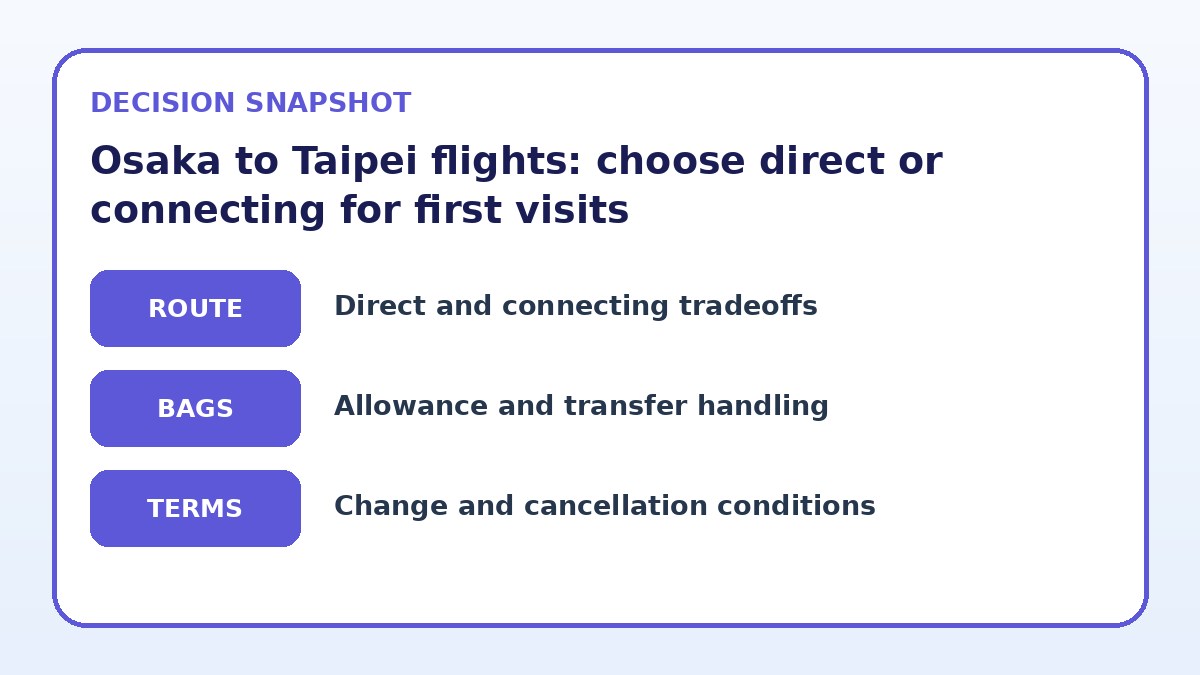
If you’re planning your first trip from Osaka to Taipei, the practical answer is simple: pick the option that matches your priorities. If convenience and minimal hassle are top priorities, a direct flight (if available from your chosen airport) usually wins. If you need more timing flexibility, lower fares, or want to add a stopover city as part of the journey, a connecting itinerary can make sense. Before you book, check total door-to-door time, layover length and airport terminals, baggage transfer rules, and whether separate tickets require rechecking luggage through immigration. Also compare cancellation and change conditions and the carrier’s final booking page for up-to-date schedules and seat assignments. Use these criteria to weigh the tradeoffs and choose the flight that best fits the rhythm of your trip, not only the fare shown at first glance.
How to identify direct versus connecting options
When you search for Osaka to Taipei flights, results are typically labeled as nonstop or connecting. Nonstop means the aircraft flies from departure to arrival without scheduled stops. Connecting flights list one or more intermediate airports where passengers disembark or remain onboard while passengers and baggage transfer. On some search platforms, a single booking with a connection will show total elapsed time and layover details; take those numbers as the starting point for comparison rather than the individual flight segments alone.
Be careful with mixed itineraries: some results combine two separate tickets sold by different carriers. That can look like a single connection but may require you to collect bags and recheck them, possibly leaving and re-entering airport security. Always open the detailed itinerary view on the airline or booking site to confirm whether the transfer is protected by a single ticket and whether the carrier guarantees baggage transfer. If the booking page doesn’t clearly state this, contact the provider before purchasing.
Practical tradeoffs: time, cost, and stress
Direct flights save time in the air and reduce the number of procedures—check-in, security, and immigration—so they’re usually less stressful for first-time visitors. A shorter total journey also reduces the chance of missing ground connections or experiencing travel fatigue upon arrival. If you value simplicity, prioritize itineraries with the fewest touchpoints even if the ticket costs a bit more. Remember that flight length alone isn’t the only factor: airport transfer time to and from Osaka (Kansai or Itami) and arrival airport accessibility in Taipei (Taoyuan or domestic airports) affect total travel time.
Connecting options often surface because they allow more departure times, seasonal routing, or slightly cheaper fares by splitting the journey across carriers and hubs. However, the savings may come with longer layovers and added complexity. Longer connections can be useful if you want a planned break to rest or explore a transit city briefly, but unplanned delays create higher rebooking risks. If you accept connections to save money, add buffer time, verify through-checked baggage rules, and choose airports and airlines with good on-time reputations where possible.
| Approach | Best for | Tradeoff to check |
|---|---|---|
| Direct flights | Travelers who prioritize minimal hassle, quick door-to-door time, and straightforward baggage handling. | Often fewer departure times and sometimes higher fares or less flexibility for schedule changes. |
| Short connecting flights (single layover) | Passengers seeking more departure options or slightly lower fares without adding excessive travel time. | Requires managing a layover; possible need to change terminals or recheck baggage depending on the ticket. |
| Long connections with planned stopovers | Travelers who want to see another city, break up a long journey, or align timing with local plans. | Adds total travel time and increases complexity for baggage and visa requirements in the transit country. |
| Separate-ticket connections | Budget-focused or highly flexible travelers comfortable accepting higher disruption risk to lower ticket cost. | No protected connection—missed flights usually leave you responsible for rebooking and baggage issues. |
What to verify on the booking page before paying
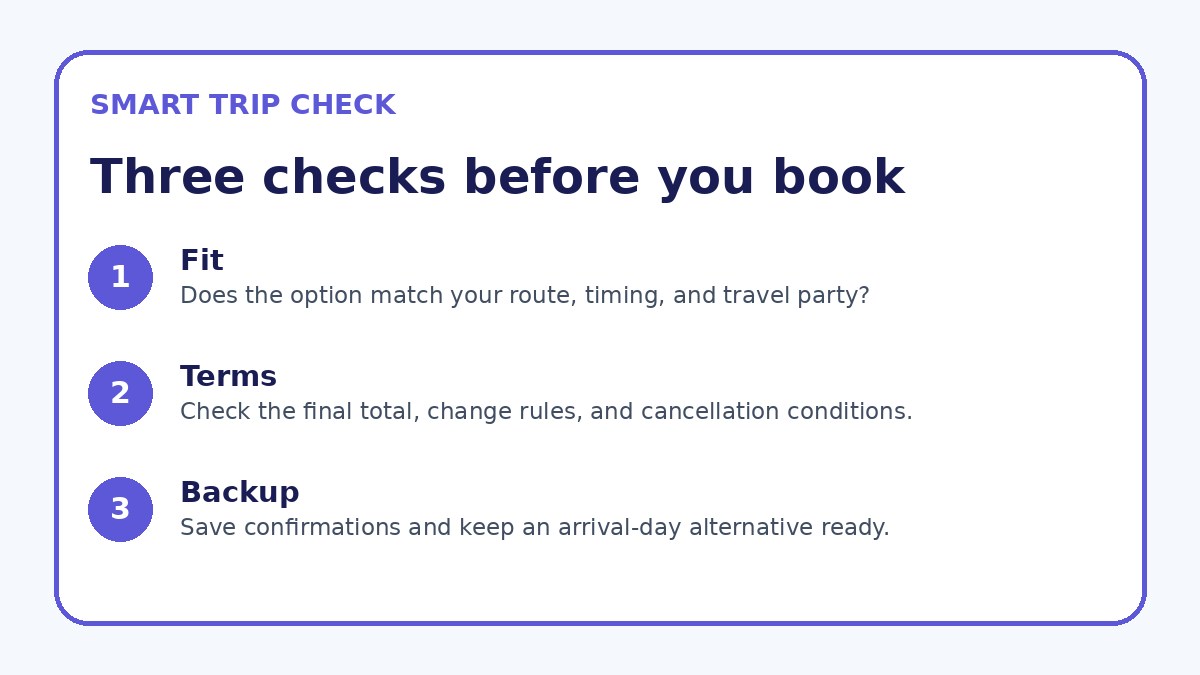
On the airline or agency booking page, confirm whether the ticket is a single itinerary (one PNR) or several separate tickets. A single PNR generally protects you if an earlier flight is delayed and causes a missed connection. Also check whether baggage allowances and seat selection apply across all segments or differ by carrier. If the booking page shows carrier codeshare information, expand the details to see which airline actually operates each flight segment and who handles customer service in case of disruption.
Next, review change and cancellation policies, including fees and the fare class rules tied to refunds or rebooking. Note the minimum transfer times advised by the airports involved and the terminals used for arrival and departure—these affect how much layover time you realistically need. If any information is unclear, call the airline or the agency before purchase. You can check live availability and recent schedules on platforms like Trip.com, but always finalize plans on the operating carrier’s official site to confirm the current conditions.
Before you book
- Confirm whether your booking is a single PNR (protected connection) or multiple separate tickets before purchasing.
- Verify baggage transfer rules for each segment and whether you must claim and recheck luggage at the layover airport.
- Check terminals for arrival and departure and allow extra transfer time if you must change terminals or pass immigration.
- Compare total door-to-door travel time, not only airtime or the headline fare, when selecting an itinerary.
- Review change, cancellation, and refund policies for each carrier on the operating airline’s final booking page.
- If booking a tight connection, buy travel insurance that covers missed connections and check rebooking procedures in advance.
Choosing based on traveler type and trip goals
If you’re a first-time visitor to Taipei prioritizing ease—traveling with family, carrying fragile equipment, or arriving late in the day—direct flights reduce variables and are usually the better option. Short, predictable travel windows make it simpler to arrange ground transfers and accommodation check-ins. Direct itineraries also reduce the number of different airline rules you must navigate, which lowers the chance of surprises with baggage, seating, or meal service.
If your goal is to balance budget and flexibility, or if you want to see another city briefly, connecting flights can be attractive. Business travelers who need a specific departure time not offered nonstop might accept a connection. Experienced travelers comfortable with transfers might find reasonable savings or schedule fits via a hub. Whatever your profile, match the itinerary to your tolerance for complexity, and make contingency plans: extra layover buffer, travel insurance covering missed connections, and knowledge of rebooking procedures for your carrier.
Frequently asked questions
Is it safer to book a direct flight from Osaka to Taipei for a first-time visitor?
For first-time visitors, a direct flight generally reduces the number of moving parts—fewer check-ins, no intermediate immigration, and a single boarding procedure—so it’s often the safer and simpler option. Direct itineraries lower the chance of missing a connection or having to manage luggage through multiple airports. However, safety here means predictability and simplicity rather than an absolute security difference; if a direct option greatly restricts timing or cost, a carefully chosen short connection can still work well if you verify baggage transfer and allow adequate layover time.
How long should I make my layover if I choose a connecting itinerary?
Aim for at least the airline or airport’s published minimum connection time plus an extra buffer to allow for delays, immigration queues, and terminal changes. For international-to-international transfers at a familiar hub, a one- to two-hour layover may be sufficient; for transfers that require passing through immigration or rechecking baggage, plan several hours. If you’re unsure, look up the transit airport’s layout and recommended minimums on the carrier’s site and add 60–120 minutes as a safety margin, especially when traveling with checked luggage or during busy travel periods.
Can I trust third-party sites when comparing Osaka to Taipei flights?
Third-party search engines are useful for finding options and comparing schedules, but always cross-check critical details on the operating carrier’s final booking page before you pay. Third-party sites sometimes omit baggage rules, carry different change and refund conditions, or sell separate tickets that appear as a single itinerary. Use aggregator search tools to shortlist options, and then confirm PNR status, baggage handling, seat assignments, and airline contact details on the airline’s official site. You may check live availability on platforms like Trip.com, but finalize specifics with the operating carrier.
Final planning note
Choosing between direct and connecting Osaka to Taipei flights comes down to your priorities: convenience and fewer logistics, or flexibility and potential cost savings. For first-time visitors or travelers who prefer a straightforward experience, direct flights minimize variables and make arrival logistics easier. If schedule constraints or budget concerns push you toward connections, pick short, reliable layovers, confirm baggage transfer, and leave extra buffer time. Always verify the final itinerary and policies on the operating carrier’s booking page, and prepare a contingency plan for missed connections so you travel with confidence rather than uncertainty.
Continue planning
Check current options and final conditions
Use the provider page to confirm live availability, the final total, cancellation terms, and every condition that matters to your trip.
This evergreen planning guide was created with AI-assisted drafting and a structured quality review. It does not display live prices, schedules, availability, visa guidance, or provider rankings. Verify current details before booking. Some links are affiliate links; we may earn a commission at no additional cost to you.