For most solo travelers planning Osaka to Hiroshima transport, the practical choice boils down to prioritizing time, cost, or convenience. If you want the quickest, direct rail options usually win; if you need to save money, overnight or highway buses can be competitive; if minimizing transfers or luggage handling matters most, prioritize options with fewer connections and easy station access. This article gives a clear recommendation up front, then unpacks tradeoffs so you can pick the best option based on your priorities, luggage, and arrival or departure times. Wherever provider-specific facts matter—schedules, exact fares, seat reservation policies, or whether a given service requires a transfer—double-check the operator or booking site before buying. You can use Trip.com as one place to compare current availability, but always verify details on the carrier’s official page.
See current options before you compare the details
Availability and final conditions change. Open Trip.com now or keep reading for the practical comparison.
The practical recommendation up front
For most solo travelers deciding how to travel from Osaka to Hiroshima, choosing a direct daytime train from central Osaka to central Hiroshima is the most practical balance of speed, simplicity, and predictability. Trains typically put you in the city centre at departure and arrival, reduce handling of luggage, and keep options flexible if you need to change plans. This approach favors travelers who want to maximize daytime sightseeing in Hiroshima and prefer reliable, straightforward station-to-station transfers.
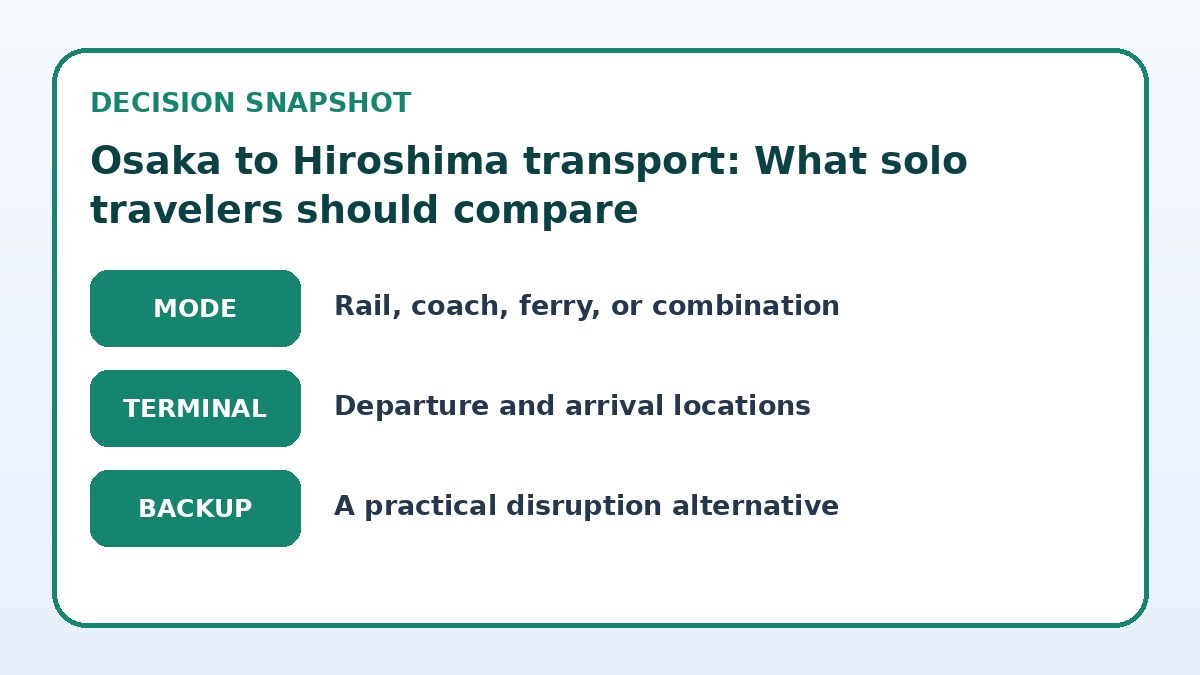
That said, "practical" depends on your priority. If minimizing cost is the goal and you can trade time for savings, an express or overnight bus might serve you better. If you must reach an airport or connect to a flight, compare train-to-airport combinations and flights carefully, making sure to account for time spent getting to and from airports and the potential for extra transfers. Always verify real-time schedules, seat reservation options, luggage restrictions, and boarding locations with the carrier before purchasing.
Comparing travel time, convenience and how they affect solo trips
Travel time matters differently to each solo traveler. If you value sightseeing or have a tight daytime window in Hiroshima, shorter door-to-door journey time is usually the priority. When comparing options, add up walking or transfer times: station arrival and exit, transfer between platforms, or transit to and from out-of-town bus terminals and airports. Practical choices reduce the number of handling steps—fewer platform changes and minimal last-mile transfers lower the chance of missing connections and reduce stress.
Convenience also means predictable luggage handling and access to help if something goes wrong. Trains from central stations generally provide staffed ticket counters and clear signage, which helps when navigating alone. Buses sometimes use suburban terminals that require a short feeder ride, while flights add airport check-in and security. If you rely on a single suitcase or carry-on, that may tilt you toward options with fewer steps; if you have bulky items, check each carrier’s luggage policy on their booking page before you commit.
| Approach | Best for | Tradeoff to check |
|---|---|---|
| Direct daytime train | Solo travelers who prioritize speed and straightforward station-to-station travel | Higher base ticket cost and potential need to reserve a seat during busy periods |
| Highway or overnight bus | Budget-focused travelers willing to trade time to save on tickets or accommodation | Longer journey and possible boarding at less central terminals |
| Flight (including connections) | Those connecting onward by air or needing a very specific departure time | Extra time and transfers for check-in, security, and airport transfers |
| Combination (train + local transfer) | Travelers balancing cost and convenience with flexible schedules | More steps and potential reliance on punctual connections |
Ready to check the option that fits your plan?
Use your exact dates and traveler details so the provider page can show the current total and conditions.
Cost tradeoffs and when to choose buses or flights
If budget is the decisive factor, highway or overnight buses often offer lower up-front fares than direct daytime trains—but they take longer and may require boarding at a less central terminal. For solo travelers willing to trade time for savings, buses can be practical, especially if you prefer to travel overnight and save a night of accommodation. Compare total door-to-door costs, not just ticket prices, to include local transfers, potential taxis, and added travel time that eats into your schedule.
Flights between the region’s airports can be practical in niche cases—for instance when you’re connecting onward by air or when a specific timing need makes a flight the only viable option. However, flights introduce extra steps like check-in, security, and travel between city centres and airports. For most short domestic routes, surface travel avoids those extra steps; if you consider a flight, verify baggage allowances, airport transfer times, and whether the flight is direct or requires connections before booking.
Before you book
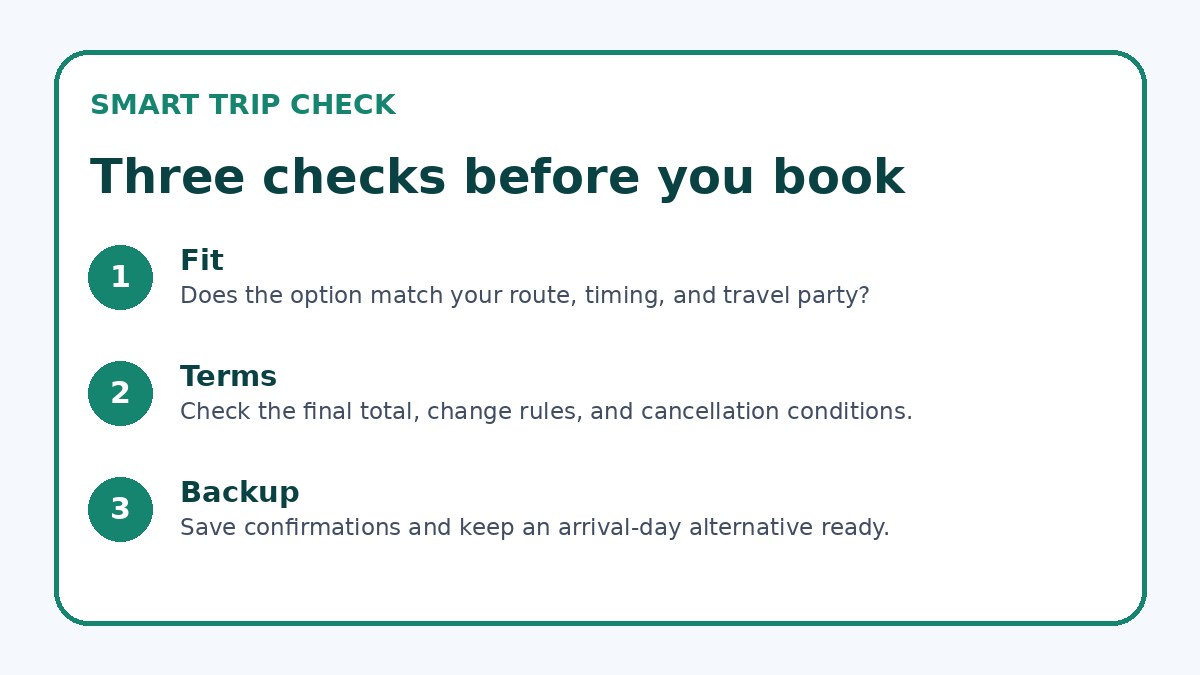
- Confirm departure and arrival station names and the exact terminal or platform on the carrier’s official site.
- Verify luggage allowances and handling rules for trains, buses, or flights before purchasing your ticket.
- Check whether seat reservations are required or recommended and reserve in advance when possible.
- Add estimated walking, transfer, and waiting times to the advertised journey duration to get true door-to-door timing.
- Plan for language or accessibility needs by checking station services and staffing in advance.
- Identify a realistic backup option for later the same day in case your preferred service is full or delayed.
Decision checklist: what to compare before you book
Before buying any ticket, compare the full journey: departure and arrival locations, total expected door-to-door time, number of transfers, luggage rules, seat reservation policies, and the ease of finding assistance if needed. Look at the carrier’s official booking page to confirm the latest schedule, whether seats are reservable, and any rules about refunds or changes. For buses, locate the precise boarding terminal; for trains, check whether you need to reserve a seat or if open seating is common; for flights, factor in recommended check-in times and onward transfer methods.
Also consider non-ticket factors that affect solo travelers: ease of obtaining help in English or your language, platform and station accessibility if you have mobility concerns, and late-night options if you arrive late. If you’re using a rail pass or any discount card, verify what services it covers and whether you must reserve seats in advance. Finally, have a simple backup plan—an alternative train or bus later that day—so you’re not stranded if your first choice is full or delayed.
Frequently asked questions
Is the train always the fastest way between Osaka and Hiroshima?
Trains are usually the fastest surface option for city-centre to city-centre travel, but “fastest” depends on where you start and finish. If your itinerary requires travelling from an airport or a suburban location, the total door-to-door time may change the comparison. Also factor in time needed to reach stations, check luggage procedures, and whether you must transfer. To decide, total the door-to-door time for each option—including local transfer times—and choose the service that fits your schedule best. Always confirm on the carrier’s site whether specific trains are direct or require transfers.
How should a solo traveler handle luggage when comparing options?
Check each provider’s luggage policy before booking because allowances and handling differ. Trains generally allow standard suitcases aboard with some overhead or storage space, but large items or surges in passenger numbers can complicate carriage. Buses and flights often have strict size and weight limits and may require checked luggage procedures. If you carry awkward or oversized items, prioritize options with clear baggage rules and minimal transfers. When in doubt, contact the operator or verify their rules on the official booking page so you won’t be surprised at boarding.
What’s the best approach if I need to travel late at night or early morning?
If you must travel outside regular daytime hours, compare late-night or overnight buses with limited train schedules, and check whether early trains require reservations. Overnight buses can save a night’s accommodation, but boarding locations and comfort levels vary; make sure you understand pickup points and any required ID checks. Early-morning trains may be limited, requiring an early start to reach the station. For both scenarios, confirm exact departure times, boarding locations, and staff availability on the carrier’s official pages so you can plan transportation to the terminal and ensure safety and convenience when travelling solo.
Final planning note
Choosing the most practical Osaka to Hiroshima transport depends on what you value: speed, cost, or simplicity. For most solo travelers who want predictable, city-centre arrivals and minimal transfers, a direct daytime train offers the best balance. If saving money is the priority and you can accept a longer journey, buses are a sensible alternative. Flights make sense mainly when they integrate with other air travel or meet a specific timing need. Whatever you pick, verify schedules, luggage rules, boarding points, and seat reservation requirements on the carrier’s official page before you book. Use the checklist above to compare door-to-door time, convenience, and cost so you travel with confidence.
Continue planning
Check current options and final conditions
Use the provider page to confirm live availability, the final total, cancellation terms, and every condition that matters to your trip.
This evergreen planning guide was created with AI-assisted drafting and a structured quality review. It does not display live prices, schedules, availability, visa guidance, or provider rankings. Verify current details before booking. Some links are affiliate links; we may earn a commission at no additional cost to you.