
For couples planning a trip to Osaka, the practical question isn't only which neighborhood or view you prefer — it's which booking terms protect your plans. If one partner's schedule might shift, flights are uncertain, or you want to lock in a room without committing rigidly, prioritize flexible cancellation and modification policies when comparing Osaka hotels. Start by deciding how much risk you're comfortable accepting: fully refundable up to a date, free changes but with rate differences, or a partly nonrefundable deposit that reduces price. Couples often trade price for flexibility; the right tradeoff depends on your tolerance for last-minute changes, how you handle budgeting, and what activities require firm dates. Below you'll find clear decision criteria, examples of how to read policy language, and a checklist to use when you book. Verify the final cancellation window, any penalties, and whether third-party bookings change the policy on the provider's final booking page before you confirm.
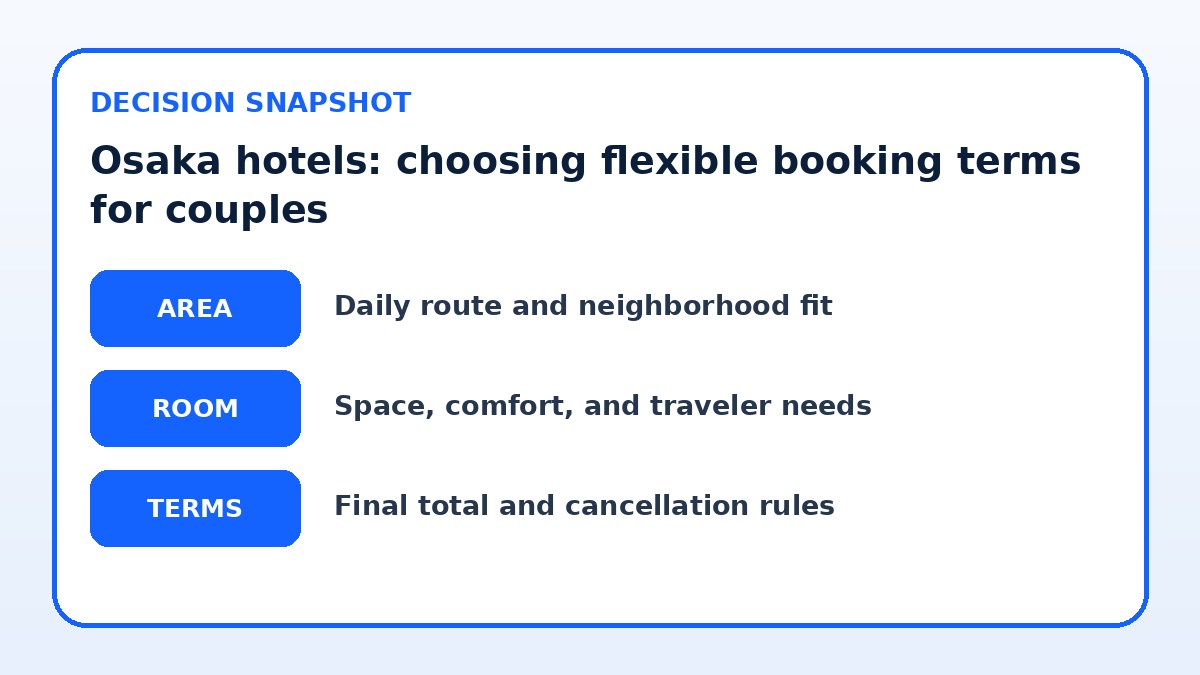
See current options before you compare the details
Availability and final conditions change. Open Trip.com now or keep reading for the practical comparison.
Understand the main flexible booking types
Hotels typically advertise a few different flexibility options: fully refundable up to a cut-off date, partially refundable with a deposit retained, nonrefundable with free changes allowed, or rates that permit date changes but charge for upgrades. For couples, the most useful distinction is between refunds (money back) and modifications (ability to change dates or guest details without a penalty beyond rate differences). A refundable policy may still require cancellation several days before arrival to receive a full refund, while modification-friendly policies can allow you to move dates closer to your stay but may require paying any rate gap.
When you read a policy, look for precise terms: the final cut-off time (often given in local time), whether refunds are subject to a service fee, and how changes to reservation length or room type are handled. Also check whether special-rate rooms, promotional add-ons, or packages carry separate rules. For couples juggling work or family obligations, a modification-friendly rate can be more valuable than a small refund because it preserves your trip without the hassle of rebooking later.
How to weigh price versus flexibility as a couple
Evaluate risk tolerance together. If one partner has a project deadline or an uncertain schedule, a pricier refundable rate might save stress and provide emotional value that outweighs the cost difference. Conversely, if both partners’ schedules are fixed and you’re confident about dates, a nonrefundable rate with a lower price can be sensible. Consider the likely scenarios: would you cancel entirely, postpone by a few days, or change the number of nights? For example, if shifting dates by a few days is likely, a rate that allows free date changes but charges for rate differences could be the best balance.
Another factor is your savings buffer and appetite for last-minute rebookings. If you prefer simplicity and don’t want to hunt for alternative nights, prioritize policies that explicitly permit free modifications. If you’re comfortable re-searching and price-watching, riskier rates might be acceptable. Communicate expectations clearly before booking so neither partner is surprised by a penalty or a logistical headache if plans change.
| Approach | Best for | Tradeoff to check |
|---|---|---|
| Fully refundable up to a date | Couples with uncertain schedules who prefer minimal financial risk | Typically higher rate and possible shorter availability windows |
| Flexible modifications (date changes allowed) | Couples likely to shift dates but keep the trip | May require paying any rate difference and limited by room class |
| Partially refundable with deposit | Couples balancing some protection with lower upfront cost | Deposit may be forfeited for late cancellations |
| Nonrefundable/cheapest rate | Couples with fixed plans who prioritize savings | Little to no recourse if plans change |
Ready to check the option that fits your plan?
Use your exact dates and traveler details so the provider page can show the current total and conditions.

What to verify on the booking page and confirmation
Always read the full policy on the booking page and again on the confirmation email. Verify the cancellation deadline in local Osaka time, whether refunds are full or partial, and whether third-party bookings (OTAs) have different rules than booking direct. If you see phrases like “nonrefundable” or “no changes allowed,” treat them as strict unless the fine print says otherwise. If the hotel offers vouchers instead of refunds, confirm how long the voucher is valid and whether it applies to standard rates or only specific offers.
If any condition is unclear, contact the hotel or booking provider before paying. Ask specifically about couples-related changes—adding or removing an extra guest, upgrading the room on arrival, or moving dates by a night or two—and get any special concessions documented in writing. If you use an OTA, compare the OTA’s stated policy with the hotel’s policy on the hotel website, and keep screenshots of the terms shown at booking. For convenience, you can also check a site like Trip.com to compare current availability and terms, but always confirm on the final booking page.
Before you book
- Confirm the exact cancellation deadline in Osaka local time on the final booking page before entering payment details.
- Note whether refunds return to the original payment method and how long processing typically takes, as stated by the provider.
- Ask if date changes are allowed without penalties and whether they can be completed online or require direct hotel contact.
- Compare the hotel’s direct-policy language with any OTA terms and keep screenshots of the policy shown at booking.
- Check whether promotional add-ons (breakfast, airport transfer) have separate cancellation rules and whether they are refundable.
- If you rely on travel insurance, verify that the hotel policy’s restrictions align with what your insurer will reimburse.
Decision checklist for common couple scenarios
Scenario-based thinking simplifies choices. If one partner’s work trip might overlap with leisure days, favor free-modification or refundable rates that permit switching dates close to arrival. If you plan a honeymoon or a once-only anniversary trip with fixed flights, prioritize a guaranteed room with clear cancellation insurance options. For flexible, multi-week explorations that might add nights, pick rates that allow night changes without penalties and are easy to extend. For short city stays where savings matter more than flexibility, compare the potential penalty against the saved amount to decide.
Also consider outside protections. If you have travel insurance that covers cancellations for covered reasons, you can factor that into how much flexibility you need from the hotel itself. However, insurance claims can take time and require documentation; if minimizing stress is key, direct hotel refunds or modifications are more immediate. Talk through the most likely “what if” scenarios with your partner and use that to pick the booking term that balances cost, convenience, and peace of mind.
Frequently asked questions
Can couples change the name on a hotel reservation or add a guest without penalty?
Policies on changing guest names or adding people vary by hotel. Many permits minor name corrections without penalty if the booking stays otherwise intact, but adding a guest or switching the lead guest sometimes triggers different room occupancy rules or an extra-guest fee. If adding a person changes the room type required for occupancy, the hotel may treat that as a modification and apply rate differences. Always check the booking terms and, when in doubt, contact the hotel to request authorization in writing so you have proof of the permitted change.
Is it safer for couples to book direct with the hotel or through an online travel agency?
Booking direct often simplifies communication and clarification of flexible terms, and some hotels provide more lenient or clearer modification routes to direct bookers. OTAs can offer good comparisons and special rates but may have their own cancellation procedures and hold different refund timelines. If you choose an OTA, read both the OTA’s and the hotel’s stated policies on the final confirmation page. For couples who want fewer intermediaries when modifying or confirming special requests, booking direct can be more straightforward—though it’s still essential to verify the exact policy at confirmation.
How do I calculate whether paying extra for flexibility is worth it for our trip?
Estimate the probability of a change and the likely cost of that change, then compare it to the price difference between flexible and restrictive rates. For example, if a refundable rate costs substantially more but the chance of needing changes is high, the extra cost may be justified for stress reduction and convenience. Also include indirect costs, like nonrefundable flights or lost time rebooking. Couples should discuss both financial and emotional value—sometimes a small extra sum that prevents last-minute stress is worth more than the theoretical savings from a nonrefundable fare.
Final planning note
When choosing Osaka hotels as a couple, the single best step is to align booking terms with the specific uncertainties you anticipate. Decide together whether you need refunds, free date changes, or simply the lowest rate, and then check the precise language on the final booking confirmation. Use scenario planning—what might cause you to cancel, postpone, or extend—and choose the option that minimizes the most likely friction. Keep documented evidence of the policy at the time of booking, and if anything is ambiguous, ask the hotel or booking provider to confirm the terms in writing. That preparation keeps your focus on enjoying Osaka together rather than managing logistical surprises.
Continue planning
Check current options and final conditions
Use the provider page to confirm live availability, the final total, cancellation terms, and every condition that matters to your trip.
This evergreen planning guide was created with AI-assisted drafting and a structured quality review. It does not display live prices, schedules, availability, visa guidance, or provider rankings. Verify current details before booking. Some links are affiliate links; we may earn a commission at no additional cost to you.