Practical answer up front: for business travel between New York City and Toronto, choose the flight that balances schedule fit with baggage rules and connection risk — not simply the lowest fare. If you travel with only a carry-on and can tolerate an earlier arrival at the airport, you can save time and reduce the chance of checked-bag delays. If you need checked luggage, add more buffer to your arrival time and prefer direct routings or single-ticket connections to avoid luggage recheck and missed-connection exposure. Before you book, gather exact travel dates, departure airport choice (NYC has several), return flexibility, number of bags, and whether you’ll require priority security, lounge access, or fast-track processing at customs. That information determines whether a slightly higher fare is worth the operational certainty for a tight business schedule.
See live routes for your exact travel day
Compare direct and connecting choices with the same baggage and traveler details.
Routing and how it affects baggage risk
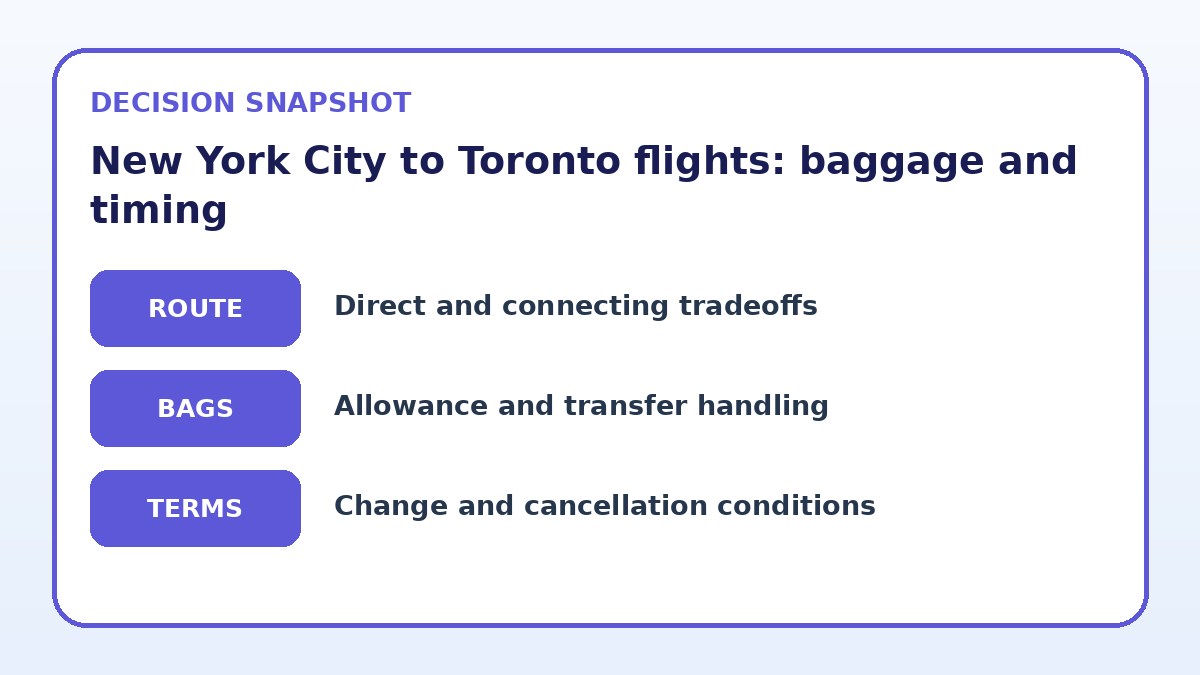
Routing choices on the New York City to Toronto corridor most commonly split between nonstop flights and itineraries with a connection. For business travelers who rely on precise arrival times, nonstop options minimize the number of handoffs for your luggage and reduce the chance that a delay in one leg cascades into a missed connection. When evaluating routes, look at how many carriers and operating partners are involved: a single-ticket itinerary booked through one airline or alliance generally means the airline will transfer checked bags and rebook you on the next available flight if an irregularity occurs, while separate tickets can leave you responsible for reclaiming and rechecking luggage.
Connections can be unavoidable depending on schedule fit or fare tradeoffs. If a connection is necessary, prioritize itineraries with longer minimum connection times and connections in large hubs where re-accommodation options are more frequent. Also verify whether the connection requires passing through U.S. or Canadian preclearance or customs — that affects whether you need to collect and recheck bags and how much time to allow. For business travelers, the marginal premium for a direct flight or a guaranteed single-ticket connection is often justified by the reduced baggage and connection risk.
Baggage choices: speed versus certainty
Decide whether you can travel carry-on only, because that choice dramatically shortens airport time on both ends. A single well-packed carry-on plus a personal item lets you skip checked-bag drop, head straight to the security line, and avoid baggage claim after arrival. For Toronto arrivals, carrying only a personal item or roller also removes the baggage-recovery step at customs, which can shave 15–45 minutes depending on arrival volume. However, ensure your carry-on meets the operating carrier’s size and weight policies and be realistic about bringing suits, laptops, and presentation materials; if you need garment bags or extra equipment, checked baggage may be unavoidable.
When checked bags are part of the trip, plan for the added steps: earlier airport arrival, time at the bag-drop counter, and retrieving luggage at the destination. For connecting itineraries, confirm on the booking page whether checked bags are transferred automatically or must be claimed and rechecked during connection. If the itinerary mixes carriers, verify whether the fare is interlined. Also consider paying for priority baggage handling or checked-bag guarantees if your employer values punctuality; these add costs but can shorten wait times at both ends and might avoid a last-minute wardrobe or equipment problem on arrival.
Compare flight-selection strategies
| Flight strategy | Best for | Risk to check |
|---|---|---|
| Book nonstop with carry-on only | Tight schedules and minimal baggage needs | May limit packing and could be pricier than connecting options |
| Single-ticket connecting itinerary with checked bag | Moderate schedules needing extra luggage with transfer protection | Longer total travel time but lower risk of lost bags |
| Separate tickets to lower fare with checked luggage | Cost-conscious travelers willing to self-manage connections | Higher risk: you must recheck bags and handle missed connections |
| Flexible business fare with priority services | Executives who need certainty and last-minute changes | Higher upfront cost, but reduces stress from delays and baggage issues |
Recheck the complete itinerary
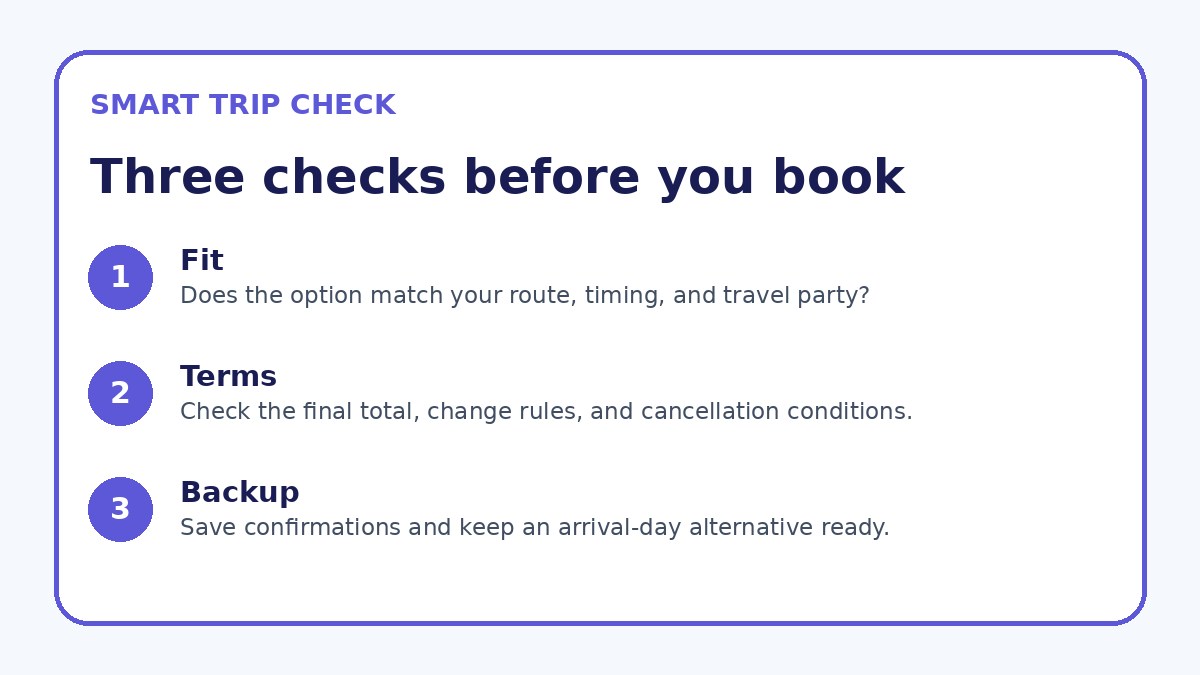
Confirm airports, connection handling, baggage, and change conditions before deciding.
Scheduling airport time for business priorities
For Manhattan-area departures, factor travel time to the selected New York airport, allowing extra cushion for traffic, transit disruptions, or delays in ride services. Business travelers with meetings immediately on arrival should add buffer for immigration, customs, and taxi or rideshare pickup in Toronto. If you travel during peak business windows, choose early morning nonstop flights where on-time performance tends to be better; conversely, late afternoons can be riskier because delays propagate throughout the day. Decide how much risk you can tolerate: an arrival slot that saves one hour of flight time may expose you to a higher chance of missing a meeting if the routing or baggage handling is less reliable.
If you require working time in transit, consider lounge access or priority security to protect meeting prep time. For same-day returns, look for flights with realistic minimum connection times and avoid itineraries with tight turnarounds between arrival and departure. When your schedule requires firm timing, buy a fare with flexible rebooking or a refundable option if offered, and confirm how changes are handled on provider pages. Always build a pre-arranged contingency in your schedule — an alternate meeting slot, remote dial-in plan, or a later same-day flight you could switch to with minimal penalty.
Flight details to verify
- Confirm exact travel dates, preferred NYC departure airport, and desired arrival window in Toronto before searching fares.
- List every item you need to carry (laptop, suits, presentation hardware) to choose carry-on only or checked baggage.
- On the airline or booking page, verify baggage allowances per segment and any weight or size restrictions.
- Check whether your itinerary is single-ticket or separate tickets and how that affects baggage transfer and re-accommodation.
- Add airport buffer time: allow extra time for checked-bag drop, security lines, and cross-border immigration procedures.
- Review fare change and cancellation terms and note any fees or same-day change options in writing from the carrier.
Fare conditions and what to verify before booking
Fare rules determine how easily you can adjust plans if flights are delayed or canceled. Before you click purchase, check change and cancellation fees, whether seat selection and baggage are included, and if same-day flight change options exist. Some business fares include flexible changes and bags in the price; others require a separate bundle or add-on. Look closely at the provider’s final booking page for the exact baggage allowance per segment and any weight limits — carriers sometimes vary allowance between partner-operated legs on the same ticket.
Also verify whether your fare requires online check-in windows, has strict minimum connection times, or limits refunds to travel vouchers. Confirm the precise transfer and recheck rules for international connections and whether there’s preclearance availability (which affects arrival procedures in Toronto). If you’re booking through an aggregator or corporate travel portal, use the provider’s final confirmation page to validate the operative carrier, baggage terms, and change penalty specifics. Trip.com can be used as one place to compare availability and conditions, but always confirm critical operational facts on the airline’s or booking agent’s final page.
Flight Guide questions travelers ask
How early should a business traveler arrive at a New York airport for a Toronto flight?
Aim for 60–90 minutes before departure if you’re truly carry-on only and have mobile boarding passes. If you need to check a bag, arrive at least 90–120 minutes earlier to allow time for bag drop and security. Also factor in travel time to the airport from your meeting location and potential traffic or transit delays. If you require special services like priority security or need to visit an airline counter, add another 15–30 minutes. Always verify recommended arrival times on the airline’s final booking page, as carriers sometimes set their own guidelines.
What should I check about baggage rules when comparing fares for this route?
Confirm whether the fare includes a free checked bag and what the carry-on and personal item size and weight limits are. Look at the baggage policy for each operating carrier on the itinerary, not just the booking carrier, because partner rules can differ. If your itinerary has connections, verify whether checked luggage is interlined or must be reclaimed at the connection airport. Also check for fees on oversized or overweight items and whether priority baggage handling is available. Always save a screenshot or PDF of the carrier’s baggage rules shown at booking.
If I have a tight meeting after arrival, how do I reduce the risk of delay from luggage or customs?
Travel carry-on only when possible to skip baggage claim and reduce customs interactions. Select nonstops or single-ticket connections to minimize transfers and the chance of delayed luggage. Choose flights that arrive at quieter times to shorten immigration and pickup waits, and consider priority lanes or immigration preclearance options if available. Factor in a time cushion between arrival and your meeting and prepare a backup plan such as remote participation in case of delays. Verify reentry, customs, and baggage procedures on the airline’s and airport’s official pages before departure.
Final decision note
For business travel between New York City and Toronto, the most practical choice balances schedule certainty, baggage needs, and fare flexibility. If your trip is time-sensitive and you can travel light, a nonstop with carry-on only simplifies the journey and reduces delay exposure. If you must check luggage, prefer single-ticket routing or a fare that includes baggage and flexible rebooking; that protects you from rechecking hassles and missed-connection fallout. Gather exact travel dates, departure airport choice, and a clear list of items you’ll carry before searching fares — then confirm baggage rules, interline status, and fare change conditions on the airline or booking page. That preparation keeps the trip predictable and lets you focus on the business at hand.
Continue planning
Check current options and final conditions
Use the provider page to confirm live availability, the final total, cancellation terms, and every condition that matters to your trip.
This evergreen planning guide was created with AI-assisted drafting and a structured quality review. It does not display live prices, schedules, availability, visa guidance, or provider rankings. Verify current details before booking. Some links are affiliate links; we may earn a commission at no additional cost to you.