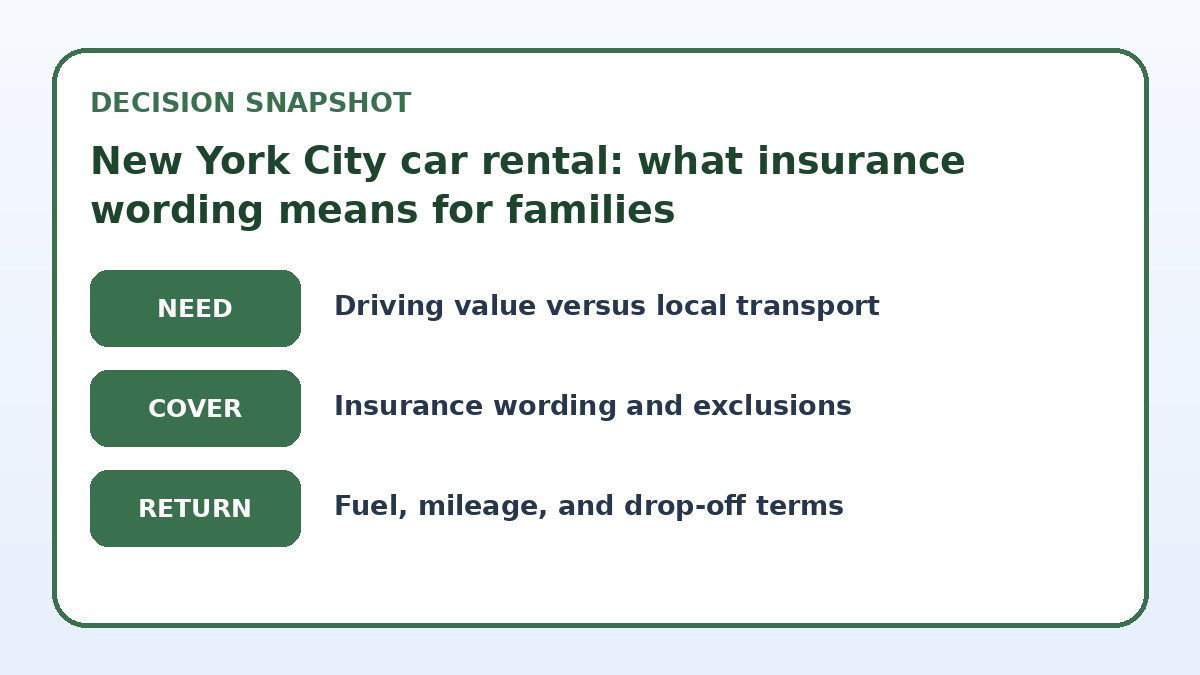
If you’re renting a car in New York City with kids, the most practical step is to read the actual insurance wording before you click confirm. Focus on three phrases: liability limits (how much is paid to other people), collision damage waiver (who pays for damage to the rental), and personal accident or medical coverage (what protects passengers). These terms determine who pays and when — and they vary by rental company, credit card benefit, and third‑party insurer. Families should prioritize clear liability protection and a collision option that removes surprise deductibles; consider passenger medical limits if you won’t rely on your health insurance while traveling. Keep your driver list short and confirm allowed drivers and age limits. Before finalizing, compare the exact policy text shown at checkout, your credit card’s terms, and any separate policy you’re offered — and verify these details on the provider’s final booking page.
See current options before you compare the details
Availability and final conditions change. Open Trip.com now or keep reading for the practical comparison.
Decoding the main insurance terms
Start with three core terms: Liability, Collision Damage Waiver (CDW) or Loss Damage Waiver (LDW), and Personal Accident Insurance (PAI) or Supplemental Medical. Liability covers damage you cause to other people and their property. CDW or LDW covers damage to the rental car; sometimes it only limits your financial responsibility rather than transferring all risk. PAI or medical coverage helps pay injuries to vehicle occupants but often duplicates travel or health insurance. Families should also spot “loss of use” and administrative fees — these can be billed while a car is being repaired and sometimes appear even when other coverage applies.
Next, look for qualifiers embedded in policy wording: deductible amounts, whether coverage is ‘primary’ or ‘secondary’, named driver requirements, and territory limits (for example, whether crossing state lines or into Canada is allowed). Policies frequently list excluded uses — off-road driving, using the car for commercial purposes, or driving under the influence — which are standard but critical to note. Also check sub-limits for child seats or third‑party property damage. If any phrase is unclear, ask the rental agent to show the clause in writing or request the insurer’s full policy document before accepting the rental.
How credit cards and your personal auto policy interact
Many credit cards offer rental car protections if you pay for the rental with the card, but the scope varies widely. Key distinctions to read in the card’s policy wording are whether coverage is primary (pays first) or secondary (pays after your personal auto insurance), what vehicle types are excluded (luxury cars, trucks, vans), and any country or state exclusions. For families, confirm that the card’s definition of ‘vehicle’ and the permitted driver list align with your planned rental — some cards exclude additional drivers or drivers under a certain age.
Your personal auto insurance at home may extend to rentals, but limits and deductibles apply. If your home policy offers strong liability and comprehensive/collision coverage with a low deductible, you may decline most add‑ons. If it doesn’t, a paid CDW at the rental desk or a separate short‑term policy could make sense. Crucially, verify whether your personal policy allows drivers who aren’t household members, and whether it covers long‑distance rentals or rentals in urban zones like New York City where parking and scratch risk is higher.
| Approach | Best for | Tradeoff to check |
|---|---|---|
| Use personal auto insurance + credit card primary coverage | Families with comprehensive home auto policies and credit cards that provide primary rental coverage. | May require filing claims with your insurer and handling a deductible or temporary holds on your card. |
| Buy rental company Collision Damage Waiver (CDW/LDW) | Families who want minimal paperwork and no surprise repair bills while traveling with children. | Usually higher daily cost; check for overlapping coverage you already own to avoid duplication. |
| Purchase standalone short‑term rental insurance from third party | Families seeking a potentially cheaper alternative to desk CDW with clear online policy wording. | You must verify claim handling rules and ensure the policy is accepted by the rental company at pickup. |
| Decline all add‑ons and rely on minimal coverage | Budget-conscious families willing to accept higher out‑of‑pocket risk to lower upfront costs. | Risk of large bills after accidents or damage and potential complications if an unlisted driver is involved. |
Ready to check the option that fits your plan?
Use your exact dates and traveler details so the provider page can show the current total and conditions.
Family-specific coverage decisions and tradeoffs
Families often weigh convenience and peace of mind against cost. Adding the rental company’s CDW typically reduces or eliminates the deductible and simplifies claims, which can be valuable with children onboard to avoid out‑of‑pocket repair bills. However, buying CDW at the desk can be expensive; if your credit card provides primary collision protection, or your personal insurance has a low deductible, you may decline the desk CDW and carry a copy of the card policy instead. Consider the hassle factor: filing claims from a trip, paying repair holds on a card, and potential rate increases on your personal insurance after a claim.
For family needs, also consider liability limits that match your assets and the costs of injury in a dense urban environment. Supplemental liability insurance at the counter increases the policy limit but may duplicate coverage you already have through personal insurance or a homeowner policy. If you won’t use public medical systems or your travel health insurance is thin, a PAI add‑on can be helpful. Ultimately, the decision hinges on how much administrative work and out‑of‑pocket risk you’re willing to accept in exchange for lower upfront rental quotes.
Before you book
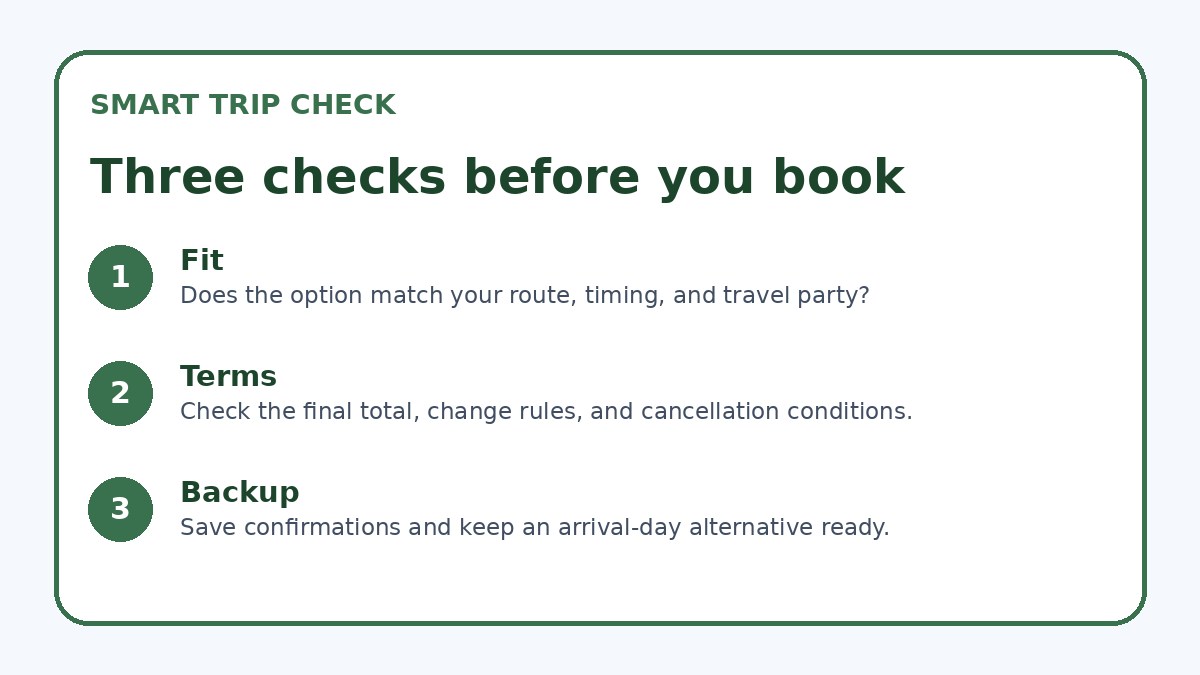
- Read the rental company’s insurance wording PDF at booking and save a copy to your phone and email.
- Confirm who is an authorized driver and add all family drivers to the contract before pickup.
- Check your credit card’s rental policy for primary vs secondary coverage and vehicle exclusions; print proof if needed.
- Photograph the vehicle thoroughly on pickup and return with timestamps to document existing damage.
- Verify deductible amounts, loss‑of‑use charges, and administrative fees listed in the rental agreement.
- Ask the agent to initial any verbal clarifications about coverage and keep the signed agreement with insurance terms.
Practical steps at booking and pickup
When booking, request the exact insurance wording or policy PDF the rental company will use at pickup. Read exclusions and confirm who qualifies as an additional driver, whether teenage drivers carry a surcharge, and whether child seats have separate liability rules. If you plan to return the car in a different state or take it across a border, confirm territorial limits in writing. If booking through an aggregator, follow through to the supplier’s page and check the final terms there — Trip.com is one example site you may use to compare, but always verify details on the rental company’s own booking page before you finalize.
At the pickup desk, ask to see the insurance section on the rental agreement and have the agent initial any changes or clarifications. Photograph the car’s condition and keep a timestamped record on your phone; this is often helpful if damage disputes arise. If you decline coverage, get that decline recorded on the contract to avoid later confusion. Finally, retain copies of any third‑party or card insurance documentation in both paper and digital form, and make sure all named drivers carry proof of authorization and the same credit card if required by the insurer.
Frequently asked questions
Does my credit card always cover rental cars in New York City?
Not always. Coverage depends on the card’s specific policy wording: some cards offer primary coverage (they pay first), others are secondary (they pay after your personal auto insurance), and some exclude certain vehicles or locations. For families, check whether additional drivers and under‑age drivers are covered. You must also follow any card conditions—commonly charging the entire rental to the card and declining the rental company’s CDW. Always read the card’s full rental policy and print or save proof before pickup; verify acceptability with the rental company at booking.
If I buy the rental company’s CDW, do I need travel medical insurance for my kids?
CDW covers damage to the rental vehicle but does not replace medical coverage for injuries. If you rely on family health insurance or travel medical coverage, verify their terms for out‑of‑state care. Supplemental Medical or Personal Accident Insurance at the desk can provide an extra layer for immediate medical expenses for passengers, but it often duplicates existing health policies. Review your health and travel insurance policies for emergency medical limits, and decide whether the rental add‑on reduces a risk you’re uncomfortable accepting while traveling in a busy city environment.
What should I verify on the rental company’s final booking page before I pay?
Check the exact insurance wording shown on the final booking page, including deductible amounts, liability limits, named driver rules, geographic restrictions, and the cancellation/refund rules for optional coverages. Confirm any additional driver fees, under‑age driver surcharges, and whether child seats are listed as an extra service with separate liability notes. If the booking references third‑party insurance or credit card benefits, confirm contact information for claims. When in doubt, request or download the insurer’s policy document and keep it with your travel paperwork.
Final planning note
Families renting a car in New York City benefit most from clear, documented decisions about insurance before they arrive at the desk. Focus on liability limits, how collision coverage handles deductibles and loss‑of‑use, and whether passenger medical protection fits existing policies. Balance convenience against cost: a rental company CDW often simplifies claims and reduces immediate stress with kids, while credit card or personal coverage can save money if their wording matches your trip’s needs. Whatever you choose, read and save the exact policy wording, add all authorized drivers in advance, and verify the final terms on the rental company’s booking page so you avoid surprises during the trip.
Continue planning
Check current options and final conditions
Use the provider page to confirm live availability, the final total, cancellation terms, and every condition that matters to your trip.
This evergreen planning guide was created with AI-assisted drafting and a structured quality review. It does not display live prices, schedules, availability, visa guidance, or provider rankings. Verify current details before booking. Some links are affiliate links; we may earn a commission at no additional cost to you.