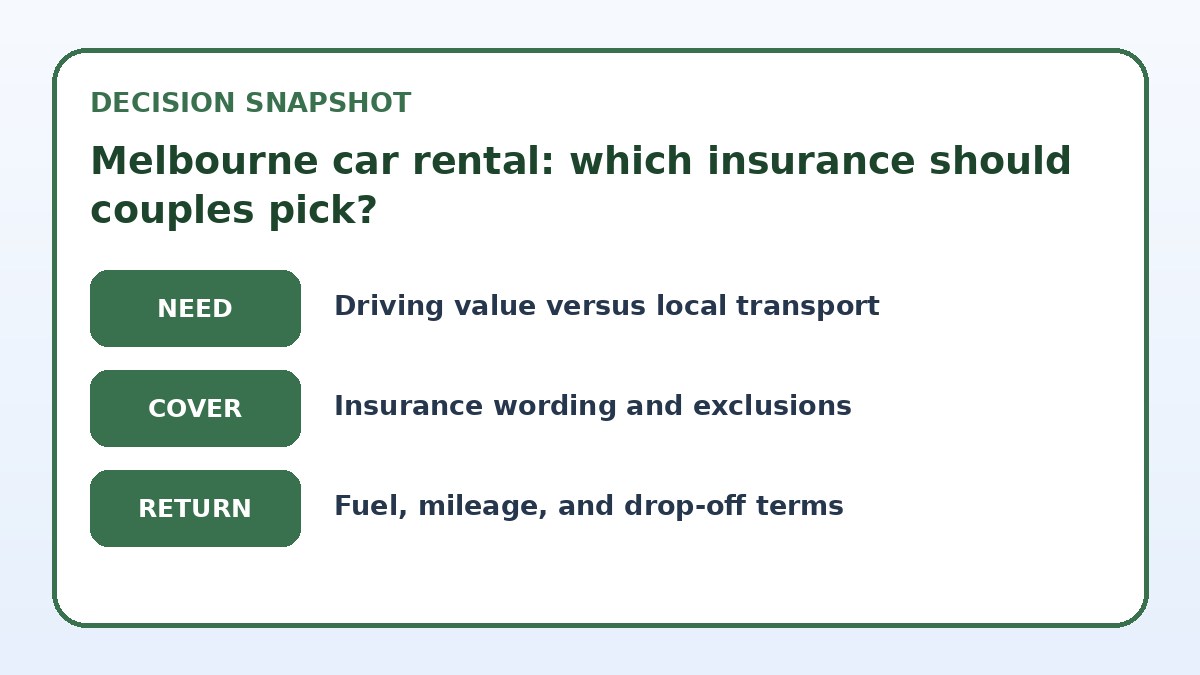
If you and your partner are renting a car in Melbourne, the practical choice is to secure Collision Damage Waiver (CDW) or Loss Damage Waiver (LDW) plus third-party property cover, and consider adding supplemental liability and personal effects protection only after comparing limits and exclusions. Start by confirming who is listed as an authorised driver, the excess amount (the amount you’d pay if a claim is made), and whether the quoted price already reduces that excess. Couples should also check whether their credit card or home car insurance offers primary or secondary cover in Australia—this can affect whether adding the rental company’s premium cover is necessary. Below I explain the common terms, how to spot exclusions in the fine print, and a simple decision process for two people sharing a rental in Melbourne.
See current options before you compare the details
Availability and final conditions change. Open Trip.com now or keep reading for the practical comparison.
Key insurance terms couples must understand
Car rental insurance uses a few standard terms that determine financial exposure. Collision Damage Waiver (CDW) or Loss Damage Waiver (LDW) limits your liability for damage to the rental vehicle but usually does not eliminate responsibility entirely — the rental agreement will show an excess (also called a deductible). Third-party liability covers damage you cause to other people’s property; in Australia, basic liability is often included but limits vary. Supplemental liability insurance (SLI) raises those limits, which can matter if you plan to drive on busy roads or in congested urban areas like central Melbourne.
Personal Accident Insurance (PAI) and personal effects cover protect occupants and belongings but often duplicate travel insurance benefits, so check your travel policy first. CDW/LDW exclusions are particularly important for couples sharing driving: many policies exclude damage caused on unsealed roads, by driving under the influence, or by drivers not named on the contract. Always note whether cover is primary (it pays out first) or secondary (your personal insurance must pay before the rental provider’s policy). That distinction affects whether you’ll face a reclaim process and temporary card holds for excess at pick-up.
How to decide which cover both partners should buy
Start by listing the realistic risks for your trip: city driving, nearby beaches or country roads, who will drive and for how many kilometres, and how comfortable you are with potential excess amounts. If one partner’s credit card offers primary rental car insurance in Australia, you may not need the rental company’s CDW — but verify the card’s terms carefully: some cards exclude Australian hires or certain vehicle types. If neither partner has robust primary cover, consider company-provided excess reduction that lowers or removes the excess at pick-up; for couples splitting costs this can be an acceptable trade-off for peace of mind.
Also factor in the practicalities of claims: a lower excess means less immediate outlay after an incident and a simpler resolution, but it usually raises the daily rate. For couples on a short weekend drive around the Mornington Peninsula or through the Yarra Ranges, a moderate excess with solid third-party liability might balance cost and risk. For longer road trips involving less-maintained roads, pay attention to exclusions and err on the side of a more comprehensive option that explicitly covers gravel or unsealed surfaces if you may use them.
| Approach | Best for | Tradeoff to check |
|---|---|---|
| Keep rental’s basic CDW and add SLI | Couples wanting low administrative hassle and solid third-party limits | Higher daily cost but simpler claims and usually fewer surprises at pick-up |
| Decline rental CDW and rely on credit card insurance | Couples with confirmed primary card coverage for Australian rentals | You must follow the card issuer’s rules exactly and handle more paperwork if a claim arises |
| Buy the rental company’s super-cover to remove excess | Couples who prefer to avoid a large deposit or potential out-of-pocket excess | Higher upfront price; may duplicate protections you already have elsewhere |
| Accept higher excess, add only personal effects/PAI | Budget-conscious couples who carry strong travel insurance | Lower daily rate but greater financial exposure if damage occurs |
Ready to check the option that fits your plan?
Use your exact dates and traveler details so the provider page can show the current total and conditions.
What to verify on the provider’s final booking page
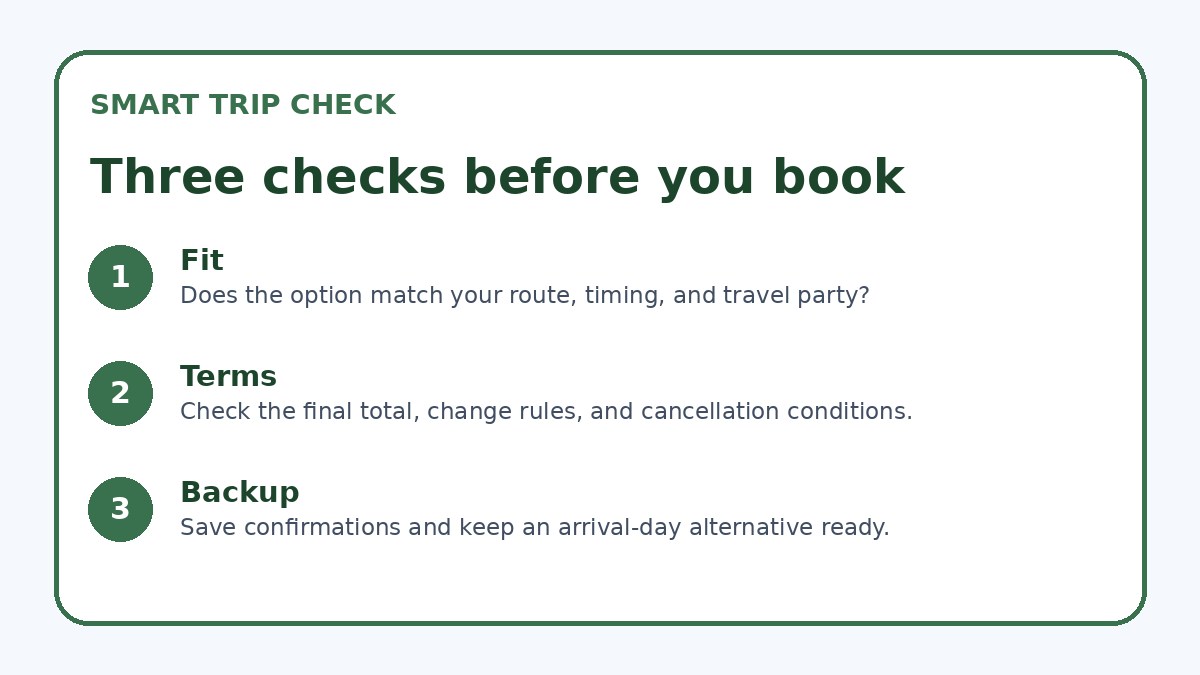
When you reach the provider’s final booking page, verify the named drivers, the excess amount, and whether the price shown already reflects any excess-reduction options. Check the exact wording about damage — phrases like “super-cover removes excess” or “CDW subject to exclusions” matter and should be backed by a clear exclusions list. Look for explicit statements about unsealed roads, windscreen and tyre cover, alcohol and drug exclusions, and whether the policy covers theft when keys are left in the car. If any clause is unclear, use the booking provider’s messaging or phone line to get written confirmation before you travel.
Confirm also whether extras commonly charged at pick-up apply, such as an additional driver fee, young-driver surcharge, or mandatory GPS/call-out fees. Verify the payment hold amount on your card for security deposit: rental companies often place a pre-authorisation hold equivalent to the excess or more. If you plan to rely on credit card insurance, note whether the card requires you to decline the rental company’s damage waiver; follow the card issuer’s instructions precisely and screenshot any confirmation to avoid disputes at the counter.
Before you book
- List both partners as authorised drivers on the rental contract and confirm no additional driver fees will be charged at pick-up.
- Check the excess amount and whether any purchased cover fully removes or only reduces that excess; get the exact figure in writing.
- Verify whether your credit card or personal car/travel insurance offers primary or secondary rental car coverage in Australia and save policy references.
- Read the exclusions section for unsealed roads, windscreen/tyre damage, theft conditions, and alcohol/drug-related exclusions before you accept cover.
- Confirm the expected pre-authorisation or security deposit amount on your payment card and ensure you have sufficient available credit.
- If buying top-level cover, request a written confirmation that it applies to both named drivers and covers the specific vehicle type you’re reserving.
Couple-specific scenarios and tradeoffs
If both partners will share driving equally, listing both as authorised drivers is the first step. If one driver is significantly younger, insurers often charge higher excesses or surcharge fees for drivers under a certain age — sometimes adding more than the cost of an excess reduction. Couples should weigh whether the younger driver’s occasional use justifies paying a daily surcharge, or whether the older partner can handle most driving to keep costs down. Also consider who will pay the excess and how you’d split that expense if an incident occurs: clear financial expectations avoid friction after a collision or scratch.
For couples who want minimal hassle, a top-level damage waiver that removes the excess and includes windscreen and tyre cover is convenient but costlier. Conversely, if you’re comfortable managing potential claims and have good backup insurance, accepting a higher excess and saving on daily hire can be sensible. The practical middle ground for many couples touring Melbourne is buying enough third-party liability to feel covered in urban traffic and either reducing the excess to a manageable level or confirming primary card cover that avoids additional rental charges.
Frequently asked questions
Can we rely on our credit card to cover rental car damage in Melbourne?
Possibly, but you must verify details directly with your card issuer. Ask whether the card provides primary cover for rentals in Australia or only secondary cover that pays after your own insurance. Confirm exclusions such as driver age limits, vehicle categories, and whether it covers loss of use fees or administrative charges. If the card requires declining the rental company’s CDW, follow that instruction exactly and keep written proof. Before you travel, request the card issuer’s rental insurance terms in writing so you can show them at pick-up or in a claim.
Should both partners be on the rental agreement even for short drives in Melbourne?
Yes—add both partners as authorised drivers to ensure cover remains valid. If a partner drives but isn’t listed, the rental company may void insurance for any incident that occurs while they were behind the wheel. Also check whether adding a second driver incurs a fee, and compare that cost to the potential expense of an uninsured incident. For short trips, the extra driver fee is often modest and worth the certainty that both of you remain covered throughout the hire.
What common exclusions can unexpectedly void cover during a Melbourne hire?
Typical exclusions include driving on unsealed or private roads, driving under the influence of alcohol or drugs, using the vehicle for commercial purposes, leaving keys in an unattended unlocked car, and damage to the underbody if stated in the contract. Windshield and tyre damage is sometimes excluded unless you buy specific cover. Always read the exclusions list on the booking page and ask for clarification in writing for anything ambiguous. If you plan activities that venture off paved roads, explicitly confirm whether that use is covered.
Final planning note
For couples renting a car in Melbourne, the right insurance choice balances risk tolerance, existing cover from cards or travel insurance, and the trip’s driving conditions. Practical steps are straightforward: name both drivers on the contract, check whether your credit card provides primary cover, confirm the excess amount and exclusions, and decide whether reducing or removing the excess is worth the extra daily cost. Discuss who will pay excess charges and how you’ll handle a claim before you travel. Finally, verify all critical wording on the supplier’s final booking page—if anything is unclear, ask for written confirmation. For up-to-date availability and options you can compare online, Trip.com is one place to review provider terms before you complete booking, but always treat the rental supplier’s final booking page as definitive.
Continue planning
Check current options and final conditions
Use the provider page to confirm live availability, the final total, cancellation terms, and every condition that matters to your trip.
This evergreen planning guide was created with AI-assisted drafting and a structured quality review. It does not display live prices, schedules, availability, visa guidance, or provider rankings. Verify current details before booking. Some links are affiliate links; we may earn a commission at no additional cost to you.