Practical answer up front: before you hit search for Los Angeles to Honolulu flights, have exact travel dates, each traveler’s full name and date of birth, preferred cabin and baggage needs, carry-on children gear, and a target schedule window ready. With that information you can directly compare nonstop versus one-stop routing, include realistic baggage costs, and verify connection times and fare conditions for refunds or changes. Families benefit most from checking seat availability together, timing flights around nap and meal schedules, and confirming airport transit time in Los Angeles to avoid rushed connections. This article shows the route-versus-fare tradeoffs, how to weigh connection and baggage risk, and the precise items to verify on the airline’s or booking site’s final page before you complete a purchase.
See live routes for your exact travel day
Compare direct and connecting choices with the same baggage and traveler details.
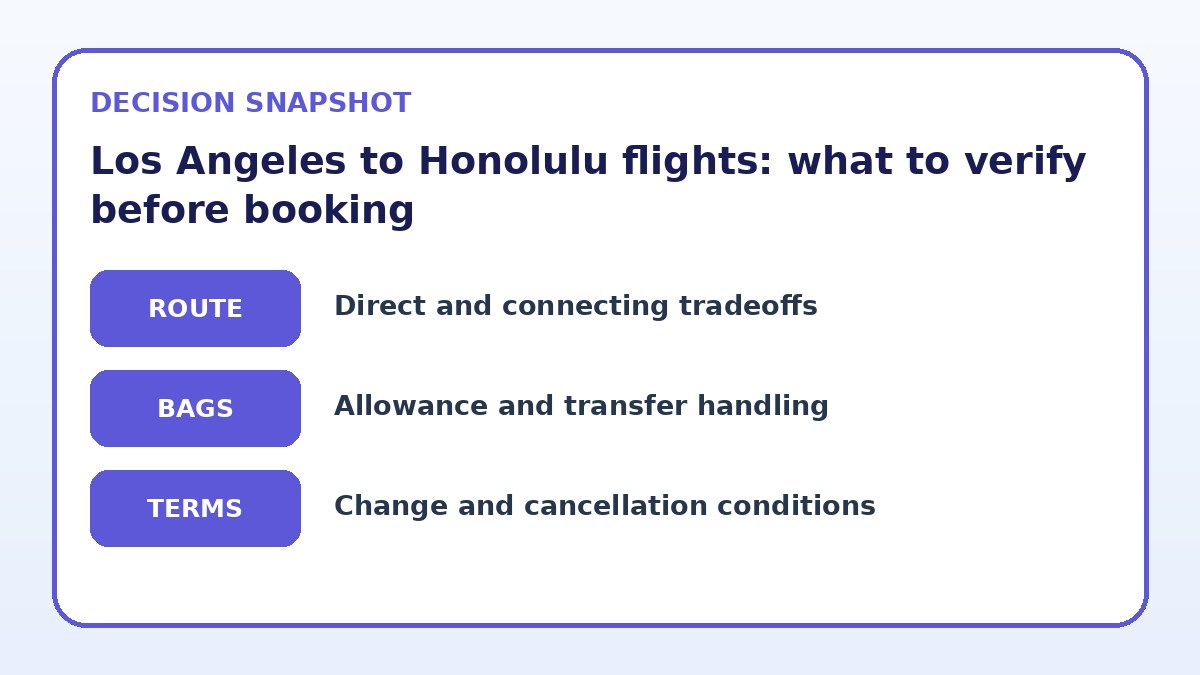
Routing choices: nonstop vs. connections
For families, the fundamental routing decision is whether to prioritize a nonstop flight or accept a connection for a lower base fare or better schedule. Nonstop flights reduce the number of times you have to deplane, manage carry-on bags, and calm children during transitions. If nonstop options exist on your planned dates, check seat maps for family seating and whether the cabin configuration supports bassinets or extra-legroom seats you may need. If nonstop space is scarce or costly, evaluate one-stop itineraries that keep layovers at a single friendly airport and avoid tight minimum connections.
When considering connecting itineraries, research the airport where you would change planes: does it have family-friendly facilities, orderly transfer processes, and minimal airside distance between gates? Don’t assume connection times listed by search engines are safe for families—factor in stroller gate check, restroom breaks, and a buffer for potential arrival delays. On the airline’s final booking page, verify total elapsed travel time, terminal changes, and whether your itinerary requires re-checking luggage. Keep a list of acceptable layover lengths that suit your children’s routines before you compare live fares.
Baggage and carry-on planning for families
Baggage rules determine real trip cost and convenience for families. Before comparing fares, inventory what you’ll bring: checked suitcases, infant equipment, car seats, strollers, and extra carry-on bags for snacks and entertainment. Different fare buckets and carriers treat checked bags, infant items, and car seats differently—some allow stroller gate check free of charge, while others count car seats as a checked item. Put these specifics into a simple spreadsheet so you can add up base fare plus baggage and seat costs rather than just comparing headline prices.
On the airline’s final booking or confirmation page, verify how many checked bags are included per passenger and whether infant or lap child items are exempt from fees. Check size and weight limits and the stated process for gate-checking strollers or registering car seats. If a connection requires re-checking bags, note that in your planning and confirm whether your fare includes through-checked baggage. Keep photographic records and serial numbers of bulky items and know what proof you’ll need if a carrier asks for damage claims later.
Compare flight-selection strategies
| Flight strategy | Best for | Risk to check |
|---|---|---|
| Choose nonstop flights where available | Families prioritizing fewer transitions and simpler logistics | Often higher base fares and limited seat availability for groups |
| Book one-stop itineraries with long layovers | Families willing to trade time for lower fares and calmer transfers | Longer total travel time and more time managing children in airports |
| Select flexible/refundable fares | Families needing the ability to change plans without steep penalties | Higher upfront cost that may not be used if travel goes as planned |
| Buy the cheapest nonrefundable fare and add protections | Families comfortable with risk who want the lowest base cost | Potentially large fees for changes or need to buy separate travel insurance |
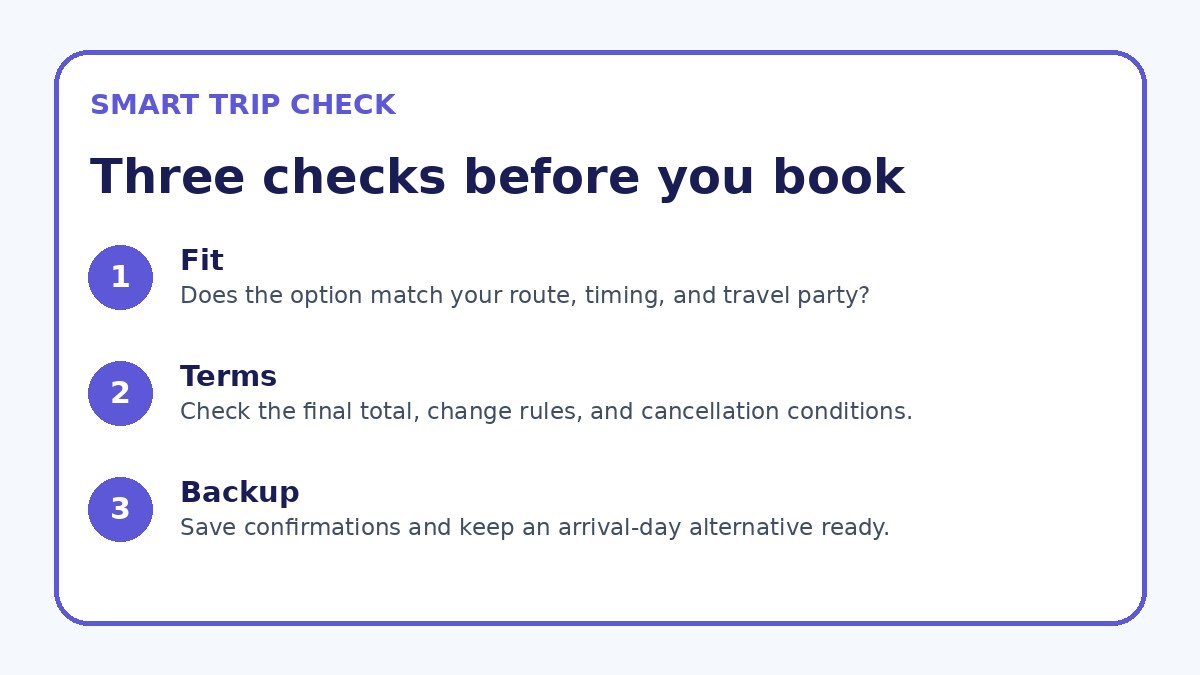
Recheck the complete itinerary
Confirm airports, connection handling, baggage, and change conditions before deciding.
Schedule fit and family routines
Match flight times to your children’s sleep and meal patterns rather than chasing the absolute cheapest departure. Early-morning departures can be great if the family sleeps on the plane, but they may require a disruptive pre-dawn airport drive and longer time at the terminal. Evening arrivals in Honolulu can work well if your children adapt to local time on arrival, but consider airport transfer times and hotel check-in policies. Create a shortlist of acceptable arrival windows in Honolulu and departure windows from Los Angeles before scanning fares.
When evaluating flight options, factor in pre-flight routines like arriving early for strollers and security, and post-arrival needs such as picking up checked car seats or passing through baggage claim. If traveling with infants, plan for nursing or feeding windows and confirm whether the aircraft has space for a bassinet or if you’ll need to reserve bulkhead seats. On the booking page, check whether seat assignments are allowed at purchase and, if not, what the carrier’s family seating policy recommends to secure adjacent seats.
Flight details to verify
- Lock in exact travel dates and times for departure and return, including acceptable alternative dates for each family member before searching live fares.
- Collect each traveler’s full legal name, date of birth, and any loyalty numbers to enter accurately at booking and avoid name-correction fees.
- List all luggage and child equipment (checked bags, strollers, car seats, infant items) and check the airline’s specific size, weight, and gate-check rules on its booking page.
- Decide on seating preferences (adjacent seats, bulkhead, bassinets) and verify seat assignment availability and any fees during the booking process.
- Read and save the fare conditions shown on the airline or OTA final page: change fees, refund policy, deadline for requests, and baggage inclusions.
- Prepare a contact and document pack (photocopies or photos of IDs, medical notes for special needs, and emergency contacts) to confirm before you finalize the booking.
Fare conditions and refund/change risk
Fare conditions—change fees, refundability, and rebooking rules—matter more for families because illnesses or schedule conflicts happen. Before booking, decide how flexible you need to be. Lower-cost fares often limit changes or impose high fees; flexible fares or refundable options give peace of mind but usually cost more. Instead of assuming, read the fare rules linked on the booking page: note the exact penalties for date changes, whether name corrections are permitted, and the timeframe required to request a refund or credit.
Also confirm what happens to extra services if you must alter travel: will your paid seats, checked bag allowances, or onboard extras carry over to a rebooked itinerary or be forfeited? When comparing options, mentally add the potential cost of a last-minute change or a family emergency to the base fare to see if a flexible fare saves money overall. If you use an OTA or search engine, verify the same fare rules on the airline’s own booking page before committing, and consider checking availability on Trip.com as an additional reference point.
Flight Guide questions travelers ask
Should families always pick nonstop Los Angeles to Honolulu flights?
Not always. Nonstops reduce the number of transitions and can make traveling with small children more predictable, but they may come at a higher fare or limited seat availability. Families should weigh whether the convenience of fewer connections outweighs the incremental price. For some trips, a single connection with a comfortable layover and family-friendly transfer airport can be less stressful and significantly cheaper. Before booking, compare the total door-to-door time, seat availability for your party, and the combined cost of fare plus baggage and seat fees.
How do I calculate the true cost of a family flight from Los Angeles to Honolulu?
Start with the base fare for all passengers, then add mandatory taxes and fees shown at checkout. Next, add the cost of checked baggage for each bag you’ll need, any paid seat assignments required for family seating, and charges for infant or car-seat handling if applicable. If you expect date changes, factor in the potential change fees or cost of a flexible fare. Keep a running total in a spreadsheet and verify each line item on the airline’s final booking page so there are no surprises after purchase.
What should I verify on the airline’s booking page versus a comparison site?
On the airline’s booking page, confirm seat assignment rules, exact baggage allowances and dimensions, fare conditions for changes and refunds, and whether any infant or special-item rules apply. Comparison sites can show relative prices and routing options, but fare rules and baggage inclusions may differ or display differently. Always cross-check the final price breakdown and the cancellation/change policy on the carrier’s own page before paying. Optionally, check Trip.com or another OTA for alternate displays of availability, but treat the airline page as the definitive source for ticket terms.
Final decision note
Booking Los Angeles to Honolulu flights for a family is about trading time, cost, and certainty. Start by assembling exact traveler details, luggage needs, and a window of acceptable departure and arrival times. Use those inputs to compare nonstop and connecting options, and be sure to add baggage and seat fees to the headline fare. Read and save the fare conditions on the carrier’s final booking page, and decide whether a flexible fare or travel protection is worth the extra peace of mind. With a clear checklist and the family’s priorities defined, you’ll make faster, more confident comparisons and choose the option that fits your household needs.
Continue planning
Check current options and final conditions
Use the provider page to confirm live availability, the final total, cancellation terms, and every condition that matters to your trip.
This evergreen planning guide was created with AI-assisted drafting and a structured quality review. It does not display live prices, schedules, availability, visa guidance, or provider rankings. Verify current details before booking. Some links are affiliate links; we may earn a commission at no additional cost to you.