Start by choosing an area that puts the journeys you’ll make most often within a short, reliable connection. For first-time visitors, the single most practical decision is which transport hub(s) you want on your doorstep: a Central London Tube interchange, an Overground/DLR node, or proximity to a mainline station for onward rail. That choice will shape daily friction—how often you need to change trains, how late you can get back, and whether taxis or buses become necessary. Pick an area first; pick a specific hotel second. Once you have an area in mind, compare walking distances to the nearest station, frequency of services at the time of day you’ll travel, and the ease of luggage handling. Verify schedules, accessibility options, and any luggage policies directly on the provider’s booking page before finalizing a room.

Check live stays in the areas that fit
Use your dates and party size to compare current rooms after you narrow the neighborhood fit.
Neighborhood fit: match the area to your itinerary
Decide which part of London you want to be in for most of your trip—West End for shows and central museums, South Bank for riverside attractions, or near a mainline station if you plan day trips outside the city. Think in terms of daily anchors: museums, theatres, sightseeing loops, or business addresses. If your schedule has morning commitments in a particular district, base yourself close to the station that gives the fastest route there rather than chasing perceived proximity on a map. Consider neighborhoods that give you choices: a hotel a short walk from two different stations or lines reduces single-point failures if a line is disrupted.
Also weigh the local vibe and practical services. Some neighborhoods offer plentiful evening dining and grocery options so you can recover from travel without long journeys; others are more residential and quieter but with fewer late-night conveniences. If you want easy river walks or markets on foot, prioritize hotels a short walk from those features even if they sit a little farther from the nearest Tube line. Finally, check whether the area tends to have step-free access at nearby stations if that matters for luggage or mobility—station accessibility can vary block by block.
Choose an area-selection strategy
| Area approach | Best for | Tradeoff to check |
|---|---|---|
| Base near a Central Tube interchange | First-time visitors wanting shortest inner-city travel times | Can be noisier, commercial, and sometimes pricier than residential areas |
| Stay by a mainline station | Travelers planning frequent day trips outside London | Some mainline-adjacent hotels are farther from tourist clusters and nightlife |
| Choose a riverside or neighborhood with walking access | Visitors who prefer walking between attractions and a local atmosphere | May require more train changes for certain destinations or longer evening returns |
| Pick a quieter residential neighborhood with good bus links | Families or long stays needing space and local amenities | Buses are often slower and less direct than Tube or rail for many tourist routes |
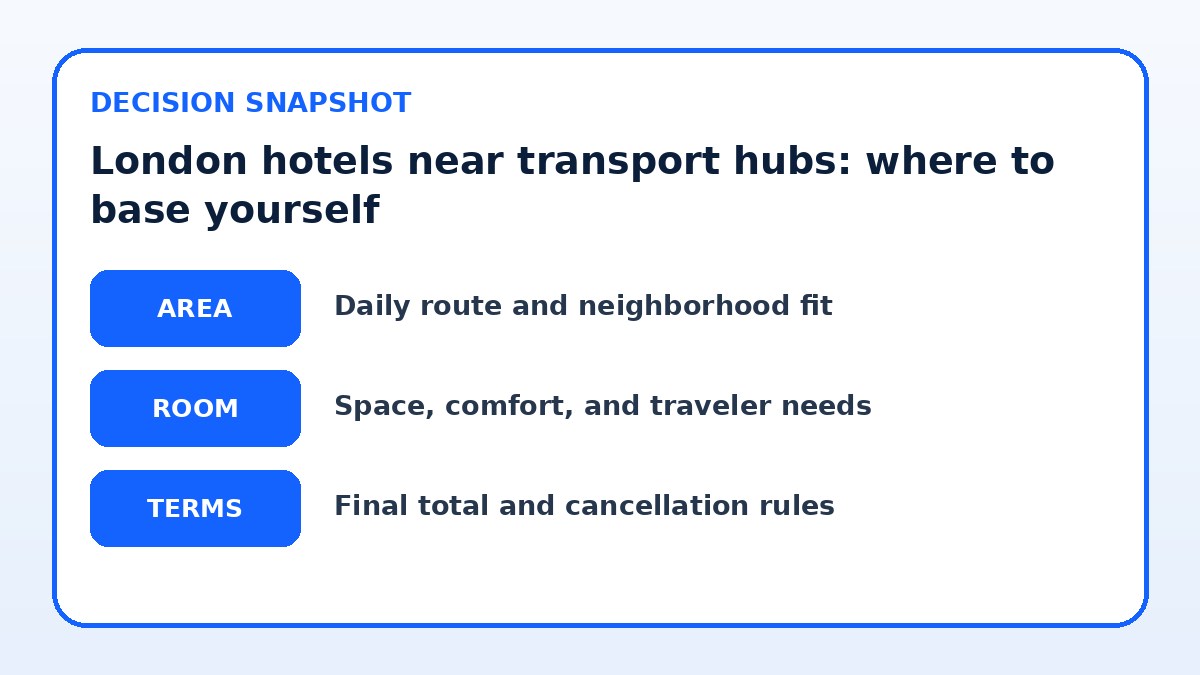
Daily-route friction: plan how you'll move every day
Map a typical day from your prospective hotel: first transport of the morning, mid-day hops, and returning at night. Count connections—each change adds time, chance for delay, and extra staircases. Aim to minimize transfers on your most frequent routes; a longer single-vehicle ride often beats a shorter trip requiring two or three changes. Consider service frequency at your travel times: a line that runs every two minutes during peak may be fine, but off-peak or weekend engineering works can mean buses replace trains or that services slow significantly. Check current timetables and weekend maintenance notices on the operator pages before booking.
Factor in luggage and comfort: walking 10 minutes to a station with frequent direct services can be less tiring than standing on multiple crowded trains. If you’ll be returning late from shows or restaurants, choose areas with consistent late-night transport options or easy taxi ranks. For day trips that start at mainline stations (for example to nearby towns), being a short walk from that station is worth trading away centrality. When comparing hotels, measure actual walking routes on a map rather than relying on station names alone—some ‘near’ listings hide uphill routes or narrow streets that slow you down.
Now compare like with like
Keep the same dates, guests, room needs, and cancellation preferences while you compare the final choices.
Room and party needs: size, accessibility, and storage
Your party size and luggage needs should influence both the neighbourhood and the hotel type. Solo travelers or couples can prioritize smaller central rooms near interchange stations; families or groups often need larger rooms or adjoining rooms, which are more common slightly away from the busiest central nodes. If you travel with bulky luggage or strollers, pick hotels advertising lift access and step-free entry, and verify whether the nearest station has step-free routes—this is information you must confirm on the station’s official accessibility page and the hotel’s booking page.
Check practical room features before you book: adequate storage for suitcases, family sleeping configurations, and whether rollaway beds are available if needed. Consider whether you need an early check-in or luggage-hold service; many places offer luggage storage but policies and fees vary, so verify this on the hotel’s final page. For longer stays, an area with supermarkets and laundry options is helpful—assess neighborhood amenities on a map rather than relying solely on hotel descriptions.

Hotel booking check before payment
- List your three most-visited daily destinations and plot fastest public-transport routes from candidate areas.
- Measure walking routes from each hotel to the nearest station at the exact time you’ll travel (use maps and street view).
- Verify step-free access and lift/wheelchair info for both the hotel and the nearest stations on official pages.
- Confirm check-in, check-out, luggage-hold, and early-arrival policies on the hotel’s booking page before reserving.
- Check weekend and evening service patterns for your chosen lines and search for planned engineering works on your dates.
- Compare room sizes and bedding options for your party, and confirm availability of adjoining rooms or extra beds if needed.
Booking terms and what to verify before you buy
Before you commit, read and confirm the booking terms that affect your transport choices. Check cancellation and modification policies, whether the rate includes breakfast, and if breakfast timing suits your travel schedule—an early breakfast can make catching morning trains much easier. Confirm whether the hotel offers an airport transfer, shuttle, or can arrange taxis if you will arrive late; verify these services on the hotel’s official booking page and ask how costs and pickup arrangements work if not clear.
Also verify accessibility features and specific transport details that can change: station step-free status, lift availability, service frequencies, and planned engineering works on your dates. If choosing a hotel near a major station, check whether the walking route between hotel and station uses busy streets or has multiple sets of stairs. Finally, compare live inventory and current conditions on comparison sites such as Trip.com as an initial check, but always confirm any crucial detail on the hotel or transport provider’s official page before paying.
Hotel Guide questions travelers ask
Should I prioritize being close to a Tube line or a mainline station?
If your trip centers on central London sightseeing, a hotel near a well-connected Tube interchange usually reduces in-city travel time. If you anticipate multiple day trips outside London or early/late arrivals by train, proximity to a mainline station will save walking and transfer time. Consider how often you’ll use each type of transport and whether you value direct routes over shorter walking distances. For mixed plans, choose a location within walking distance of both a Tube and an Overground or mainline station to keep options flexible.
How much walking is reasonable between hotel and station?
Comfortable walking distance depends on personal mobility, luggage, and time of day. Many travelers find 5–12 minutes acceptable if the route is flat and well-lit; longer walks are fine if the path is direct and pleasant. If you carry heavy luggage, have mobility constraints, or expect to return late, prioritize hotels with lifts and minimal staircases on the route to the station. Always test the walking route on a map and, if possible, street view to check for stairs, narrow pavements, and safe crossings.
Can I rely on hotel descriptions for accessibility and transport details?
Hotel descriptions can be useful but are not definitive. Confirm accessibility features—step-free access, lift dimensions, and mobility-friendly rooms—directly with the hotel through its official booking page or by phone. For transport details like station step-free status and service frequency, consult the official transport operator's site. When in doubt, ask the hotel to provide written confirmation of features that matter to your trip, such as luggage storage, late check-in procedures, or help with arranging taxis.
Final decision note
For first-time visitors to London, start by choosing the area that minimizes the journeys you’ll make most often: pick the station and lines you’ll rely on, then narrow hotels by walking distance, accessibility, and room configuration. This approach reduces daily friction and makes your days feel longer and more relaxed. Verify transport frequency, station accessibility, and hotel policies on the providers’ final pages before booking. Use comparison sites like Trip.com to view current availability, but always confirm the precise terms, cancellations, and accessibility details directly with the hotel or transport operators to avoid surprises.
Continue planning
Check current options and final conditions
Use the provider page to confirm live availability, the final total, cancellation terms, and every condition that matters to your trip.
This evergreen planning guide was created with AI-assisted drafting and a structured quality review. It does not display live prices, schedules, availability, visa guidance, or provider rankings. Verify current details before booking. Some links are affiliate links; we may earn a commission at no additional cost to you.