If you only have room for one priority when booking London hotels as a solo traveler, pick the factor that will shape every day of your trip: do you want less walking and faster transit connections, or do you want a private, quiet room to rest and work? Practically speaking, choose a central location if you plan many short outings, theater nights, and late returns; choose room comfort if you'll be working, recovering from travel, or simply prefer longer, restful stays. When you’re ready to book, compare hotel descriptions, floor plans, and guest photos for room size and noise notes, and always verify bed type, exact location (street/entrance), and cancellation or check-in policies on the provider’s final booking page. If you like, use Trip.com to compare current availability, but double-check any specifics directly with the hotel before you finalize.
See current options before you compare the details
Availability and final conditions change. Open Trip.com now or keep reading for the practical comparison.
Decide what your days will demand
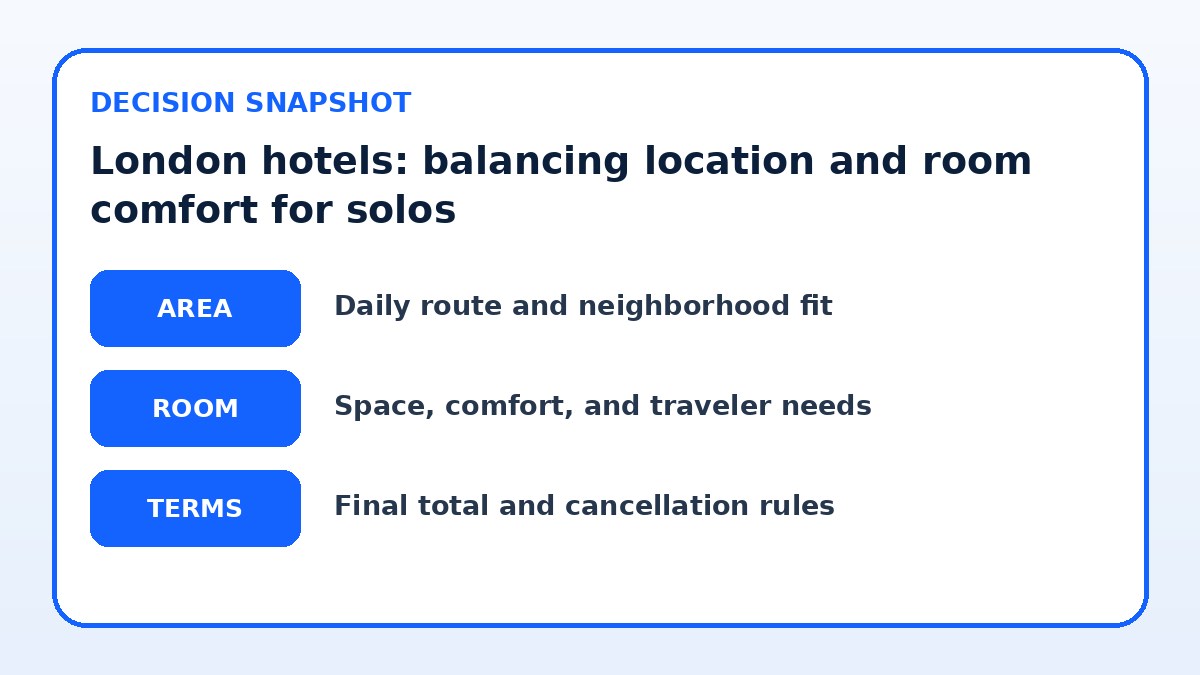
Start by listing how you’ll spend most days: full‑on sightseeing with frequent returns to the hotel, long workdays and evenings in, or a mix of theater nights and late meals. If you expect many short excursions and want to maximize time at attractions, a location inside zones 1–2 (central neighborhoods) will cut travel time and let you walk more. Conversely, if your schedule includes long work stretches, early nights, or you simply value a peaceful retreat after busy days, a quieter neighborhood with larger rooms might be a better fit even if it adds 20–40 minutes of transit each way.
Also consider how you’ll move around: if you’ll rely on walking, prioritize a compact central base close to the places you want to see; if you prefer public transit, check which tube or rail lines serve the hotel and how late services run. Solo travelers should factor in safety and convenience for late returns: well‑lit streets, nearby 24‑hour transport options, and easy taxi access reduce stress. Make a quick spreadsheet or notes comparing estimated door‑to‑door travel times from candidate neighborhoods to your top three planned destinations.
What to check about the room itself
When room comfort matters, look past the headline category and read the description carefully: exact bed size, room square footage, and whether the hotel lists soundproofing or blackout curtains. Guest photos and recent reviews often reveal if corridors, bars, or street noise intrude; if you’re sensitive to noise, ask to be allocated a higher floor or an internal courtyard room. For remote work or streaming, verify the stated Wi‑Fi type and whether the room includes a desk, adequate lighting, and convenient power outlets near the bed.
Consider practical features that affect comfort: ensuite versus shared bathrooms, lift access (important with luggage or mobility needs), and whether daily housekeeping or laundry options are available. If you expect to arrive late or depart early, confirm 24‑hour reception or key collection options. Because hotel descriptions can change, verify these specifics on the hotel’s booking page before paying and, when uncertain, contact the property directly to request photos or confirmation of the exact room you’ll receive.
| Approach | Best for | Tradeoff to check |
|---|---|---|
| Central compact room | Sightseeing, late-night plans, first-time visitors | Smaller living space and potentially more noise despite shorter transit times |
| Outer larger room | Work-focused stays, long rest periods, budget-conscious comfort | Longer daily commutes and less immediate access to central nightlife |
| Well-located mid-range neighborhood | Balanced trips with mixed sightseeing and downtime | Moderate commute and mid-size rooms that may lack premium amenities |
| Boutique or aparthotel with amenities | Independent travelers wanting privacy, cooking, or dedicated workspace | Fewer direct transit links and variable housekeeping or reception hours |
Ready to check the option that fits your plan?
Use your exact dates and traveler details so the provider page can show the current total and conditions.

Tradeoffs: location convenience versus restful space
Choosing location buys proximity to attractions, restaurants, and nightlife, saving time and often transport costs. However, that convenience usually comes with smaller rooms, more street noise, and fewer in‑room amenities. Inner London hotels can be excellent for short trips that prioritize seeing many sights; for solo travelers who expect to be out most of the day, the tradeoff of a snug room can be worth it. If your priority is to maximize daytime exploration and minimize transit, center your stay where it cuts the most time from your typical itinerary.
If your priority is sleep quality, workspace, or a sense of privacy, moving a bit farther out often yields larger rooms, quieter surroundings, and sometimes better on‑site facilities like a small gym or lounge. That convenience for rest comes at the cost of longer commutes to central attractions, and some evenings may require planning around transport schedules. Weigh how much of your time will be spent at the hotel; if restful downtime matters more than shaving minutes off travel, larger rooms are the practical choice.
Before you book
- List your top three daily activities and map their locations to see which neighborhoods minimize travel time.
- Filter hotel options by exact room type, bed size, and listed amenities; save screenshots of the listing details before booking.
- Message the hotel to request room floor, orientation (street or courtyard), and confirmation of soundproofing if noise concerns you.
- Check the nearest transport options and calculate door-to-door travel times for morning, evening, and late-night returns.
- Confirm check-in/out flexibility, cancellation terms, and whether late arrival is allowed on the hotel’s final booking page.
- Keep written confirmation of your room request and provider terms; bring printed or digital copies of any hotel replies.
Practical booking tips and what to verify
When comparing London hotels, filter searches by neighborhood and then narrow by room features that matter most: bed size, free Wi‑Fi, non‑refundable vs flexible rates, and cancellation windows. Pay attention to floor level and room orientation if noise is a concern—requesting a courtyard or higher‑floor room often helps. For transport, note the nearest tube/rail station and check whether the journey requires a transfer; an extra 10 minutes of walking to a better‑connected station can sometimes be worth it.
Before you commit, verify critical details on the booking page and ask the hotel if anything is unclear: exact room dimensions, bed configuration, check‑in and check‑out flexibility, and whether any refurbishments or events could affect noise or access during your stay. If you use comparison sites like Trip.com to view options, still confirm the provider’s terms on the hotel’s official page. Keep screenshots of booking confirmations and written replies to any direct hotel communications in case details need reconciling later.
Frequently asked questions
Is it safer for solo travelers to stay in central London or outer neighborhoods?
Both central and outer neighborhoods in London can be safe for solo travelers; safety often depends more on street lighting, how well you know the route at night, and common‑sense precautions than on centrality. Central areas have more people and later-night activity, which can feel reassuring, but they also attract pickpockets and can be noisy. Outer neighborhoods can be quieter and feel more residential, but check transport links for late returns and ensure the street to the hotel is well lit. Verify exact location and nearby services on the hotel’s booking page before you commit and check local travel advice if you have specific safety concerns.
How much should I prioritize Wi‑Fi and workspace in London hotels?
Prioritize Wi‑Fi and a proper workspace if you plan to work, stream, or handle travel tasks from your room; unreliable internet or poor lighting can disrupt work and add stress. Look for explicit mentions of high‑speed or business Wi‑Fi and confirm whether the room includes a desk, comfortable chair, and nearby power outlets. If the listing lacks details, ask the hotel directly for speed tests, photos of the workspace, or whether an alternative quiet lounge or business center is available. Always verify these specifics on the final booking page because amenities and policies change.
Can I save money by staying farther out and still enjoy London easily?
Yes—staying outside the most central neighborhoods often gets you more room for the money and a quieter environment. The tradeoff is added commute time to central attractions; evaluate whether that extra travel fits your daily plans. To make it work, pick accommodations near a fast transport link or a major rail/tube line, and factor in the time and cost of those journeys when comparing options. Double‑check the hotel’s exact distance to the nearest station on the booking page and use a map to estimate realistic door‑to‑door travel times during the times you’ll be moving around.
Final planning note
Balancing location and room comfort when booking London hotels as a solo traveler comes down to honest priorities: if you want to maximize sight‑seeing time and late evenings, central locations shorten journeys and add convenience. If sleep, workspace, or a calm base are more valuable, stepping a neighborhood out usually delivers larger rooms and quieter nights at the expense of more travel. Use a simple list of daily needs, check specific room details—floor level, bed size, soundproofing, and Wi‑Fi—on the hotel’s booking page, and message the hotel with any exact requests. With clear priorities and a few verification steps, you can choose a London base that fits how you actually want to spend your trip.
Continue planning
Check current options and final conditions
Use the provider page to confirm live availability, the final total, cancellation terms, and every condition that matters to your trip.
This evergreen planning guide was created with AI-assisted drafting and a structured quality review. It does not display live prices, schedules, availability, visa guidance, or provider rankings. Verify current details before booking. Some links are affiliate links; we may earn a commission at no additional cost to you.