If you want a practical place to sleep and a low-friction way to move around Hong Kong, start by picking a neighborhood with fast access to the MTR (subway), major ferry piers, or frequent bus/minibus corridors. For most first-time visitors that means deciding between Hong Kong Island (Central/Sheung Wan/Causeway Bay), Kowloon (Tsim Sha Tsui/Mong Kok), or an airport-adjacent area if arrival times and early departures matter. The simplest rule: prioritize an MTR interchange or a pier within a short walk when your daily plans include the Peak, Tsim Sha Tsui promenades, and at least one day trip to Lantau or outlying islands. This article gives a direct recommendation up front, then walks through neighborhood fit, expected daily-route friction, room and party needs, and the final booking terms to check before you hit pay.
Check live stays in the areas that fit
Use your dates and party size to compare current rooms after you narrow the neighborhood fit.
Neighborhood fit: match local character to your itinerary
Start by mapping your top three priorities — sightseeing, dining and nightlife, shopping, or nature outings — and then choose a neighborhood that naturally serves most of them. Hong Kong Island neighborhoods such as Central and Sheung Wan cluster high-end dining, Peak access, and ferries to outlying islands; Causeway Bay is a shopping and restaurant hub with dense transit links. On the Kowloon side, Tsim Sha Tsui places you on the harbourfront with easy access to museums and evening promenades, while Mong Kok focuses on street markets and local food streets. Each area gives you a different daily rhythm: quieter mornings or louder nights, more walking or more short rides.
Think about what you’ll do late at night or very early in the morning. If you expect late dinners and bars, staying within Central or Tsim Sha Tsui keeps taxi and transit options plentiful late into the evening. If you plan daytime island hopping or a lot of hiking on Lantau or the Sai Kung coast, consider a location a bit closer to ferry piers or bus terminals that serve those routes. Also consider crowd tolerance — Causeway Bay is lively and crowded, while certain parts of East Kowloon or quieter island towns offer calmer evenings at the expense of a slightly longer commute back to central attractions.
Choose an area-selection strategy
| Area approach | Best for | Tradeoff to check |
|---|---|---|
| Stay next to a major MTR interchange | Maximizing route flexibility and fast transfers across the city | Rooms tend to be busier and may command higher nightly density with more street noise |
| Choose a harbourfront hotel in Tsim Sha Tsui | Evening promenades, museums, and convenient ferries to Hong Kong Island | More tourist traffic and possibly longer walks to quieter dining streets |
| Book on Hong Kong Island (Central/Sheung Wan/Causeway Bay) | Short trips to the Peak, compact walking tours, and island-side dining | Higher daytime crowds and compact rooms compared with outlying neighborhoods |
| Stay near an airport or Tung Chung | Early flights, Lantau tours, or minimizing travel time to the airport | Farther from central attractions; you’ll trade convenience to the airport for longer daily commutes |
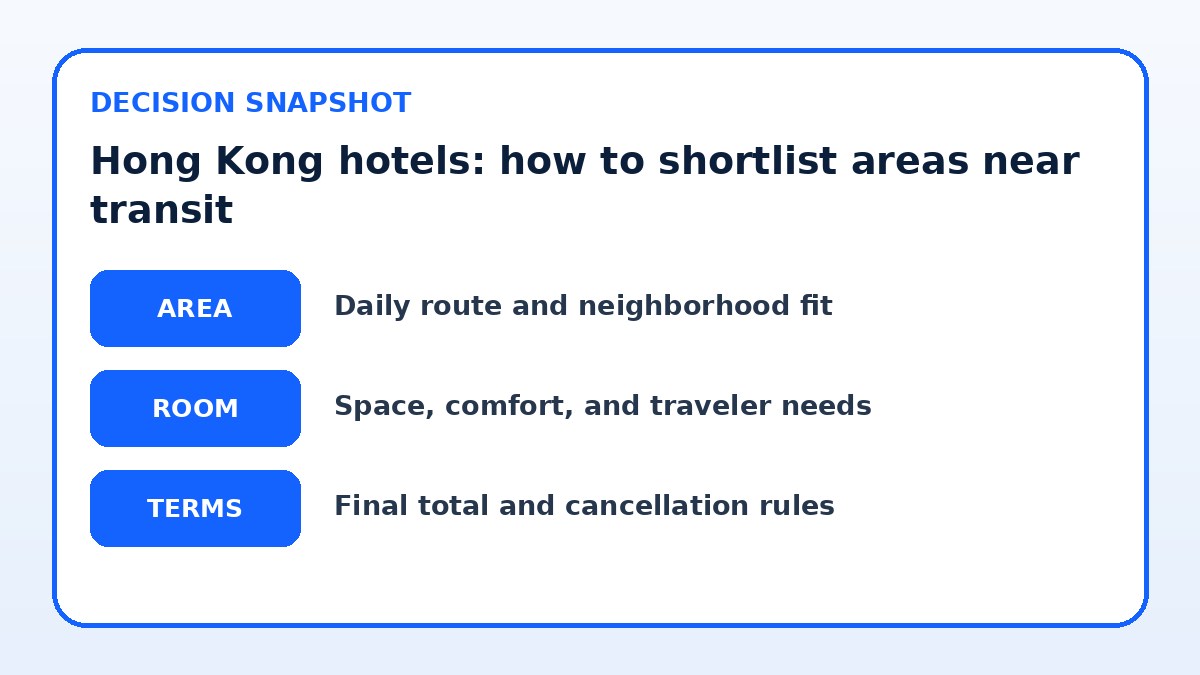
Daily-route friction: measure walking, transfers and luggage pain
Daily-route friction is the invisible cost of where you stay: the total time and hassle of getting from your hotel to the places you want to visit, including walks, staircases, and transfers. To assess this, list your most-visited stop (for example, The Peak, Avenue of Stars, or a popular restaurant) and estimate the typical transit pattern from candidate neighborhoods: direct MTR ride, one transfer, or a combination with a short ferry or bus. Short walks to an interchange station matter more than a single additional MTR stop; multiple transfers multiply stress, especially when you’re carrying luggage or traveling with children.
Also account for vertical movement inside neighborhoods — Hong Kong uses many elevated walkways and escalator systems that can speed or slow you depending on where the hotel entrance sits. Factor in peak-hour crowding: morning and evening commute times can add 10–20 minutes to journeys on busy lines. If you want to minimize this friction, prioritize hotels within five to ten minutes' walk of an interchange or a line with direct routing to your priority sights. When in doubt, note the walking route on a map app and time it at the expected hour of travel.
Now compare like with like
Keep the same dates, guests, room needs, and cancellation preferences while you compare the final choices.
Room and party needs: size, accessibility and shared facilities
Choosing the right room is inseparable from neighborhood choice because some districts are dominated by compact city hotels while others offer larger serviced apartments. If you’re a solo traveler or couple, a compact room near an MTR station usually suffices and keeps you centrally located. Families, older travelers, or groups should prioritize family rooms, suites with separate sleeping areas, or serviced apartments with kitchen facilities. Accessibility matters: ask about elevator access, step-free routes from the street to the lobby, and room layout if anyone in your party uses mobility aids.
Also think about in-building facilities that reduce friction between sightseeing trips: laundry services, luggage storage, a 24-hour front desk, and a small convenience shop can make a big difference on a long trip. If you plan on buying groceries or preparing simple meals, staying in areas with supermarkets and markets within a short walk is practical. Finally, if noise sensitivity is high, look for buildings with soundproofing claims and check which side of the street the room faces; quieter back alleys are common tradeoffs for slightly longer walks to transit.

Hotel booking check before payment
- Map your top three daily priorities and identify the closest MTR line or ferry pier that serves at least two of them.
- Measure walking time from the hotel entrance to the nearest station entrance during the hour you expect to travel.
- Confirm elevator or step-free access from street to lobby and, if needed, request a ground-floor or accessible room.
- Ask the provider about luggage storage and late check-in procedures if you arrive outside normal hours.
- Check the cancellation and change policy on the hotel’s official booking page before finalizing payment.
- Use a mapping app to preview the walking route and nearby conveniences like supermarkets, pharmacies, and eateries.
Final booking terms: what to verify before you commit
Before you book, confirm the walking time and route from the hotel to the nearest MTR station, ferry pier, or major bus stop — check the provider's page and a mapping app. Don’t rely solely on “near station” wording; some hotels list being near a station but require navigating stairs or long covered walkways. Verify check-in and check-out times, luggage storage policies, and 24-hour front desk availability if you have late arrivals or early departures. If you're arriving via the airport, confirm whether the hotel offers shuttle notices or clear instructions for the quickest public-transfer route.
Always review the booking provider’s cancellation, change, and deposit rules closely so you know how plans can shift. If you need verification of transport connections like ferry operators or special bus routes, check the operator's official schedule rather than the hotel page because service frequency and boarding points can change. You may compare current availability and conditions on Trip.com, but always cross-check key details on the hotel’s own booking page so you can confirm policies and any special requests before payment.
Hotel Guide questions travelers ask
Is it better to stay on Hong Kong Island or in Kowloon for a first visit?
Both sides work well for first-time visitors; the right choice depends on what you plan to do most. Hong Kong Island (Central, Sheung Wan, Causeway Bay) suits visitors prioritizing the Peak, high-end dining, and shorter island-side walks. Kowloon (Tsim Sha Tsui, Mong Kok) places you close to harbourfront museums, evening promenades, and lively street markets. If your itinerary mixes both, prioritize proximity to an MTR interchange that makes cross-harbour travel a single transfer so daily commutes stay short and simple.
How much walking should I expect from hotels marketed as ‘near the MTR’?
Marketing can be imprecise: ‘near the MTR’ can mean anything from a one- to 15-minute walk depending on exits and pedestrian routes. Factor in the specific station exit your destination needs, as some stations have multiple exits that change walking time. Also check for stairs, covered walkways, and busy intersections that slow you down. Use a mapping app to walk the route yourself ahead of booking, and confirm with the hotel which exit they reference on their listing.
What are the best indicators that a hotel will reduce transit friction for a group or family?
Look for short, step-free access to an MTR station or pier, family rooms or interconnecting rooms, on-site luggage storage and laundry, and a 24-hour front desk. A hotel with clear directions for public transport and nearby supermarkets or casual dining options will reduce the number of long trips you need to plan. Finally, confirm the room layout and bed configuration with the hotel rather than relying on generic room descriptions to ensure it suits children or multi-generational travelers.
Final decision note
For first-time visitors, the quickest path to a low-stress stay in Hong Kong is picking an area that naturally serves your core plans and gives you an easy link to the MTR or a ferry pier. Decide whether you prefer island-side walking and Peak access or harbourfront evenings and markets on Kowloon, then prioritize hotels within a short, step-free walk of the appropriate interchange. Balance room size and accessibility against daily-route savings and verify walking routes, station exits, and booking terms on the hotel’s official page before you book. With a neighborhood shortlisted and those checks complete, you’ll be ready to compare live availability with providers such as Trip.com or the hotel’s own booking channel.
Continue planning
Check current options and final conditions
Use the provider page to confirm live availability, the final total, cancellation terms, and every condition that matters to your trip.
This evergreen planning guide was created with AI-assisted drafting and a structured quality review. It does not display live prices, schedules, availability, visa guidance, or provider rankings. Verify current details before booking. Some links are affiliate links; we may earn a commission at no additional cost to you.