If you’re arriving in Hong Kong for the first time, decide quickly between three practical approaches: the airport train for speed and predictability, a taxi or ride-hail for door-to-door convenience, or an airport bus/shuttle for simpler luggage handling and lower stress. Which is right depends on where you’re staying, how much luggage you have, your arrival time, and whether you want the certainty of a reserved pickup. This guide gives the straightforward answer up front, then walks you through decision tradeoffs and what to verify before booking. Read it before you pick a transfer so you can balance time, cost, and convenience without surprises. It also lists the booking checks to make on carrier pages and when to consider booking a private transfer in advance.
Quick decision: pick by location, luggage, and arrival time
First, match the transfer type to the most important constraint on your trip. If you’re staying within a short walk of an airport train station, the rail option usually minimizes time and transfers. If your hotel sits off the main rail corridors or you're arriving very late, the convenience of a taxi or prebooked private transfer that drops you at the door often outweighs the higher cost. Consider luggage volume—many travelers with oversized suitcases, strollers, or sports equipment find taxis or shuttles simpler than juggling escalators and platform gaps.
Arrival time matters: if you land during off-peak hours when rail and bus frequencies drop, a booked ride can prevent long waits. Conversely, daytime arrivals when public transport runs frequently make trains and buses attractive. Also think about how familiar you want to be with local transit: first-time visitors sometimes prefer the predictability of a single door-to-door booking, while those comfortable navigating stations might prefer to save money and use public options.
How to compare the main transfer methods
Treat each option as a bundle of attributes: travel time, number of transfers, luggage convenience, cost visibility, and booking flexibility. The airport-to-city rail typically offers a consistent timetable with few transfers to central interchange stations; it’s easy to compare schedules on official rail pages. Buses and express coaches may stop closer to some neighborhoods than rail, but check where the drop-off stops are located relative to your hotel. Taxis provide direct routing but can be subject to road congestion—think about peak-hour traffic when you decide.
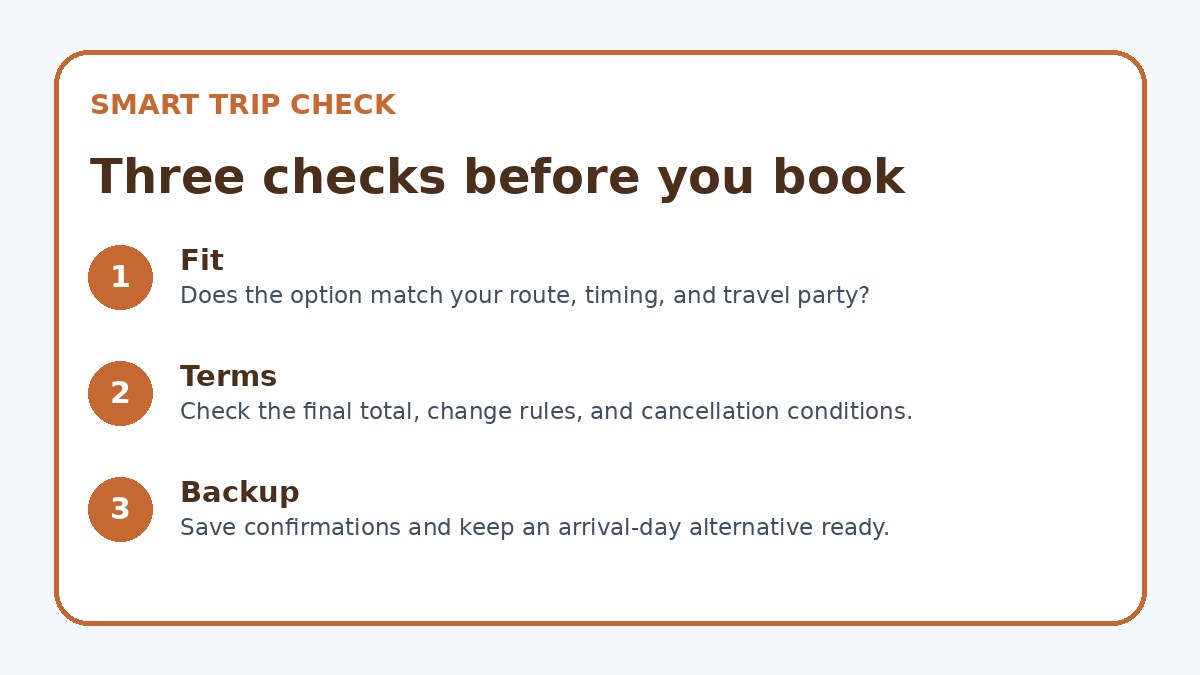
When comparing, open the provider’s final booking page to verify the cancellation policy, pick-up point, and whether the price shown includes taxes or tolls. If you’re considering a private transfer, confirm the vehicle size and luggage allowance, the driver’s meeting point at the terminal, and any waiting-time charges. Trip.com can be used to compare current availability and general options, but always cross-check details on the operator’s own page before confirming.
| Approach | Best for | Tradeoff to check |
|---|---|---|
| Airport train (rail) | Travelers staying near major stations who want fast, predictable connections | May require a taxi or short transfer from the station to hotels off-line |
| Taxi or ride-hail | Door-to-door convenience, late arrivals, or lots of luggage | Subject to traffic delays and potentially higher fares during peak times |
| Airport bus / express coach | Budget-minded travelers and those staying near coach stops | Slower than rail and may involve walking from the stop to your hotel |
| Prebooked private shuttle or transfer | Groups, families, or travelers needing multiple stops and guaranteed pickup | Higher upfront cost and requires careful confirmation of meeting details |
Practical tips for booking and arrival logistics
Before you book, note your terminal and whether your flight is domestic or international—this affects where you’ll meet a driver or board a train. Keep digital and printed copies of your booking confirmation and contact details for the operator. If you book a vehicle pickup, save the expected driver contact method and an accurate description of the meeting point inside the arrivals hall. For rail and bus, check whether you need to buy tickets before boarding or if smartcard options are accepted at machines and counters.
On arrival, give yourself time to clear immigration and collect luggage before assuming a tight transfer. Many first-time visitors underestimate the time needed for these steps, which increases the value of an airport-side meeting service if you’re on a short schedule. If you rely on ride-hailing apps, ensure your phone will work in Hong Kong or have a local SIM or roaming enabled; otherwise plan for cash or card payment options at taxi counters or ticket machines.
Before you book
- Confirm your arrival terminal and whether your flight is international or connecting before booking any transfer.
- Check the provider’s final booking page for pickup location, driver contact method, and waiting-time charges.
- Verify vehicle size and luggage allowance for private transfers to ensure all bags fit comfortably.
- Look up last service times for trains and buses for your arrival date and expected arrival hour.
- Save both digital and printed copies of confirmations and the operator’s phone number for arrival day.
- If you need accessibility features or child seats, request and confirm them directly with the operator in writing.
Safety, accessibility, and special needs
If you have mobility needs or are traveling with small children, prioritize options that minimize stairs, long transfers, or heavy lifting. Check whether a chosen transfer provides accessible vehicles or priority seating and whether stations have elevators and clear signage. For wheelchair users, confirm vehicle and station accessibility with the operator before booking; don’t assume it’s available without verification.
For late-night arrivals, verify the last service times for public transport, and consider booking a reliable taxi or private transfer in advance. If you’re carrying important or delicate items, a private transfer reduces the handling that comes with luggage storage areas on buses. Finally, always confirm refund and change policies in writing for any prebooked transfer, and keep contact details to resolve any issues on arrival.
Frequently asked questions
Is the airport train the easiest option for first-time visitors?
The airport train is often the easiest if your hotel is near a major rail interchange because it reduces time on the road and avoids traffic unpredictability. It provides straightforward signage and clearly marked platforms, which helps first-time visitors. However, if your hotel isn’t close to a train station or you have heavy luggage, a taxi or prebooked transfer may be simpler. Before you commit, check how far the station is from your accommodation and whether you’ll be comfortable moving luggage through any required transfers.
Should I prebook a private transfer or wait and take a taxi from the arrivals hall?
Prebooking a private transfer gives certainty about vehicle size, luggage space, and a driver waiting at a specific meeting point, which is comforting for late arrivals or complex itineraries. Taking a taxi from the arrivals hall can be flexible and sometimes faster if demand is low, but it means you’ll need to queue and confirm sufficient space on the spot. If your schedule is tight, or you’re unfamiliar with local cabs, prebooking reduces stress; if you prefer to remain flexible, plan a fallback taxi option.
Can I use ride-hailing apps at Hong Kong airport and are they better than taxis?
Ride-hailing apps can be convenient for door-to-door trips, but availability varies by app and operator rules at terminals, so check how pickups at the airport are handled. Taxis are regulated and available at designated ranks outside arrivals, which can be simpler when you don’t have a local app or SIM. Decide based on your phone connectivity, app familiarity, and whether you prefer cashless payments; if using an app, verify the terminal pickup procedure on the operator’s info page to avoid confusion.
Final planning note
Choosing how to get from Hong Kong International Airport into the city comes down to a few clear tradeoffs: speed versus door-to-door convenience, cost versus simplicity, and luggage handling versus transfers. For most first-time visitors, start by checking where your hotel sits relative to the rail network; if it’s close, the airport train often provides the clearest, fastest route. If you’re arriving late, traveling with family, or bringing oversized luggage, favor a taxi or prebooked transfer and confirm pickup details in advance. Always verify the operator’s final booking page for pickup instructions, vehicle capacity, wait-time rules, and cancellation terms so your arrival is smooth and predictable.
Continue planning
Check current options and final conditions
Use the provider page to confirm live availability, the final total, cancellation terms, and every condition that matters to your trip.
This evergreen planning guide was created with AI-assisted drafting and a structured quality review. It does not display live prices, schedules, availability, visa guidance, or provider rankings. Verify current details before booking. Some links are affiliate links; we may earn a commission at no additional cost to you.