Practical answer first: choose the mode that minimizes door-to-door friction. If you want the fewest transfers and predictable pickup/drop-off points, choose an option that connects directly between central city terminals (e.g., main railway station to central bus terminal) or a private transfer that meets you at your hotel. If cost or scenery matters more, a rail or overnight coach trip may be appropriate but expect extra transfers between stations, airports, and city centers. When picking your ticket, check exactly where the carrier names their arrival and departure points, how they handle luggage, and the advised arrival time at the terminal. Plan at least one hour of buffer for city transfers inside Hanoi and Da Nang, and have a simple disruption plan (backup bus or domestic flight search) if the primary leg is delayed or cancelled.
Choosing rail, coach, flight, or combinations
Start by matching priorities to modes: rail is often comfortable for long daytime or overnight trips and provides predictable stations; coaches can be cheaper and run more frequently but often arrive at peripheral terminals; flights save time on the long haul but add airport transfers at both ends. For first-time visitors, view each mode by door-to-door cost and hassle, not just journey time. That means including the time and money for taxis, ride-hails, or public transit to reach the departure terminal in Hanoi and to get from the arrival terminal into central Da Nang.
If you consider combining modes — for example, an early morning train to a mid-point plus a short coach onward — map every terminal and transfer point on a real clock. Note how luggage moves between segments: trains may allow larger checked bags you can leave under the carriage, while some express coaches or minibuses restrict baggage or charge to stow it. Wherever possible pick routings that share central or well-known terminals to cut the number of extra pickups and drop-offs you must arrange.
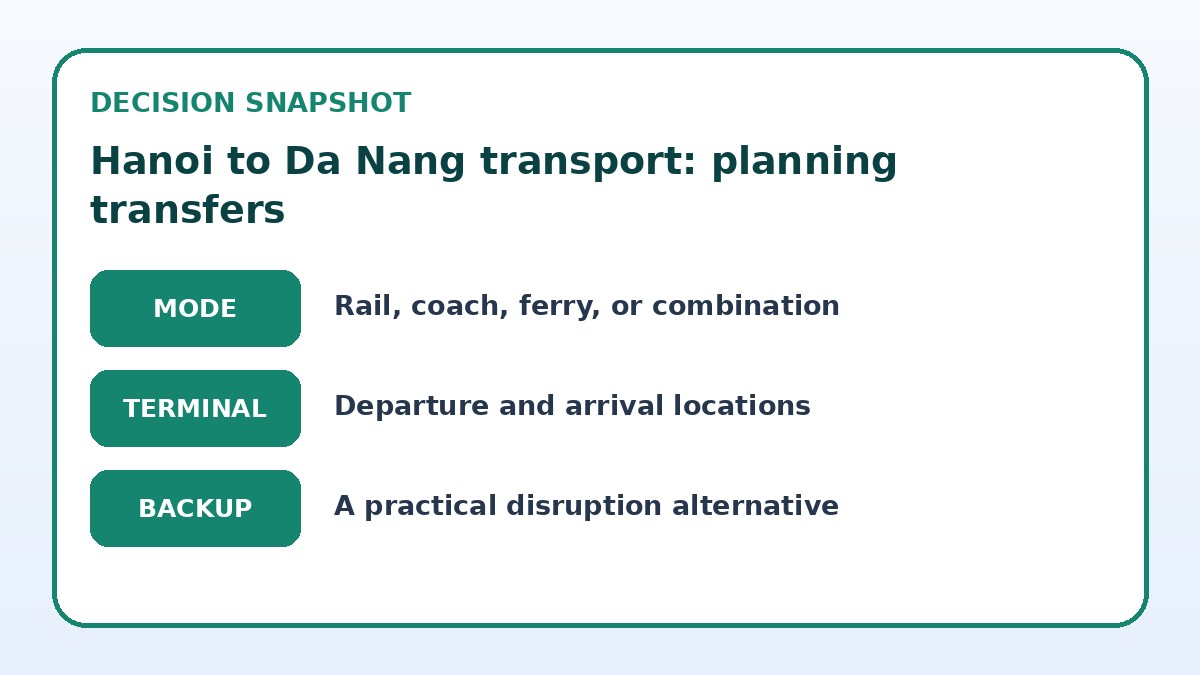
Choose the end-to-end journey plan
| Journey approach | Best for | Friction to check |
|---|---|---|
| Single direct door-to-door transfer (private car or arranged shuttle) | Travelers who value simplicity, minimal transfers, and direct hotel pickup/drop-off. | Higher base cost and less flexibility for last-minute changes compared with public options. |
| Direct train between main stations | Those who want stable ride comfort and easy station-based taxi connections at both ends. | Requires transfers if your accommodation is far from the train stations; stations may not be central to all neighborhoods. |
| Coach service between bus terminals | Budget-focused travelers who accept more frequent departures and simpler ticketing. | Often arrives at peripheral terminals, increasing local transfer time and luggage handling. |
| Mixed-mode (flight plus ground transfer or train plus coach) | Travelers balancing time savings with cost, or those breaking the journey to visit intermediate stops. | More moving parts mean higher chance of missed connections; requires careful terminal coordination and buffer time. |
Check live intercity options
Look beyond the ride itself and compare terminals, transfers, luggage, and arrival fit.
Terminal fit and local access
Don’t assume terminal names are identical to the neighborhoods you’re staying in. Hanoi and Da Nang each have multiple transport hubs that carry similar-sounding names; online booking pages can abbreviate station names. Before you book, copy the full address shown by the provider into a map app and simulate the transfer: estimate taxi or public transit time, and check whether the terminal has a clear passenger entrance or requires a walk down a side street. For hotels, ask reception which terminal is easiest to reach and whether they can book a recommended taxi or ride-hail service.
Consider the arrival terminal’s proximity to your accommodation and the convenience of onward connections. A peripheral bus terminal might be cheaper but require a long taxi or bus ride into central Da Nang, eating into any savings. If your arrival is late at night or very early morning, prefer central terminals or prebook a transfer so you are not waiting for scarce public transport. Always confirm which side of a large station the coach or train stops at — some services use separate platforms or boarding areas for different directions.
Luggage handling and transfer friction
Think through how you will move bags between the hotel, the departure terminal, and the arrival point. Trains usually handle larger, heavier luggage more flexibly than minibuses; however, loading and unloading still takes time at intermediate stops. If you have bulky items, choose departures from main stations with baggage facilities or supply phone-ready instructions for taxi drivers to help with loading. If booking a private transfer or shared shuttle, confirm luggage limits and whether extra fees apply for oversized items.
Small but crucial choices reduce friction: use backpacks or soft-sided luggage that fit under seats of coaches, keep essential items and documents in a daypack you can carry, and avoid checking items across multiple legs when possible. If an itinerary requires moving between an airport and a coach station, plan an extra 45–90 minutes for baggage collection and ground transfers. At booking, note any provider text that defines check-in windows, baggage allowances, or recommended arrival times and verify those details on the booking page before travel.
Compare the practical alternatives
Use the final page to confirm what is actually offered on your dates and save a workable fallback.
Intercity travel checklist
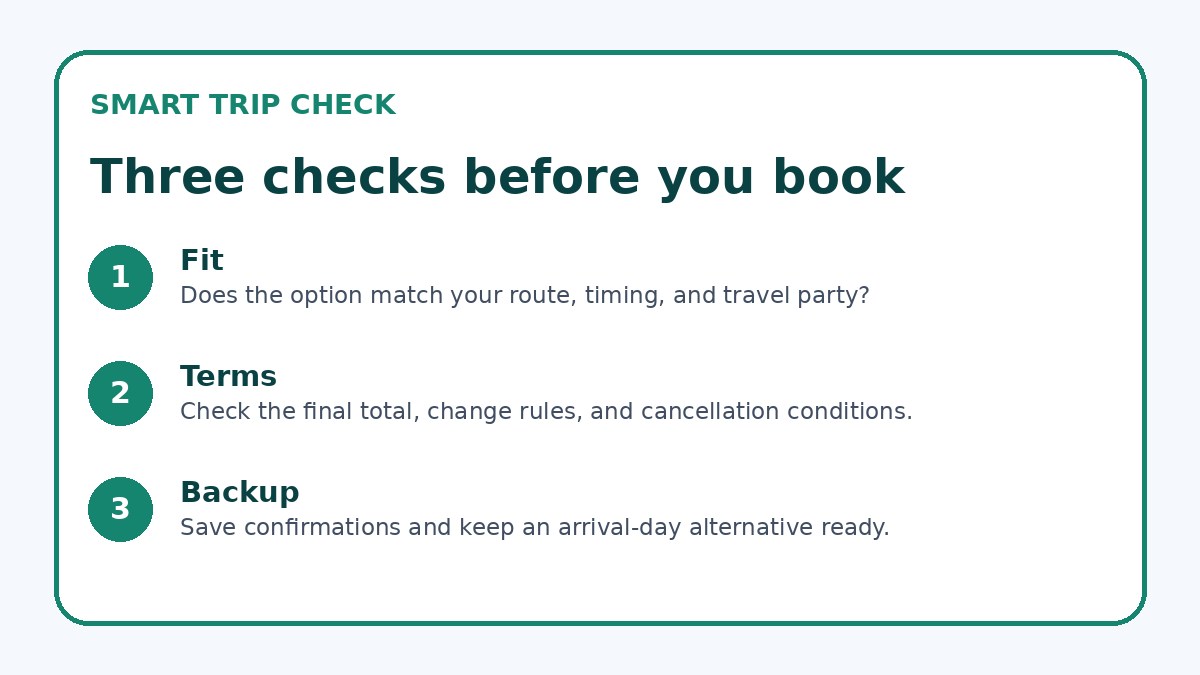
- Copy the exact departure and arrival terminal names and street addresses from your booking page into your map app and save offline.
- Estimate door-to-door travel time including predicted traffic, and add at least 45–60 minutes buffer for city transfers.
- Confirm luggage allowances and any extra baggage fees on the carrier’s final booking page before you travel.
- Ask your hotel or host for a recommended taxi company or transfer service that knows the terminal layout.
- Keep digital and printed copies of tickets, terminal addresses, and local contact numbers for offline use.
- Identify one realistic alternate service (train, coach, or flight) you could book if your planned leg is cancelled.
Timing flexibility and a disruption backup
Build buffer time into every transfer. Traffic near Hanoi’s centers can be unpredictable, and delays on one leg often cascade into missed connections. When you choose tight connections, you trade lower layover time for higher stress and the risk of overnight disruption. For first-time visitors, a single longer layover that gives ride-hail or taxi alternatives is often more valuable than saving an hour on the scheduled journey. Consider time-of-day: early morning departures may avoid traffic but have fewer backup services if something goes wrong.
Prepare a simple disruption plan before you leave: identify one or two alternative providers that cover the same route and confirm how you would reach them (app, phone number, or ticket office). Keep screenshots or PDFs of your booking and the provider’s terminal addresses for offline use. If a booked leg is cancelled, use your backup plan to find the next coach or train that arrives at the same convenient terminal — if none exist, check flights or local shared transfers. Trip.com can be used to compare current availability as one of several search tools, but always verify final pickup and drop-off locations on the carrier’s own page before you commit.
Rail & Intercity Transport questions travelers ask
How much time should I allow to transfer between Hanoi city and departure terminals?
Allow at least 60–90 minutes to reach many major departure terminals from central Hanoi when using a taxi or ride-hail, and more during peak traffic. This estimate covers the trip to the terminal plus time to handle luggage, find the correct boarding area, and complete any ticket checks. If you rely on public buses or need to transfer between stations, add extra time. Before booking, check the provider’s recommended arrival window and map the route at the planned departure hour to adjust your buffer.
What should I do if my first leg is delayed and I miss a connection?
If you miss a connection, first contact the carrier for the delayed leg and the onward provider to learn rebooking or standby options. If immediate rebooking through the carrier isn’t possible, use your backup plan: search for the next service that arrives at a convenient terminal, or book a private transfer if time-critical. Keep receipts for any emergency expenses, and take screenshots of confirmations. If you booked through an agent, check their change and refund rules and what support they provide for missed connections.
How do I compare door-to-door travel times effectively?
To compare door-to-door times, start with the scheduled journey time and then add realistic ground transfer times at both ends. Include time to travel from your lodging to the departure terminal, check-in or boarding windows, and the time from the arrival terminal into central Da Nang or your accommodation. Don’t forget likely traffic conditions for the hour of travel and potential baggage handling time. Create two scenarios — optimistic and conservative — to decide whether shorter scheduled ride time is worth the additional transfer risk.
Final decision note
For first-time visitors, the right Hanoi to Da Nang transport choice depends on how you weigh convenience against cost. Prioritize door-to-door simplicity if you want fewer uncertain steps: central terminals, direct transfers, or prebooked private cars reduce stress. If you choose rail or coach for savings or experience, explicitly map and allow time for terminal transfers and luggage moves. Always verify terminal addresses, luggage rules, and recommended arrival windows on the final booking page before you travel, and prepare a short disruption plan with one or two realistic alternatives. That preparation turns a complex multi-leg trip into a predictable, manageable journey.
Continue planning
Check current options and final conditions
Use the provider page to confirm live availability, the final total, cancellation terms, and every condition that matters to your trip.
This evergreen planning guide was created with AI-assisted drafting and a structured quality review. It does not display live prices, schedules, availability, visa guidance, or provider rankings. Verify current details before booking. Some links are affiliate links; we may earn a commission at no additional cost to you.