
If you’re flying Dubai to Doha with heavy suitcases, sports gear, or extra boxes, the most practical departure airport is the one that reduces handling time, offers clear baggage policies, and keeps surface transfers simple. In Dubai that usually means choosing the airport whose on-the-ground facilities, airline check-in desks, and ground-transport connections match your baggage needs. Don’t treat the choice as only about distance: airport layout, where your airline operates, luggage allowance and excess-fee transparency, and the ease of curbside drop-off all matter. Read on for the tradeoffs between Dubai’s main airport options, how to compare direct versus connecting itineraries if needed, what to verify on booking pages, and a checklist that helps you leave Dubai with confidence and without last-minute baggage headaches.
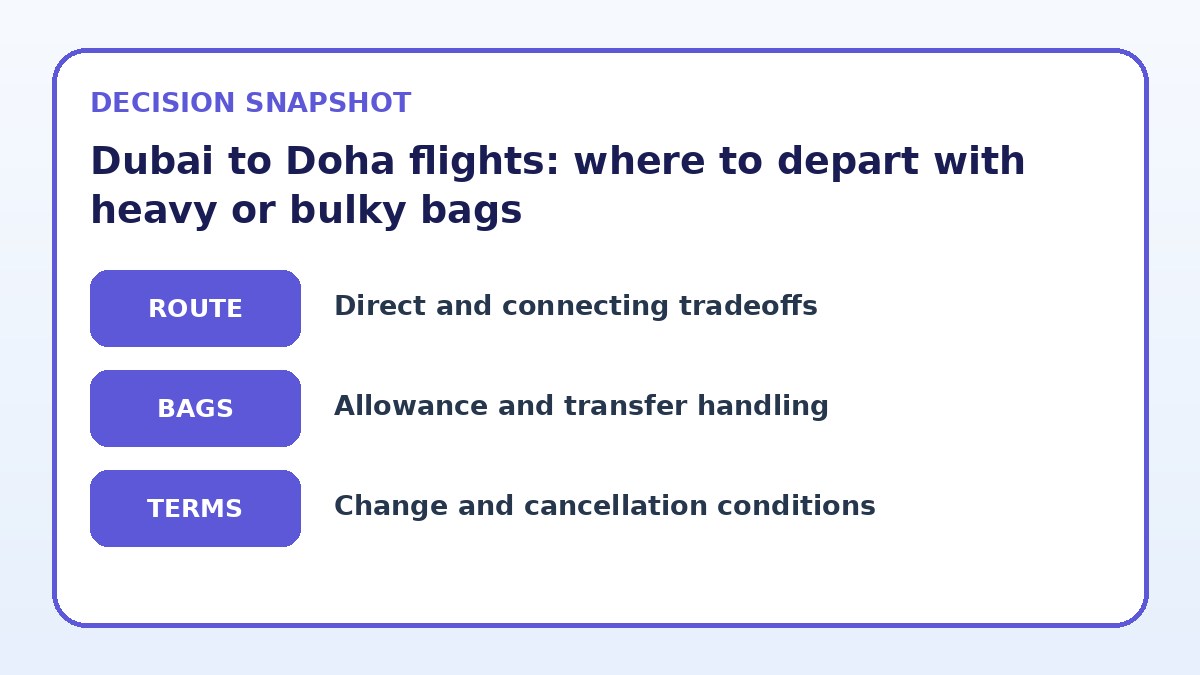
See current options before you compare the details
Availability and final conditions change. Open Trip.com now or keep reading for the practical comparison.
Which Dubai departure airport is most practical for extra luggage?
Dubai’s airport choices should be evaluated for baggage convenience rather than merely proximity. Travelers with extra luggage typically focus on the airport that offers straightforward check-in lanes, generous space for trolleys and oversized items, and familiar handling procedures for special items. If your carrier operates from a terminal with dedicated transfer desks and good curbside access, you’ll save time and reduce the number of manual lifts. Also consider whether the terminal layout keeps check-in counters, oversized-bag desks, and security lines close together—short, predictable walks beat long terminal shuttles when you’re laden with baggage.
Airlines and terminals change over time, so when planning pick the airport where your airline currently operates mainline flights rather than occasional or budget terminals. Mainline terminals tend to have more staffed desks that understand excess-baggage rules, while secondary or budget gates can be cramped and under-resourced for handling outsized items. For connecting itineraries, confirm whether your luggage will transfer automatically at the airline or alliance level; if not, you may need to collect and re-check bags, and that is a major factor when choosing a departure airport.
How to compare baggage policies and special handling
Baggage allowances and special-handling rules are set by the airline and differ between fare types; they are not fixed by the airport. For each potential flight, review the airline’s published size and weight limits, fees for overweight or extra pieces, and procedures for sports equipment, musical instruments, or fragile items. When policies are ambiguous, look for a dedicated page on the airline’s site covering oversized or special baggage and note exactly where you must declare the item—at online check-in, at the counter, or at a separate oversized-baggage desk.
When special handling is required (for example, palletized cargo, fragile crates, or batteries in sports equipment), call the airline or the airport’s cargo/special-handling desk to confirm procedures and any paperwork. Ask whether the item requires advance booking as a cargo shipment instead of regular checked baggage. On the airline’s final booking and baggage pages verify: whether the item is accepted, how it must be presented at drop-off, and what fees or advance notices are needed. Trip.com can be a place to compare current availability, but always verify operational details on the airline’s official page before you travel.
| Approach | Best for | Tradeoff to check |
|---|---|---|
| Choose the airport with your airline’s main terminal | Travelers wanting experienced staff and full baggage services | May require longer ground travel if it’s farther from your accommodation |
| Pick the closest airport or terminal to reduce transfer time | Those prioritizing short door-to-gate time and minimal lifts | May be limited in staffed oversized-baggage facilities or space |
| Select a direct flight even if from a less convenient terminal | Avoiding re-checks and reducing handling risks for bulky baggage | Might involve tougher curb access or less baggage support at departure |
| Book a connecting itinerary with guaranteed through-check | People seeking cost savings while avoiding manual baggage transfers | Requires careful verification that the ticket truly includes through-checked bags |
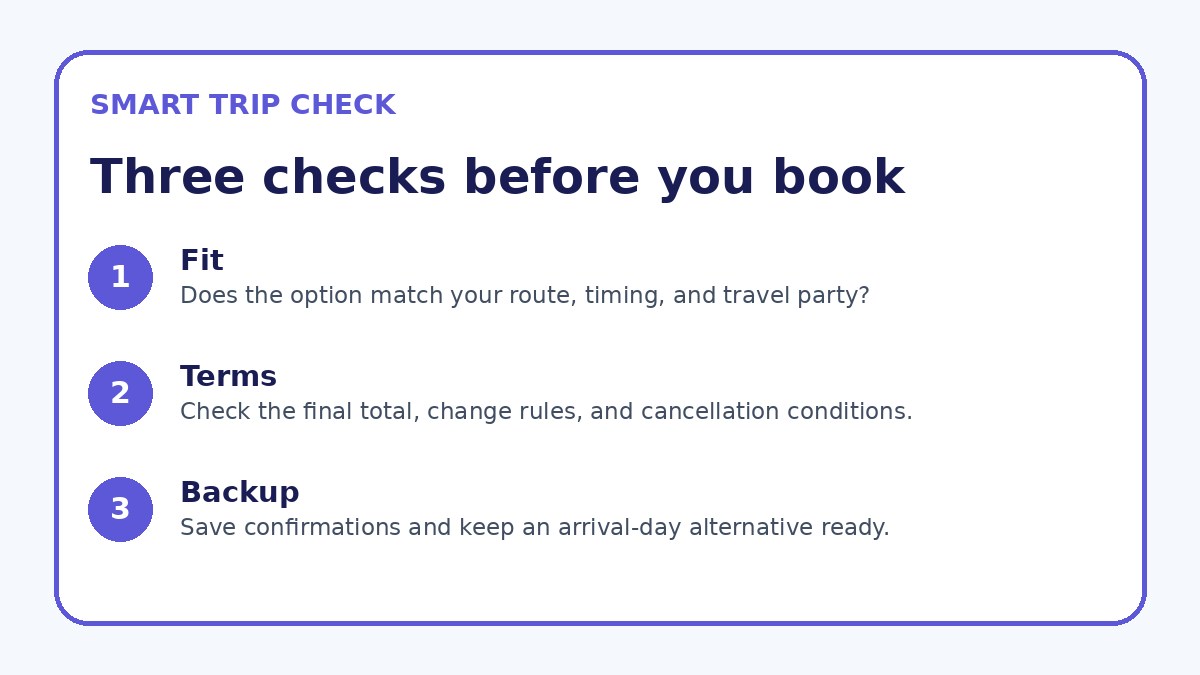
Ready to check the option that fits your plan?
Use your exact dates and traveler details so the provider page can show the current total and conditions.
Transit, transfers and time allowances when you have extra bags
Transfers between city and airport, and between terminals, matter more when you carry heavy or numerous bags. Plan for longer door-to-gate times than you would with hand luggage alone: allow extra minutes for check-in, oversized-baggage handling, security lanes and moving between terminal zones. If your arrival into Dubai uses a different terminal than your departure, check whether the terminals are connected airside (no re-check needed) or whether you’ll need to collect bags and re-check—if re-check is required, choose an airport and connection that gives you ample time and easy ground transport options.
Consider how you will reach the departure terminal: private transfers, rideshares, airport taxis with luggage assistance, or hotel shuttles vary in their willingness to handle many bags or bulky items. Some providers help load and unload, others do not. If arriving at the airport curb with heavy luggage, pick terminals with convenient short-term parking or drop-off zones near check-in. Where possible, book a transfer service that explicitly lists luggage capacity and assistance to avoid surprises at the curb.
Before you book
- Confirm your exact baggage allowance and fees on the airline’s official booking/baggage page for the fare you will buy.
- Call or email the airline to declare oversized or specialty items and ask whether advance booking is needed.
- Check which terminal your flight departs from and map the curbside drop-off, short-term parking, and trolley availability.
- Verify whether your baggage will be through-checked for connecting flights or if you must collect and re-check.
- Arrange a transfer service that specifies luggage capacity and assistance, or reserve porters if you need help at the curb.
- Take screenshots or save PDFs of baggage policies and any special-handling confirmations to show at check-in if questions arise.
Booking strategies and what to verify before you confirm
When selecting flights, prioritize clarity over marginal savings. Compare direct and connecting options: a slightly more expensive direct flight that saves you re-checking a collection of heavy bags may be the more practical choice. If the cheapest option requires a self-transfer with separate tickets, plan for the time and physical effort of moving luggage between terminals or airports. On the airline’s final booking page verify baggage allowances for your exact fare class, any excess-baggage fee schedule, and instructions for oversized items. Look for phrases like ‘sports equipment,’ ‘excess piece,’ and ‘maximum weight per piece’ to ensure your items fit within policy.
If your itinerary involves codeshares or alliances, confirm which carrier is responsible for baggage handling and whether they accept through-checked luggage on the full journey. Before confirming, print or save the airline’s baggage policy screens or screenshots showing your fare’s included allowance and any paid extras. Finally, if you need special assistance—trolleys, porters, or dedicated oversized-bag lanes—book these services directly with the airline or the airport help desk in advance to secure smoother handling on departure day.
Frequently asked questions
Can I bring oversized sports equipment on Dubai to Doha flights?
Policies for oversized sports equipment vary by airline and fare class. Check the airline’s specific rules for items such as golf clubs, surfboards, or bicycles on its baggage or special-handling pages. Note whether the item is accepted as checked baggage, requires packing to certain standards, or must be shipped as air cargo instead. If the airline allows it as checked baggage, verify weight and dimension limits, any additional fees, and whether you need to declare or pre-book the item. Always print or save the airline’s guidance to present at the airport if staff request it.
If I buy separate tickets, will my luggage be transferred between flights?
Separate tickets typically mean no automatic transfer of checked luggage unless the airlines have a specific interline agreement. Before booking, ask both carriers whether they will accept a through-checked bag on separate itineraries. If the answer is no, plan time to collect your bags, clear immigration if necessary, and re-check at the departure terminal. For travelers with heavy or bulky luggage, separate tickets increase complexity and risk; choosing a single-ticket itinerary or confirming baggage transfer in writing reduces that uncertainty.
How much extra transfer time should I allow at the airport when I have multiple large suitcases?
Allow substantially more time than for hand-luggage-only travel. Build in extra minutes for check-in, oversized-baggage declaration, security screening, and walking between areas—factor at least an additional 30–60 minutes beyond usual recommended check-in times depending on volume of baggage and terminal size. If you must move between terminals or collect and re-check bags, increase your margin further. If unsure, call the airline or airport to ask about typical processing times for oversized or extra pieces and plan your arrival at the airport accordingly.
Final planning note
Choosing the most practical Dubai departure airport when you have extra luggage is about minimizing handling, ensuring clear baggage rules, and simplifying transfers. Prioritize the terminal where your airline operates mainline services and where staff and facilities can confidently process oversized or numerous bags. Double-check the airline’s baggage policy for your exact fare, ask about special-handling or cargo requirements, and confirm whether luggage will be through-checked on connecting itineraries. Finally, plan your ground transfer with luggage assistance and allow extra time at the airport. These steps reduce stress and the chance of last-minute fees or rework on the travel day.
Continue planning
Check current options and final conditions
Use the provider page to confirm live availability, the final total, cancellation terms, and every condition that matters to your trip.
This evergreen planning guide was created with AI-assisted drafting and a structured quality review. It does not display live prices, schedules, availability, visa guidance, or provider rankings. Verify current details before booking. Some links are affiliate links; we may earn a commission at no additional cost to you.