Pick the neighborhood first: deciding whether you want sand, river views, quick airport access, or a compact city-base will make your hotel search practical and fast. For a first-time visitor, the most useful hotels in Da Nang are those that reduce daily transit time and align with the sights and pace you want. If you plan mostly beach time, prioritize the My Khe/An Thuong strip or east-side hotels with easy walkability to the sand. If your trip focuses on Hoi An, the airport, or onward trains, a hotel near major roads or the city center will save taxi time. This guide gives a clear way to shortlist an area, weigh room and party needs, and check the final booking details you must verify on a hotel’s page or a booking site like Trip.com.

Check live stays in the areas that fit
Use your dates and party size to compare current rooms after you narrow the neighborhood fit.
Neighborhood fit: pick the area that matches your main plans
Start by matching the neighborhood to the single thing you’ll do most in Da Nang. If your priority is beach time and easy seaside strolling, focus on hotels labeled near My Khe or An Thuong — these neighborhoods cluster beachfront hotels, cafes, and casual nightlife. If culture and markets are the draw, a riverfront or downtown hotel near the Han River and Dragon Bridge puts evening lights and local dining within short taxi rides. Travelers connecting to Hoi An, Da Nang Airport, or Ba Na Hills should consider hotels closer to the arterial roads or the airport side of the city to reduce transfer time to onward destinations.
Consider how much noise, nightlife, and local life you want around your hotel. Beach strips can be lively into the evening, while central riverside areas are active at night with restaurants and weekend markets. A quieter apartment-style hotel or a boutique guesthouse a few blocks off the main promenade may suit families or light sleepers better. Use neighborhood photos, map pins, and recent guest descriptions to verify walkability and street noise before shortlisting an area.
Choose an area-selection strategy
| Area approach | Best for | Tradeoff to check |
|---|---|---|
| Beachstrip (My Khe / An Thuong) | Beach lovers, casual dining, and easy seaside walks | Can be busier at night and may require taxis to cultural sites or markets |
| Riverside / City Center | Evening dining, markets, and central access to bridges and urban sights | Higher daytime traffic and fewer large family suites in some properties |
| Airport / West-side | Early flights, quick transfers to Hoi An or Ba Na Hills | Less beach access; fewer evening dining options within walking distance |
| Quiet neighborhoods/off-promenade | Families, light sleepers, and longer stays needing apartment-style comforts | Requires more short taxi or motorbike trips to major attractions |
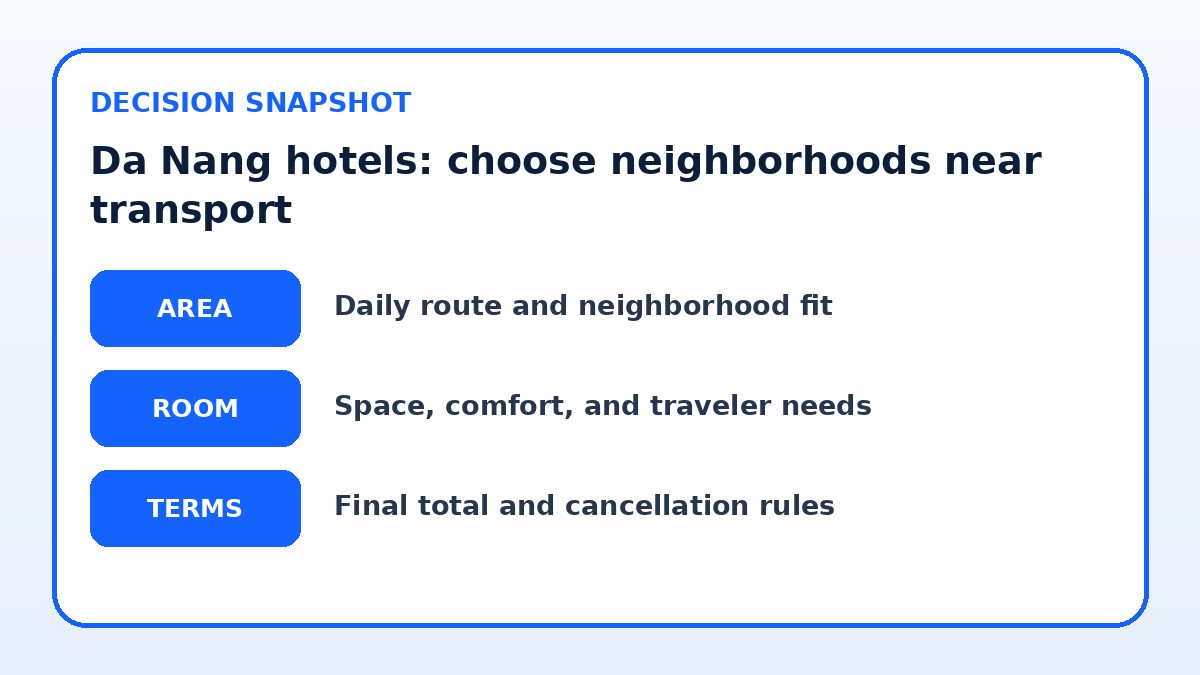
Daily-route friction: how transport choices shape each day
Estimate your typical day: breakfast, one main activity, lunch, and an evening plan. If sightseeing is spread across the wider region — Hoi An, Marble Mountains, or Ba Na Hills — staying near major roads and the central bus routes reduces time spent zig-zagging across town. For beach- and city-mix days, riverside hotels balance both worlds, but you will still rely on short taxi rides or motorbike hires for some spots. Ask the hotel directly which areas they can call taxis to and whether they have recommended private transfer partners.
Think beyond distance: street layout, typical traffic, and bridge crossings matter. A short distance across the river can still mean longer travel at peak times. If mobility is a concern or you travel with children, choose hotels that advertise private parking, elevator access, and rooms on lower floors to avoid stairs. When comparing properties, check maps for taxi ranks, bus stops, and the nearest ride-hailing pickup points and verify those details on the hotel’s booking page before you finalize anything.
Now compare like with like
Keep the same dates, guests, room needs, and cancellation preferences while you compare the final choices.
Room and party needs: pick a hotel type that fits your group
Single travelers and couples often prioritize location and amenities like Wi-Fi and breakfast options; boutique hotels in the riverside or beach areas can deliver those in walkable settings. Families should look for family rooms, connecting rooms, or apartment-style suites, and confirm bed configuration with the hotel directly. If you travel with older parents or someone with limited mobility, request ground-floor rooms or hotels with functioning elevators and confirm access details on the property’s page.
Business or transit-focused travelers should prioritize quick airport access and quiet workspaces in-room. If remote work is part of your trip, check that the hotel cites a reliable workspace and strong Wi-Fi in guest feedback or official descriptions; verify upload speeds and any co-working space availability before booking. For groups traveling together, check the hotel’s policy for extra beds, child charges, and whether larger rooms are available in the booking engine or by emailing the property.

Hotel booking check before payment
- Confirm the hotel’s exact street address and check it against a live map to ensure the claimed neighborhood match.
- Message the property to verify transfer options and whether they arrange airport pickups or recommend trusted taxi services.
- Check room layout photos and ask for bed configurations or connecting-room availability if you travel with children or a larger party.
- Read the booking page for cancellation terms, deposit requirements, and what fees or taxes are included in the quoted rate.
- Verify accessibility needs — elevator presence, step-free entry, and bathroom support — directly with the hotel before booking.
- Compare at least two booking channels, then confirm the final room description, occupancy limits, and extra charges on the hotel’s official page.
Booking terms and final checks before you pay
Before confirming a reservation, compare flexible cancellation policies, breakfast inclusion, and whether the quoted room rate includes local taxes. Don’t assume free airport transfers or shuttle services; if those are important, find explicit language on the hotel page or message the property to get confirmation in writing. When payment terms or deposits are mentioned, check whether the booking page requires immediate payment, a credit card guarantee, or payment on arrival. For any paid transfer or shuttle, request the company or contact the hotel will use and verify that detail on the booking confirmation.
Always verify the exact address, check-in and check-out windows, any mandatory ID or registration requirements, and whether the property enforces noise curfews or early-morning maintenance. If you will rely on ride-hailing apps, ensure the hotel’s location works with the app pickup conventions in Vietnam; some streets or beachfront promenades have restricted drop-off points. If you use Trip.com or another aggregator to compare availability, confirm the final room details, cancellation rules, and extra fees on the hotel’s own page before accepting the booking.
Hotel Guide questions travelers ask
Which Da Nang neighborhood is best for first-time visitors who want a mix of beach and city?
For a mix of sand and urban life, aim for a riverside hotel that is also within easy taxi distance of the beach strip. Riverside areas put you near evening markets, bridge viewpoints, and riverside dining while keeping beach access a short ride away. Search for hotels labeled near both the Han River and My Khe, check walking distances on a map, and confirm whether the hotel is on a quiet side street or the main road because noise and pedestrian access can vary block by block.
How should I judge transport convenience if I plan day trips to Hoi An or Ba Na Hills?
Prioritize hotels near major roads or the airport side of Da Nang to minimize transfer time to Hoi An and Ba Na Hills. Check whether the hotel can help arrange private transfers and ask for typical pickup locations. Compare route options on map apps to see if your hotel’s location avoids bridge crossings or congested downtown segments. Before booking, message the property for recommendations and confirm any paid transfer arrangements on the hotel’s booking page to avoid surprises.
Is it better to choose a beachfront hotel or a centrally located riverside one for families?
Families often value space and quiet over being directly on the sand, so a family-friendly hotel a few blocks from the beach or a riverside property with larger suites may be preferable. Look for hotels advertising family rooms, kitchenettes, or connecting rooms and confirm sleeping arrangements with the hotel. Factor in ease of taxi access for excursions, proximity to pharmacies and grocery options, and whether the hotel can help arrange child-friendly activities or childcare services if needed.
Final decision note
Make the neighborhood decision first, then treat the hotel search as a filter exercise: transport link priority, daily-route friction, and your party’s room needs. Shortlist one or two neighborhoods that match your trip’s rhythm — beachfront for relaxed days, riverside for nightlife and markets, airport-side for tight connections, or quieter off-promenade areas for family comfort. Use maps to check walking distances and typical routes, message hotels about transfers, accessibility, and room layout, and confirm all key booking terms on the hotel’s official page before you pay. If you want to compare availability quickly, Trip.com can be one place to look, but always verify details with the property itself.
Continue planning
Check current options and final conditions
Use the provider page to confirm live availability, the final total, cancellation terms, and every condition that matters to your trip.
This evergreen planning guide was created with AI-assisted drafting and a structured quality review. It does not display live prices, schedules, availability, visa guidance, or provider rankings. Verify current details before booking. Some links are affiliate links; we may earn a commission at no additional cost to you.