If you’re landing at Brisbane and want to get into the city with the least hassle, your main choices are the Airtrain (or equivalent rail link), official airport buses, taxis and rideshares, or prebooked shuttles or private transfers. The practical pick depends on where you’re staying, how much luggage you have, your arrival time, and how much walking or transfers you’re comfortable with. Start by pinpointing your exact hotel or neighborhood on a map, then weigh the convenience of a door-to-door ride against the predictability and cost-effectiveness of public transport. Later in this guide I’ll explain tradeoffs for each option, what to check on provider booking pages, and a short checklist you can use at the airport to make a quick, informed decision.
Rail and public transport: how to use it and when it wins
Brisbane’s rail services that connect the airport to the city are a common choice for first-time visitors who want a simple, traffic-independent trip. To decide whether to use rail, check how close your accommodation is to Central, Roma Street, South Brisbane or other stations on the route. If you have one or two small bags and your hotel is a short walk or tram ride from a station, rail usually offers a predictable journey free from road congestion. Remember to review the operator’s website or booking page for service maps, ticketing zones, accepted payment methods, and any temporary timetable changes before you travel.
Consider tradeoffs: trains are less useful if you’re carrying oversized luggage, traveling with young children, or headed to a suburb that requires multiple transfers. Also check whether the line requires buying a smartcard or validates tickets at the station, and whether late-night services run when you arrive. If the rail schedule matches your arrival and the walk from the station to your accommodation is comfortable, this option can be the fastest and most straightforward way into central Brisbane without the variability of road traffic.
Taxis and rideshares: convenience vs waiting and costs
Taxis and rideshare apps provide door-to-door transport with the least amount of physical effort — useful if you have heavy luggage, mobility needs, or a tight schedule. At the airport, official taxi ranks and designated rideshare pick-up points are typically organized to handle arrivals; check the airport’s arrival information page for the precise pick-up area and any airport collection fees the booking platform mentions. When using a rideshare app, verify your driver’s identity, vehicle details, and the exact pickup point shown in the app before loading luggage.
The main tradeoffs are potential waits during peak arrival windows and variable fares during busy periods. For groups the per-person cost becomes more attractive, whereas solo travelers should compare the convenience premium with public transport. If you’re considering a taxi or rideshare, check the app or operator page for accessibility options, luggage capacity, and any airport surcharges so you can make an apples-to-apples comparison with other transfer choices.
| Approach | Best for | Tradeoff to check |
|---|---|---|
| Rail (train) into the city | Travelers with light luggage staying near central stations | Requires walking or a short connection; less useful late at night or for oversized bags |
| Airport taxi or rideshare | Door-to-door convenience, groups, or heavy luggage | Potential waits and variable fares during peak times; check pickup locations |
| Shared airport shuttle | Budget-conscious travelers who want direct drop-off at hotels | Slower because of multiple stops; verify exact hotel drop points |
| Prebooked private transfer | Travelers wanting a guaranteed meet-and-greet and no transfers | Higher cost than public transit; confirm cancellation and flight-delay terms |
Shared shuttles and private transfers: prebooked peace of mind
Shared airport shuttles drop passengers at multiple hotels and can be an economical door-to-door option if you’re on a budget and don’t mind extra stops. Private transfers offer a single-vehicle ride from the terminal to your accommodation and are handy if you prefer to have a driver meet you at arrivals. If you plan to prebook, read the transfer company’s terms closely: verify exactly where the driver will meet you, how they handle delays and flight tracking, and whether the rate covers wait time and tolls. Trip.com can be used as an option to compare current transfer listings, but always confirm details on the supplier’s final booking page.
Tradeoffs include the time shared shuttles add because of intermediate stops and the higher cost of private transfers compared with public transport. Shared shuttles are often the best compromise for travelers who prioritize cost over speed, while private transfers suit those who value privacy and a guaranteed meeting point. Always ensure the supplier allows flight changes or late arrivals without excessive penalties — that detail frequently changes and must be verified before booking.
Before you book
- Find your hotel’s exact street address and nearest public-transport station before you land.
- Check the airport terminal for your flight and the listed pick-up points for taxis and rideshares.
- Confirm luggage dimensions and whether your chosen transfer service specifies size limits or extra charges.
- Verify flight-tracking and delay policies on the transfer supplier’s final booking page before paying.
- Save the local emergency number and the phone number of the transfer company or hotel shuttle.
- Have a backup plan: know the nearest train station, the taxi rank location, and how to request a rideshare offline.
Practical arrival checks and choosing what to book
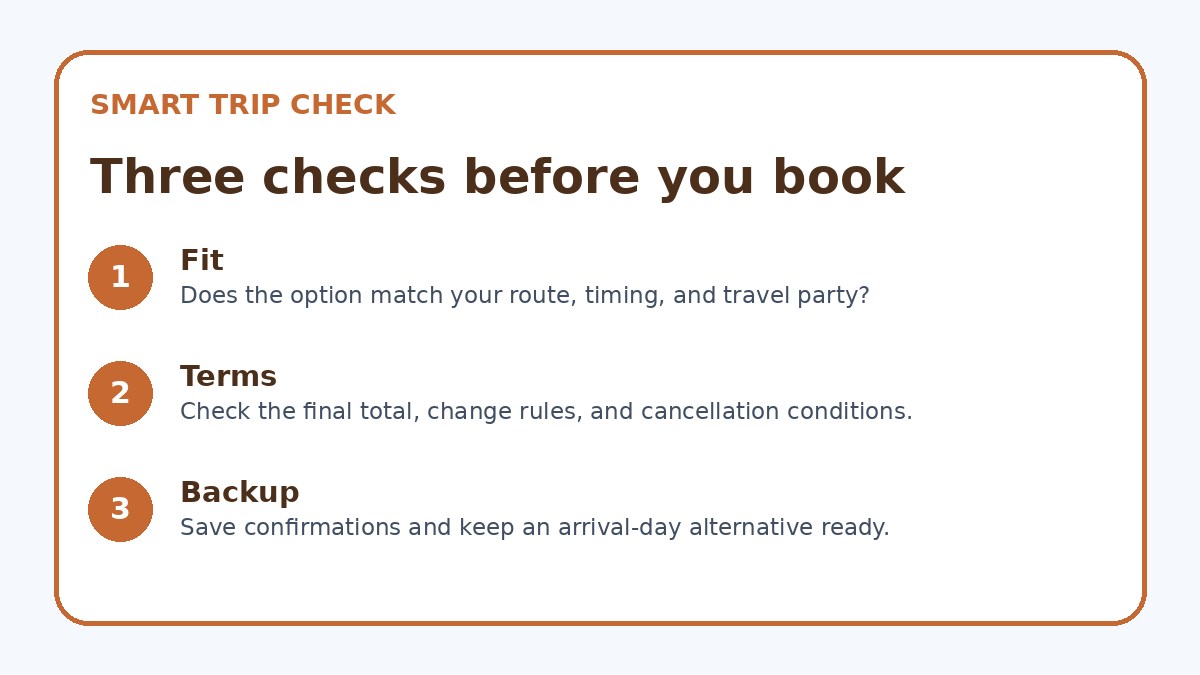
Before you book or choose an option on arrival, do three quick checks: confirm your terminal, check estimated luggage volume, and note your arrival time against public transport schedules. If your flight is delayed, find the operator’s flight-tracking or arrival policy on the booking page so you know how they handle late arrivals. Also consider whether your accommodation offers an airport shuttle — some hotels run their own free or paid services that may be the simplest option if available.
To choose, balance the door-to-door convenience you want against the price, expected wait time, and the certainty of arrival. For a moderate budget and light luggage close to the CBD, rail plus a short tram or walk often wins. For late-night arrivals, large groups, or heavy luggage, a booked private transfer or taxi/rideshare can significantly reduce stress. Keep a backup plan: know the taxi rank location, how to call a rideshare if data is limited, or where the nearest rail station is in case your first option is unavailable.
Frequently asked questions
Is it better to prebook a transfer or decide when I arrive?
Prebooking gives you certainty about pickup location, vehicle size and price terms, which is valuable for late-night arrivals, large groups, or if you have mobility needs. Deciding on arrival can save money if you’re flexible and comfortable navigating local transport — for example, taking the rail link if it’s frequent and convenient for your hotel. If you prebook, verify the supplier’s flight-delay policy and where the driver meets you; if you wait, have contact info for the airport taxi rank and rideshare pickup area.
How do I compare public transport versus door-to-door options for my hotel?
Start by mapping the door-to-door travel time and number of transfers for both choices. Public transport typically wins on cost and avoids traffic delays during peak hours, but requires walking and carrying luggage. Door-to-door options reduce hassle and transfers but can be slower in traffic and more expensive. Compare the total door-to-door time, number of transfers, and how much you value convenience. Check operator pages for route maps, station locations, and pickup points before committing.
What should I verify on the booking page of a transfer provider?
On the booking page look for the pickup meeting point (terminal and door number), how the provider handles delayed flights, included wait time, luggage allowances, vehicle type, cancellation or change policies, and any airport collection charges. Also confirm the supplier’s contact number so you can coordinate on arrival. These details change frequently, so always re-check them immediately before booking to avoid surprises at the airport.
Final planning note
Making the right Brisbane airport transfer choice starts with knowing where you’re staying, how much luggage you have, and how much you value time versus cost. For light-pack travelers staying close to central stations, the rail link plus a short tram or walk often offers an efficient, traffic-free route. If you prioritize door-to-door comfort—arriving late at night, with children, or with oversized luggage—a taxi, rideshare or prebooked private transfer simplifies the journey. Use the checklist above while you decide, and verify any crucial service details on the provider’s final booking page before you pay. If you want to compare current listings quickly, Trip.com can be one place to check availability, but always validate terms directly with the supplier.
Continue planning
Check current options and final conditions
Use the provider page to confirm live availability, the final total, cancellation terms, and every condition that matters to your trip.
This evergreen planning guide was created with AI-assisted drafting and a structured quality review. It does not display live prices, schedules, availability, visa guidance, or provider rankings. Verify current details before booking. Some links are affiliate links; we may earn a commission at no additional cost to you.