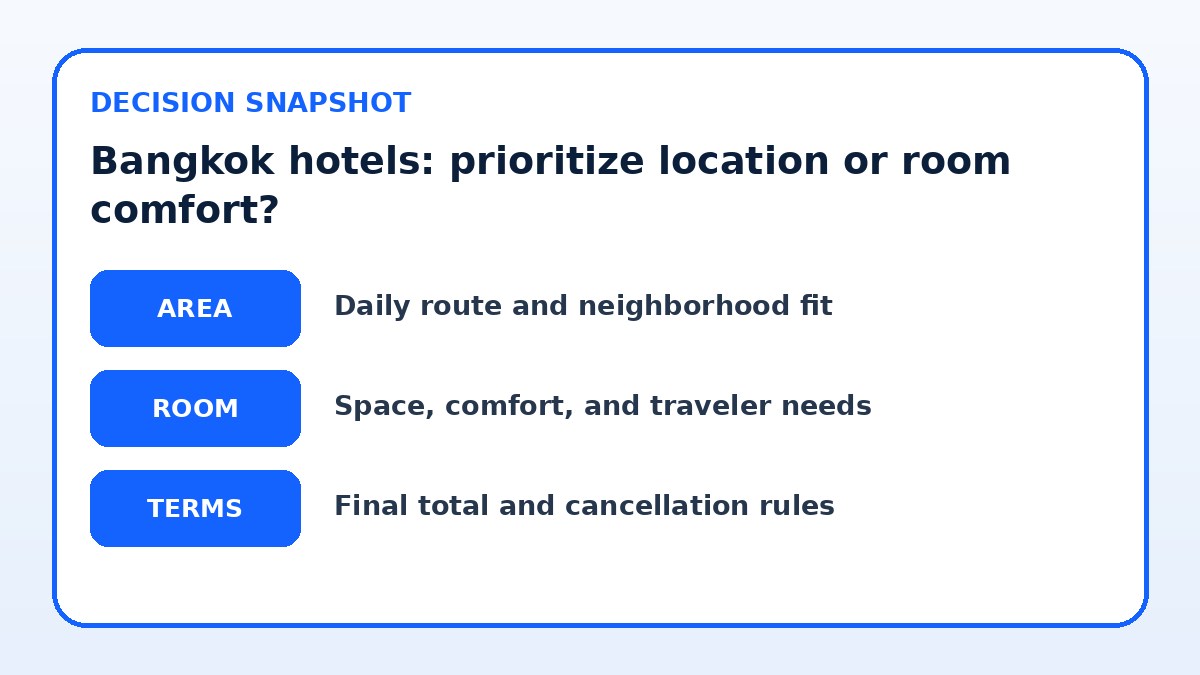
Start by choosing the neighborhood that matches your core priority for the trip—fast access to client meetings and transit, or a restful room to recover between long workdays. For most business travelers in Bangkok the sensible first question is: will your day be back-to-back meetings across the city, or concentrated in one district? If meetings cluster near the central business districts (CBD) you should prioritize proximity to save travel time and reduce schedule risk. If you have unpredictable late calls, work-from-room needs, or value a quiet night’s sleep, prioritize room comfort and in-hotel services, even if it means a slightly longer commute. This article walks through neighborhood fits, daily-route friction, room and party needs, and the final booking terms you must verify before confirming—a practical roadmap so you can shortlist an area before you start comparing live hotel inventory.
Check live stays in the areas that fit
Use your dates and party size to compare current rooms after you narrow the neighborhood fit.
Neighborhood fit: match area to your meeting map
Deciding where to stay in Bangkok begins with plotting the locations of your meetings: Sukhumvit, Silom/Sathorn, Phloen Chit/Chidlom, and the Riverside all offer different tradeoffs. If most of your appointments are along Sukhumvit, staying on or near that corridor saves travel time and gives easy access to BTS stations, restaurants, and 24-hour conveniences. For Silom and Sathorn—a hub of corporate offices and embassies—choose a hotel within walking distance to the offices you’ll visit to avoid unpredictable road traffic. If you’re meeting near the river or in the old city, prioritize quick taxi or ferry access because mass transit options are sparser there.
Beyond proximity, evaluate the micro-fit: does the area feel safe and functional for evening work? Are there reliable restaurants and coffee shops open late if you need a change of scene? Business travelers who value quick client hospitality should pick neighborhoods with convenient dining and informal meeting spaces. Conversely, if your schedule is tightly packed, prioritize a hotel that acts like a one-stop base—on-site dining, express laundry, and a business center—so you can minimize outside errands.
Choose an area-selection strategy
| Area approach | Best for | Tradeoff to check |
|---|---|---|
| Stay in the CBD (Sathorn/Silom) | Maximizing meeting proximity and reducing intra-day travel time | Generally smaller rooms and more urban noise; comfort amenities may be secondary |
| Stay along Sukhumvit corridor | Balanced access to BTS, dining, and mid-range corporate offices | Longer cross-city commutes to river or old-city meetings; can be busy at night |
| Riverside or hotel district near the river | A quieter stay with views and hotel services—good for recovery after long days | Fewer mass-transit links; expect more reliance on taxis or ferries for meetings |
| Near the airport or outside central areas | Trips with early/late flights or single-event attendance requiring airport proximity | Longer travel to central-city meetings and fewer evening dining or client hospitality options |
Daily-route friction: estimate real travel time, not just distance
Bangkok’s traffic patterns can turn a short distance into a long commute during peak hours. When you assess route friction, build realistic windows around peak periods rather than assuming best-case travel times. Use transit lines as anchors—book near a BTS or MRT station if meetings are spread across multiple nodes, but verify the station exit leads toward your meeting neighborhood; some stations have multiple exits that add walking time. For goals that require punctual in-person presence, prioritize hotels that let you walk to one or two frequent meeting points or provide consistent taxi or ride-hailing access.
Also consider ride-hailing reliability in the area and time of day; some neighborhoods clear up faster late at night, others remain congested. If airport transfers are part of your itinerary, check whether the hotel offers a fixed shuttle or easy access to the Airport Rail Link. Factor in the cost and time of transfers between meetings, evening client dinners, and your evening workspace—these cumulative minutes determine whether proximity or a better room will improve productivity and reduce stress.
Now compare like with like
Keep the same dates, guests, room needs, and cancellation preferences while you compare the final choices.
Room and party needs: what comfort means for business travel
Define ‘room comfort’ to match how you intend to use the space. For a solo traveler who needs to work in the room, prioritize a well-lit desk area, reliable high-speed Wi-Fi, clear soundproofing, and an ergonomic chair. If you routinely host small client meetings in the hotel, look for rooms or suites with separate seating areas and a clear policy on in-room visitors. For longer stays, check laundry options, mini-kitchen or pantry access, and convenient room service windows—these reduce friction and keep you focused on work.
Don’t forget sleep quality and health-related amenities. Superior bedding, blackout curtains, and temperature control become productivity tools on a business trip. Also think about hotel services that replace lost time: expedited breakfast, a fast business center, meeting rooms that can be reserved for short blocks, and on-call printing or courier services. When comfort reduces the need to leave the hotel, it can justify a longer commute to the office.

Hotel booking check before payment
- Map your meeting locations and choose the neighborhood that minimizes the total door-to-door commute time.
- Confirm the hotel’s proximity to a BTS, MRT, or main taxi routes and note specific station exits or road names.
- Verify Wi‑Fi speed, workspace setup, and whether room rates include business amenities you need.
- Check cancellation terms, earliest check-in options, and whether luggage storage is available for early arrivals.
- Ask the hotel about in-room visitor policies, meeting room rental options, and printing or courier services.
- Validate airport transfer details and reconfirm any advertised services on the property’s booking page before payment.
Final booking terms: verify what matters before you click confirm
Before you book, read the small print on cancellation, check-in windows, and what’s included in the rate. Confirm whether breakfast is included, whether the listed ‘business center’ actually meets your needs, and the Wi‑Fi speed or whether premium access costs extra. Verify the hotel’s check-in policy in case you arrive early after an overnight flight, and confirm luggage storage if your meeting schedule starts before standard check-in time. If the hotel advertises airport transfer, verify price and pickup logistics on the provider’s final booking page rather than relying on the listing description.
Also check practical items that affect daily rhythm: the location and hours of the hotel gym, 24-hour dining or grab-and-go options, and housekeeping timing if quiet hours matter to your calls. If you need invoices, receipts, or special corporate billing, confirm these procedures with the property. When comparing live inventory on booking sites—Trip.com can be used as one place to compare availability and conditions—always cross-check the hotel’s own policies and contact the property directly for any nonstandard requests.
Hotel Guide questions travelers ask
Should I always book the closest hotel to my office meetings in Bangkok?
Not always. Booking closest reduces travel-time risk and is smart for back-to-back in-person meetings, but you may sacrifice sleep quality, workspace comfort, or hotel services. If your schedule has late calls, long solo work blocks, or you plan to host clients in the hotel, a more comfortable room or a higher-service property—even with a longer commute—can increase productivity. The practical approach is to map the day: if most meetings are within walking distance, pick proximity; if they’re spread across nodes or you need reliable in-room work time, prioritize comfort.
How should I evaluate commute time given Bangkok traffic?
Estimate door-to-door time with conservative buffers for peak hours rather than relying on off-peak estimates. Use transit lines (BTS/MRT) as anchors where possible, and check walking time from the hotel to the correct station exit. For taxi rides consider a 20–40 minute variance during morning and evening peaks for cross-city trips. If punctuality is essential, prefer hotels that let you walk to frequent meeting points or that provide scheduled shuttle or reliable ride-hailing access to avoid unpredictable delays.
What hotel amenities most reliably improve a business trip in Bangkok?
Prioritize reliable high-speed internet, a comfortable work desk and chair, effective soundproofing, and breakfast or early dining options. On-site meeting rooms, express laundry, and 24-hour front desk or concierge services also reduce friction. For frequent travelers, clear invoicing and corporate billing options are valuable. Before booking, confirm these amenities on the hotel’s official booking page and ask about any charges for 'premium' Wi‑Fi or meeting-room use that may not be visible on a general listing.
Final decision note
For business travel in Bangkok the neighborhood decision should come first: align your stay with where the majority of your appointments will be and use a realistic assessment of daily-route friction to decide if proximity outweighs room comfort. If your days are tightly scheduled across multiple districts, prioritize being near a BTS/MRT station or inside the CBD to reduce commute risk. If you need extended in-room work time, quiet nights, or hospitality features, accept a slightly longer commute in exchange for a better room and services. Before booking, verify the essential terms—check-in and cancellation rules, included amenities, and any premium charges—on the provider’s final booking page. With a chosen area in mind you’ll be able to shortlist specific hotels and compare inventory efficiently.
Continue planning
Check current options and final conditions
Use the provider page to confirm live availability, the final total, cancellation terms, and every condition that matters to your trip.
This evergreen planning guide was created with AI-assisted drafting and a structured quality review. It does not display live prices, schedules, availability, visa guidance, or provider rankings. Verify current details before booking. Some links are affiliate links; we may earn a commission at no additional cost to you.