If you plan to explore beyond central Auckland — Piha, the Coromandel, or the west coast — renting a car usually improves flexibility. For first-time visitors the core question is simple: do you want the convenience of driving from the airport or the smoother pickup and drop-off within the city? Practically, airport pickup is best when you arrive late, carry lots of luggage, or start a long regional drive immediately. City pickup can lower daily costs, avoid airport surcharges, and make return logistics easier if you finish in town. This guide tells you how to weigh route value, insurance language, pickup and return friction, and when you should skip driving altogether and use a non-driving fallback.
Does driving add value to your Auckland trip?
Driving genuinely helps when your itinerary includes destinations that are difficult to reach by scheduled transit — west coast beaches, remote Coromandel coves, rural vineyards, or national parks with limited bus links. If most activities stay inside Auckland City Centre, Devonport, Waiheke (where ferries and local shuttle services are effective), or you plan organized day tours, the rental’s convenience diminishes. Also weigh how comfortable you are with left-side driving and narrow winding roads; those are part of the experience beyond the motorway.
To test whether driving is worth it, sketch a simple plan: list each overnight stop and the major day trips. Estimate travel time with and without a car using provider pages for ferries and buses. If public transport plus occasional taxis or rideshares adds only modest time and cost, you may prefer to avoid the hassles of parking and returning a vehicle in a city with metered zones and occasional congestion.
Decide whether driving earns its place
| Mobility strategy | Best for | Cost or friction to check |
|---|---|---|
| Airport pickup and immediate drive | Arrivals that begin a regional road trip or travelers with lots of luggage | Convenient start but likely higher fees and possible waits at airport depots |
| City pickup near your hotel | Short stays based in central Auckland who need a car only for day trips | Can avoid airport surcharges but may add urban pickup/return travel and parking costs |
| One-way rental (airport to city or vice versa) | Linear itineraries that end near a flight or in central Auckland | Adds routing flexibility but often includes one-way fees and must be confirmed on booking |
| Non-driving mobility (public transit, ferries, tours, taxis) | Visitors preferring no driving, avoiding parking hassles and insurance complexity | Less flexibility for remote sites; may require careful scheduling and some transfers |
Check live rental choices only after the route test
Use the exact driver, dates, pickup point, and return plan to compare current conditions.
Route value and pickup location: airport vs city
Airport pickup wins when your first daytime activity is outside central Auckland or you arrive late and want to get on the road immediately. Pickups at Auckland Airport remove the need to transfer into town with luggage and often extend your driving window, letting you reach beaches or regional towns the same day. However, many airport rentals include surcharges for facility or premium location fees—these show up on the provider’s booking page, so verify the final charges before you confirm.
City pickup is often preferable for short stays based in central Auckland because it avoids airport surcharges and can match your hotel check-in schedule. You may also find a wider range of one-way deals if you plan to return the car in town instead of to the airport. Consider whether your accommodation offers parking: inner-city hotels can charge for parking or have limited spaces, changing the effective cost and convenience of a city pickup.

Compare the full rental conditions
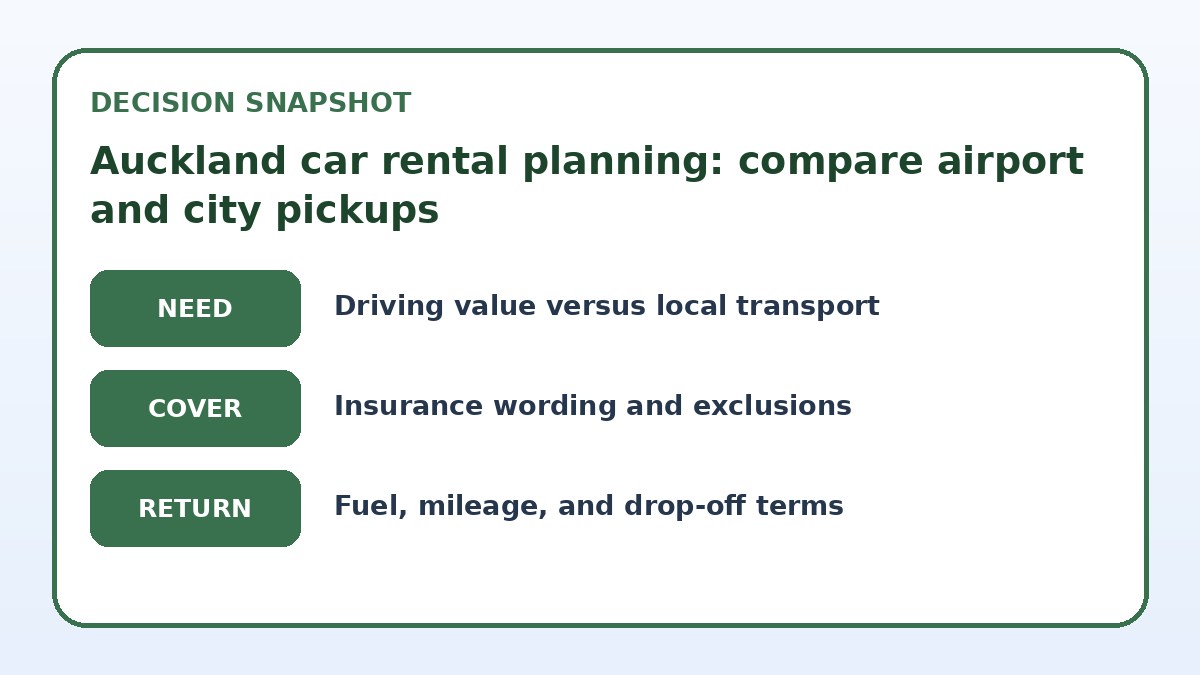
Confirm insurance wording, exclusions, deposit, fuel, mileage, and return terms on the final page.
Insurance, coverage wording, and what to verify
Insurance wording matters. Base rates often show a collision damage waiver (CDW) with a large excess; many travelers add supplemental coverage to reduce or remove that excess. Look explicitly for limitations on young-driver surcharges, additional driver fees, and exclusions for unsealed roads or certain regions. Always read the provider’s final booking page to confirm what’s covered, the size of the excess, how claims are handled, and whether roadside assistance is included.
Also verify mileage rules and cross-region permissions, particularly if you plan a ferried island trip (for example, to the Coromandel kitty-corner or Great Barrier) where some contracts restrict taking vehicles on certain ferries or to specific islands. Check deposit and payment rules: a credit card pre-authorization may be required at pickup. If any contract language is unclear, ask the provider to clarify in writing before you arrive.
Car rental terms to verify
- Compare total door-to-door time for airport pickup versus city pickup using your arrival and first-night addresses.
- Open the rental provider’s final booking page and read the insurance excess, included coverage, and any exclusions word-for-word.
- Confirm whether the rental contract allows island or ferry travel and whether any ferry operator has vehicle restrictions.
- Calculate all expected fees—airport surcharges, young-driver fees, extra driver charges, and parking cost at your accommodation.
- Note pickup window and return procedures (desk, shuttle, depot hours) and add buffer time to your travel plan.
- If skipping driving, prebook key transfers, ferries, or guided day trips to lock in seats and avoid last-minute availability problems.
Pickup/return friction and a non-driving fallback
Pickup and return friction can erase the time saved by driving. Airport pickups usually have dedicated desks and shuttle buses to off-airport lots; these are convenient but may require waits. City pickups might require scheduled appointment windows, navigating to an off-street depot, or dealing with urban traffic and parking when returning. Factor walking time from city rental offices to your hotel or the effort to transfer from the airport to a city depot when comparing options.
If you choose not to drive, plan a robust fallback: use a combination of public transport, ferries, organised day tours, and on-demand taxis or rideshares. For many visitors, buses, the train to the city, ferries to islands, and guided excursions cover the main highlights without the stress of parking and insurance. Before you cancel a rental, compare total door-to-door travel times and cost of point-to-point transport on your exact dates — Trip.com can be a place to compare current availability, but always confirm details on the operator’s page.
Car Rental & Road Trip questions travelers ask
Can I pick up a rental at Auckland Airport and return it in the city, or vice versa?
Many providers offer one-way rentals that let you pick up at Auckland Airport and return in a city depot, or the other way around. One-way options can simplify a linear route—fly in, drive to the region, then finish in town. However, one-way rentals often include an additional fee and require confirmation on the booking page. Before you book, check the provider’s exact one-way availability, any geographic limits in the contract, and where the return office is located so you can plan the end-of-trip logistics.
What should I look for in the insurance wording on a rental contract?
Focus on the collision damage waiver (CDW) excess amount, what types of damage are excluded, and whether roadside assistance is included. Check for age-related surcharges, third-party liability limits, and whether the CDW applies on unsealed roads or island ferries. The final booking page will list required deposits and accepted card types for pre-authorizations. If language is ambiguous, ask the provider to provide a clear written statement of coverage before pickup to avoid surprise charges after an incident.
How do I decide between renting for the whole trip or using a mix of public transport and occasional car hire?
Start by mapping each planned day’s origin and destination. If multiple overnight moves or long regional drives are required, a full-trip rental is usually simpler. If your stay is city-centric with only one or two day trips, combining public transport, ferries, tours, and a short-term local rental or taxi for specific days can reduce cost and parking hassle. Compare the total time, convenience, and all fees on provider pages for both full rentals and single-day hires before deciding.
Final decision note
For first-time visitors to Auckland, the right pickup location depends on your itinerary, luggage, and tolerance for urban parking and insurance details. Choose airport pickup when you need to start a regional drive immediately or want minimal transfers after arrival; expect possible airport surcharges and check shuttle or depot wait times. Opt for city pickup to avoid some fees and match hotel schedules, but confirm parking and pickup/return logistics. If you prefer not to drive, plan a reliable mix of ferries, buses, tours, and taxis. Always verify all fees, coverage limits, and pickup/return procedures on the rental provider’s final booking page before you confirm.
Continue planning
Check current options and final conditions
Use the provider page to confirm live availability, the final total, cancellation terms, and every condition that matters to your trip.
This evergreen planning guide was created with AI-assisted drafting and a structured quality review. It does not display live prices, schedules, availability, visa guidance, or provider rankings. Verify current details before booking. Some links are affiliate links; we may earn a commission at no additional cost to you.