If you're visiting Korea for the first time and want to include Jeonju on a multi-city ground trip from Seoul, start by deciding whether you prioritize speed, cost control, or flexibility. The practical route-building approach is: map your Seoul base (station or airport access), pick a principal travel mode for the Seoul→Jeonju leg (train, express bus, or car share/rental), and use that choice to order accommodations and connecting transit in each city. This article gives a clear decision framework, the everyday tradeoffs you’ll face, and the exact checks to make before booking. I’ll show how to layer day trips and overnight stays so your ground-transport plan links logically with hotels, station access, and onward travel — plus which details to verify on carriers’ booking pages or an aggregator such as Trip.com.
See current options before you compare the details
Availability and final conditions change. Open Trip.com now or keep reading for the practical comparison.
Decide your priority: speed, cost, or flexibility
Start by naming your top priority because it determines which transport you choose between Seoul and Jeonju. If getting there quickly and with minimal transfers matters most, a higher-speed rail or express intercity train will often be the logical pick. If budget is the limiting factor, long-distance buses typically offer more departure choices and lower fares. For those who want to detour to smaller towns or countryside attractions between Seoul and Jeonju, a rental car or car-share is the way to get off standardized routes and build a bespoke multi-city itinerary.
Once you identify the priority, translate it into concrete criteria: acceptable total travel time, maximum number of transfers, whether you need luggage flexibility, and how comfortable you are driving in Korea. These criteria become the checklist you use to compare specific options and to pick hotel neighborhoods that reduce transfer times. Being explicit about tradeoffs upfront prevents last-minute changes and keeps your multi-city plan coherent when you add other stops or return legs.
Compare trains, buses, and driving for your itinerary
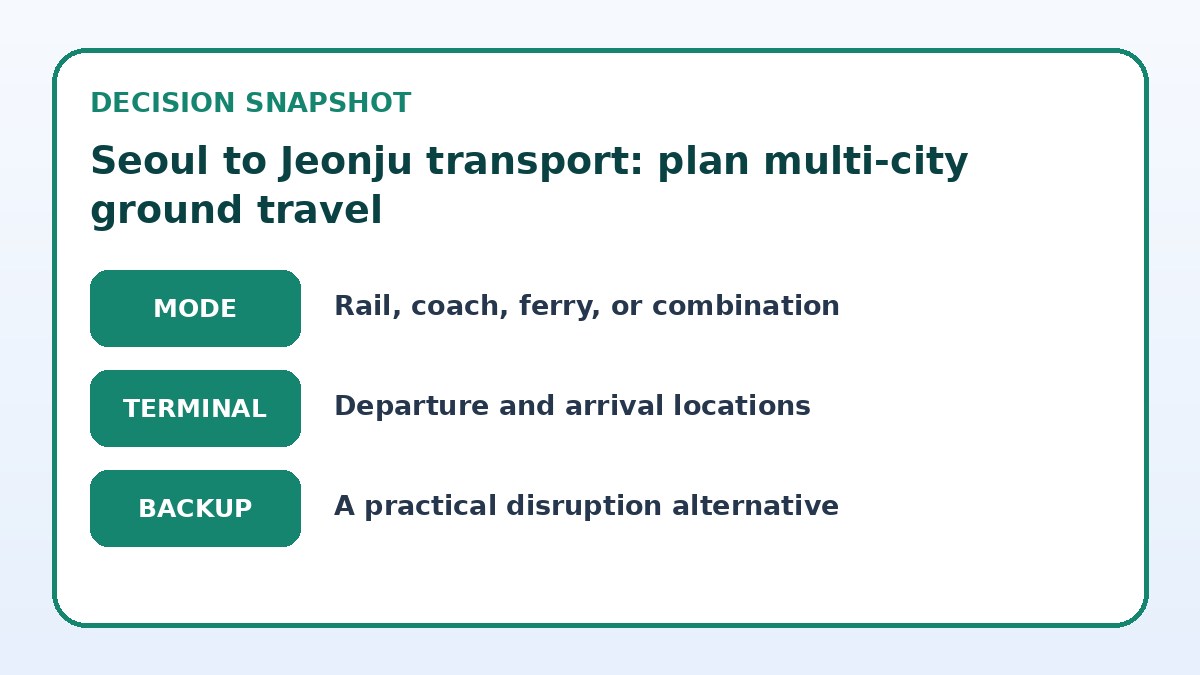
When comparing train, bus, and car options for the Seoul→Jeonju segment, list how each meets your criteria in three columns: travel time range, departure and arrival convenience (which station or hub), and luggage or comfort needs. For trains, note whether the service arrives at a central station — useful if you want to stay near transit hubs. For buses, check departure terminals and whether the bus drops you near Jeonju’s bus terminal or other neighborhoods. For driving, mark likely highway corridors and potential rural side trips, but don’t forget to plan parking and local driving conditions.
Avoid assuming a single best choice: sometimes a mixed approach works best for a multi-city plan. For example, you might take a train into Jeonju for speed, then rent a car locally for day trips to villages and return the car before heading back to Seoul by bus. When services offer direct and connecting options, compare total door-to-door time and the hassle of transfers, not just the advertised in-vehicle time. Always verify schedules, seat reservation requirements, and cancellation rules on provider pages before booking.
| Approach | Best for | Tradeoff to check |
|---|---|---|
| Intercity train | Travelers prioritizing predictable, city-center arrivals and fewer transfers | May be pricier than buses and requires checking seat reservation rules before booking |
| Express bus | Budget-conscious travelers who want many departure choices and simple luggage rules | Longer door-to-door time and arrival at bus terminals that may need local transit to hotels |
| Rental car / car-share | Visitors seeking flexibility to detour to rural sites and control over schedule | You must plan for parking, tolls, and driving in unfamiliar traffic conditions |
| Mixed approach | Multi-city itineraries that combine speed with day-trip flexibility | Requires more coordination and buffer time to manage transfers and vehicle returns |
Ready to check the option that fits your plan?
Use your exact dates and traveler details so the provider page can show the current total and conditions.
Practical booking checks and what to verify
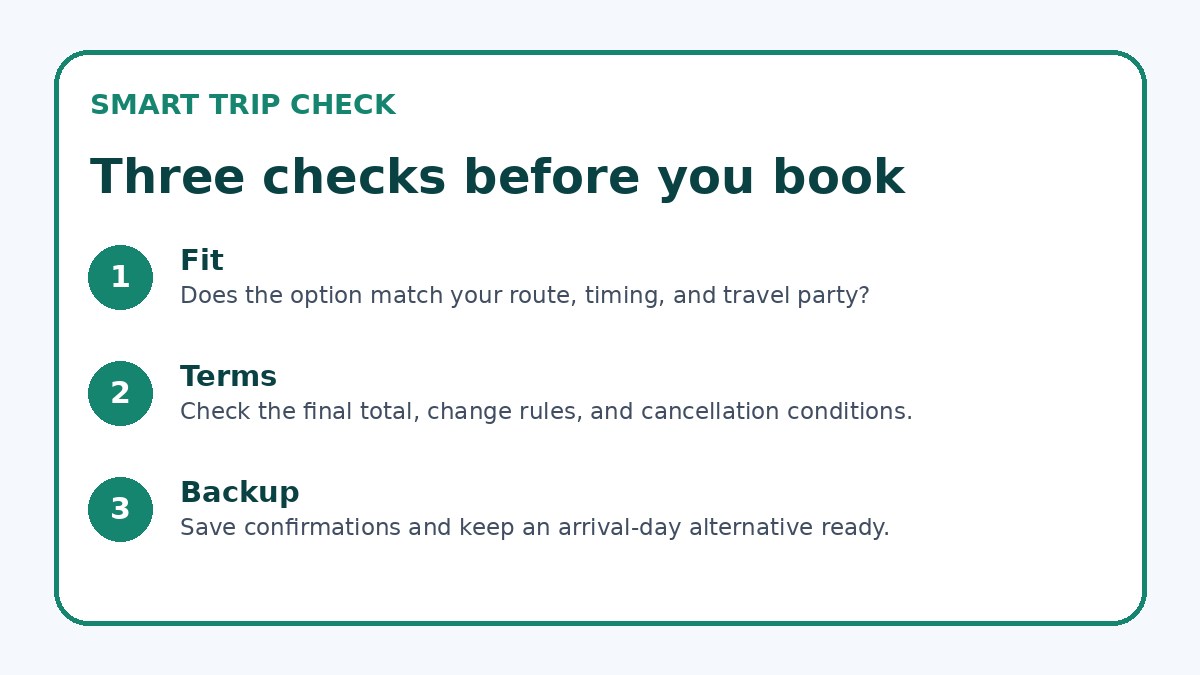
Before you commit funds, verify five essentials on the operator’s booking page: exact departure and arrival stations, whether seats must be reserved, luggage limits or fees, change and cancellation policies, and any ID or travel document rules required at check-in. If you’re using rail or express bus aggregators (including Trip.com as an optional quick comparison), cross-check the result against the carrier’s official site when possible. Confirm which station entrances or platforms correspond to the departure you select so you can estimate walking time, local transfer costs, and whether a taxi or subway connection is necessary.
Also check hotel location relative to your selected station or terminal. If you plan a multi-city route, book hotels with flexible check-in or cancellation when your intercity connections are tentative. Make sure transfers between train/bus terminals and your accommodation are realistic for your arrival time — late arrivals may require night bus or taxi options and some services reduce frequency in the evening. Keep screenshots or saved confirmations that list the exact station names and pickup points to avoid confusion on travel day.
Before you book
- Confirm exact departure and arrival station names and save screenshots of your booking confirmation.
- Check whether the service requires seat reservations and reserve seats if necessary before finalizing travel.
- Locate hotels near your chosen station or terminal to reduce transfer time and pre-book flexible check-in if possible.
- Verify luggage policies and whether there are restrictions or extra fees that affect your chosen transport mode.
- Build at least 60–90 minutes of buffer between scheduled arrival and hotel check-in for first-time navigation.
- Compare door-to-door travel time (including transfers) across train, bus, and driving options before booking.
Build the multi-city flow: sample sequencing and buffer planning
A useful sequencing approach is: (1) Fix the day you’ll be in Jeonju, (2) block a travel window that includes a cushion for delays and check-in, (3) book the onward segment only after your primary arrival is confirmed, and (4) add local transport options for first 24 hours in the city. For first-time visitors, allow at least 60–90 minutes between your scheduled arrival and hotel check-in for navigation, luggage handling, and local transfers. If you intend to make same-day side trips from Jeonju, arrange those after you confirm how you'll arrive and where you'll leave your bags.
When adding other cities, ensure your plan reads left to right on a map to minimize backtracking: pick a logical geographic sequence and choose transport modes that connect smoothly. Consider overnight stays strategically to break long journeys into manageable segments. Build contingency time into every connection and buy flexible reservations when available — that lets you swap a bus for a train, or delay a rental-car drop-off, without disrupting the rest of your multi-city itinerary.
Frequently asked questions
How do I choose between train and bus from Seoul to Jeonju as a first-time visitor?
Decide what matters more: speed and simplicity or cost and flexibility. Trains typically offer a straightforward, predictable city-center-to-city-center transfer and may reduce the need for local taxis. Buses usually have more departure times and can be cheaper but may arrive at bus terminals that require an extra local transit step. For a multi-city plan, think about how each option aligns with your hotel locations and subsequent connections. Verify seat reservation rules, terminal addresses, and luggage policies on provider pages before booking.
Is driving between Seoul and Jeonju recommended for visitors who want side trips?
Driving is useful if you plan to stop at rural attractions or villages that are poorly served by public transit, as it gives you full schedule control. However, factor in unfamiliar traffic conditions, tolls, parking availability in Jeonju’s core, and whether your rental allows one-way returns. For many visitors a hybrid approach—arriving by train and renting a car locally for a day—balances convenience with flexibility. Always check rental terms, insurance coverage, and where you must return the vehicle before you book.
How much buffer time should I add to a Seoul–Jeonju travel day in a multi-city itinerary?
For first-time travelers, adding 60–90 minutes between arrival and your first important commitment (hotel check-in, guided tour meeting) is a good baseline. If you have sequential connections within the same day, increase buffers to account for rush-hour traffic, possible platform changes, or late baggage transfers. Overnight arrivals or complex transfers deserve extra padding. Confirm realistic station transfer times on the carrier’s information pages and use that when calculating your buffer, rather than relying solely on advertised travel time.
Final planning note
Planning Seoul to Jeonju ground transport as part of a multi-city trip becomes straightforward when you pick a primary travel priority—speed, cost, or flexibility—and use that to guide modal choices and hotel locations. Compare trains, buses, and driving using door-to-door times and the number of transfers, then verify seat, luggage and cancellation rules on provider booking pages. For first-time visitors, allow generous buffers, align hotels with your arrival point, and consider a mixed approach if you want both fast intercity moves and rural detours. Keep confirmations and station names handy to reduce stress on travel day.
Continue planning
Check current options and final conditions
Use the provider page to confirm live availability, the final total, cancellation terms, and every condition that matters to your trip.
This evergreen planning guide was created with AI-assisted drafting and a structured quality review. It does not display live prices, schedules, availability, visa guidance, or provider rankings. Verify current details before booking. Some links are affiliate links; we may earn a commission at no additional cost to you.