If you’re locking in travel between Seoul and Gyeongju for business, the practical move is to confirm four things before you book: total door-to-door time, connection types (direct or multi-modal), luggage and meeting-day flexibility, and refund/change rules. Those items determine whether a seemingly faster flight really saves you time once you factor in transfers, taxis, and check-in. This article gives a tight, action-oriented pre-booking checklist, explains the tradeoffs that affect typical business travelers, and shows how to compare direct flights, indirect air routes, and rail-plus-air or bus-plus-air combinations. Use the checklist to run quick, comparable totals—travel time, risk of delay, and real cost—so you book the option that best protects your schedule and meeting outcomes.
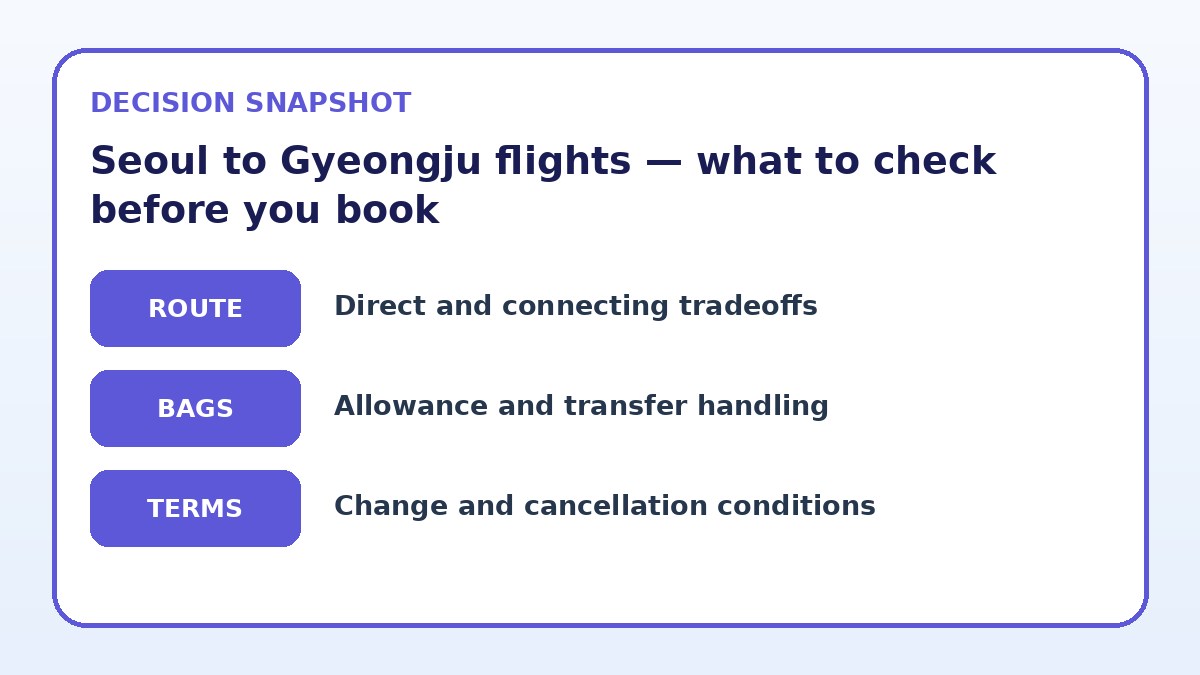
See current options before you compare the details
Availability and final conditions change. Open Trip.com now or keep reading for the practical comparison.
Define your time priorities and acceptable risk
Start by clarifying the meeting schedule and how much buffer you need. Decide whether you must arrive several hours early for setup or if a shorter buffer is acceptable. Business travelers often underweight the risk of delays or missed connections; quantify the maximum acceptable total travel time including transfers, check-in, and buffer time. Use that number as your primary filter, then compare options that meet it. If an option is close on time but has a higher chance of connection issues—tight layovers, multiple airport transfers, or peak-traffic road segments—treat it as a higher risk and require a larger time margin.
Next, think about service recovery: if a delay occurs, how important is same-day replacement travel or quick refunds? If meetings are inflexible, flexible tickets or refundable fares are worth the premium. If you have a team or backup plans at the destination, you can accept a slightly higher travel risk to save cost or travel time. Assign practical values to these tradeoffs—time value, flexibility value, and potential cost of a missed meeting—so comparisons between flight options become quantitative decisions rather than gut feelings.
Compare direct flights versus mixed-mode options
For Seoul–Gyeongju travel, evaluate whether a direct flight (if available) truly shortens your journey compared with combinations such as Seoul to Busan by air and a short ground transfer, or high-speed rail from Seoul to a station near Gyeongju. Don’t assume a single-airline option is fastest; consider total transfer time between airports, the terminal-to-terminal transit inside Seoul, and onward ground travel at Gyeongju. If a direct flight requires a long taxi or bus ride at either end, a mixed-mode route with a quick high-speed train segment might be faster overall.
When comparing options, line up the same start and end points: your office in Seoul to your meeting address in Gyeongju. Add realistic transfer times for taxis, local trains, and security lines. If you must change airports or terminals in Seoul, include that transit explicitly. For mixed modes, check schedules carefully because a missed train or delayed connection can erase any time advantage. Build alternate itineraries that keep you at your minimum buffer to see which option is most robust under moderate delays.
| Approach | Best for | Tradeoff to check |
|---|---|---|
| Direct flight (single carrier) | Travelers prioritizing fewer transfers and simpler logistics | May not save door-to-door time if airports are distant from meeting points |
| Air to nearby city + short ground transfer | Those who value shorter airtime and potentially more frequent departures | Adds ground transfer complexity and risk of local traffic delays |
| High-speed rail plus local transit | Reliable schedules with predictable arrival times and comfortable work time | Requires checking rail-to-destination connections and station-to-office transfers |
| Cheaper nonrefundable fare | Flexible schedules where cost savings outweigh change risk | Limited or costly changes; risky if meetings shift |
Ready to check the option that fits your plan?
Use your exact dates and traveler details so the provider page can show the current total and conditions.
Confirm luggage, check-in, and last-mile logistics
Business trips often fail at the last mile. Before you book, check baggage allowances and whether carry-on-only is feasible for your trip. If you rely on checked luggage, confirm minimum check-in times and whether curbside drop-off, priority lanes, or fast-track security for business fares are available. These factors influence whether a morning flight actually gets you to a meeting on time or whether boarding queues and baggage collection add unpredictable minutes. Make a note of whether meeting attire needs pressing or if you can travel in business-casual to save a change of clothes.
Also map out ground options at both ends: the estimated taxi or rideshare time from your Seoul address to the departure terminal, and from the arrival point in Gyeongju to your meeting location. For routings that end at a station rather than an airport, check the frequency and capacity of local buses or taxis during your arrival window. If your schedule is tight, consider booking a private transfer or reserving a taxi ahead. When the service provider’s page could change, verify baggage rules, check-in cutoffs, and transfer services on the final booking page before purchase.
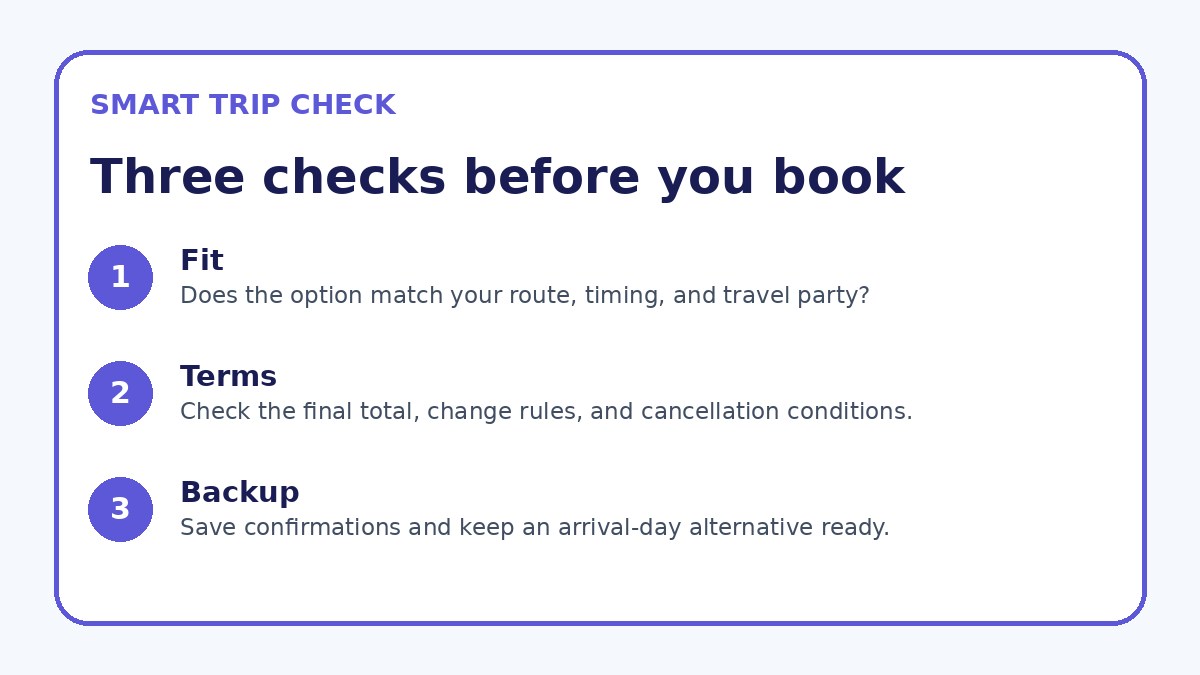
Before you book
- Calculate door-to-door travel time including realistic taxi, shuttle, and security buffers before comparing options.
- Verify whether each itinerary requires airport-to-airport transfers in Seoul and add the minimum transit time explicitly.
- Confirm baggage allowance and check-in cutoffs on the airline's final booking page; note whether carry-on suffices.
- Check fare rules for same-day changes, cancellations, and refunds and record the exact penalty amounts or waivers.
- Map last-mile transport at Gyeongju from arrival point to meeting address, and pre-book a taxi or transfer if time-sensitive.
- Save screenshots or PDFs of the final booking confirmation and the carrier’s policy pages for expense reporting and quick reference.
Fare flexibility, refunds, and confirmation details to verify
Before committing, carefully read the fare rules for changes, cancellations, and reimbursements. Business needs can change; ensure the fare you choose allows changes without punitive fees or that the penalty is acceptable relative to your meeting’s value. If you rely on corporate travel policies or expense reimbursement, verify whether the fare class is compliant. When booking through an agent or aggregator, check the provider’s final booking page for exact change and refund terms since third-party descriptions can become outdated.
Also confirm seat assignment and loyalty program credit if those matter for upgrades or future status benefits. Note how and when you’ll receive the e-ticket and whether mobile check-in is supported. If you must present proof of travel to a client or HR team, ensure booking confirmations and receipts are downloadable. For any provider-specific details such as baggage fees, lounge access, or priority boarding, verify them on the carrier’s official booking page prior to purchase; Trip.com can be used to compare availability but should be cross-checked against the carrier.
Frequently asked questions
Is flying always faster than taking high-speed rail between Seoul and Gyeongju?
Not necessarily. Flying may have a shorter airborne time, but total travel time includes check-in, security, baggage handling, and transfers between terminals or to your final meeting location. High-speed rail can be more predictable and allow you to work with fewer interruptions, and rail stations are often closer to city centers, which can reduce last-mile time. Compare door-to-door estimates for each itinerary and include realistic transfer times to determine which is truly faster for your schedule.
What should I prioritize if my meeting time is fixed and cannot shift?
Prioritize options with the highest schedule reliability and flexibility for recovery: allow larger buffers, choose refundable or changeable fares, and prefer routes with fewer handoffs. Direct options with fewer transfers reduce the number of potential failure points, and routes with frequent departures let you switch plans if an earlier leg is delayed. Also consider pre-booking a reserved transfer at the destination and documenting contingency plans with colleagues so a missed connection can be handled quickly.
Can I rely on an aggregator for final baggage and refund rules when booking?
Aggregators are useful for comparing schedules and prices, but their policy summaries can lag behind carrier pages. Always verify baggage allowances, change fees, and refund conditions on the airline’s official booking page before purchase. If you book through an agent, confirm which party handles refunds and changes and keep their contact details. Trip.com may be a place to compare availability, but cross-check provider-specific rules on the carrier’s site to avoid surprises.
Final planning note
For business travel between Seoul and Gyeongju, treat a ticket as one part of a door-to-door plan. Use the checklist to quantify total travel time, transfer complexity, luggage needs, and fare flexibility before you book. Compare direct flights with mixed-mode alternatives like air plus ground or rail, and value reliability and recovery options when meetings are inflexible. Verify final baggage, change, and refund rules on the carrier’s booking page and document confirmations for expense and contingency use. A careful pre-booking check often saves far more time and stress than chasing a marginally cheaper ticket.
Continue planning
Check current options and final conditions
Use the provider page to confirm live availability, the final total, cancellation terms, and every condition that matters to your trip.
This evergreen planning guide was created with AI-assisted drafting and a structured quality review. It does not display live prices, schedules, availability, visa guidance, or provider rankings. Verify current details before booking. Some links are affiliate links; we may earn a commission at no additional cost to you.