If you’re planning Sydney to Auckland flights with kids, the practical answer is simple: choose the option that minimizes the pain points your family most wants to avoid. For many families that means a direct flight if you prioritise speed, fewer transfers and simpler logistics. For others—especially those looking to lower the fare, visit another city, or take advantage of airline schedules—a single connection can be a reasonable tradeoff. Before booking, list the family’s top priorities (short travel time, lower cost, fewer airport moves, seat availability, flight times that match sleep schedules) and compare realistic itineraries on the same calendar dates. Verify the exact connection times, baggage rules, seat assignments, and any family or infant policies on the airline’s final booking page. For quick comparison, Trip.com can show live options alongside other booking tools, but always confirm provider details directly.
See current options before you compare the details
Availability and final conditions change. Open Trip.com now or keep reading for the practical comparison.
How direct flights help families travel easier
Direct Sydney to Auckland flights remove the stress of making a tight connection, reduce time in transit and simplify airport routines. Families travelling with toddlers, infants, or lots of carry-on gear often find that a non-stop routing lowers the chance of lost luggage and avoids the physical and emotional exhaustion of rushing between terminals. Fewer movements also reduce the number of separate security checks, gate changes and toilet stops—small conveniences that add up when managing children and prams at each stage of the journey.
A direct flight also makes it easier to plan logistics at both ends: a single arrival time means simpler airport pickup, predictable hotel check-in estimates and a clearer plan for naps or evening routines. However, direct flights may depart at less convenient hours or be more expensive; you’ll need to compare total door-to-door time and the family’s tolerance for longer uninterrupted flying against the cost and schedule of the non-stop option. Always confirm seat configuration, bassinet availability and baggage rules before finalising booking.
When connecting flights make sense for families
A connecting itinerary can be attractive if it reduces fare, provides better departure or arrival times, or lets you break the journey for a rest day en route. For families willing to accept one transfer, connections can expand the pool of available flights and sometimes offer more family-friendly cabin options. If you want to visit another city briefly, a planned stopover can turn a transfer into a mini-break rather than a stress point. The key question is whether the savings or timing benefit outweigh the added complexity for your children.
Connections introduce variables—transfer time, potential terminal changes, and the need to shepherd children between gates—that matter more when luggage re-checks or immigration are involved. Compare the minimum connection time offered by the airline, whether baggage is checked through, and whether you’ll need to clear immigration or re-check bags at the connecting airport. If the itinerary has a long layover, check whether the airport has family facilities or nearby hotels; for short layovers, choose carriers with interline agreements to reduce the risk of missed connections.
| Approach | Best for | Tradeoff to check |
|---|---|---|
| Choose direct flights | Families prioritising simplicity, fewer transfers and quicker arrival | Often higher fares or less convenient departure times |
| Choose a single short connection | Families balancing lower cost with manageable transfer complexity | Added risk of missed connections and more time in airports |
| Choose a long layover or stopover | Families who want a rest break or a short sightseeing stop en route | Longer total travel time and extra logistics for airport exit and re-entry |
| Book flexible or refundable tickets | Families needing schedule flexibility or travel insurance coverage | Higher upfront cost but reduces stress if plans change |
Ready to check the option that fits your plan?
Use your exact dates and traveler details so the provider page can show the current total and conditions.
Practical tradeoffs: cost, time, comfort and risk
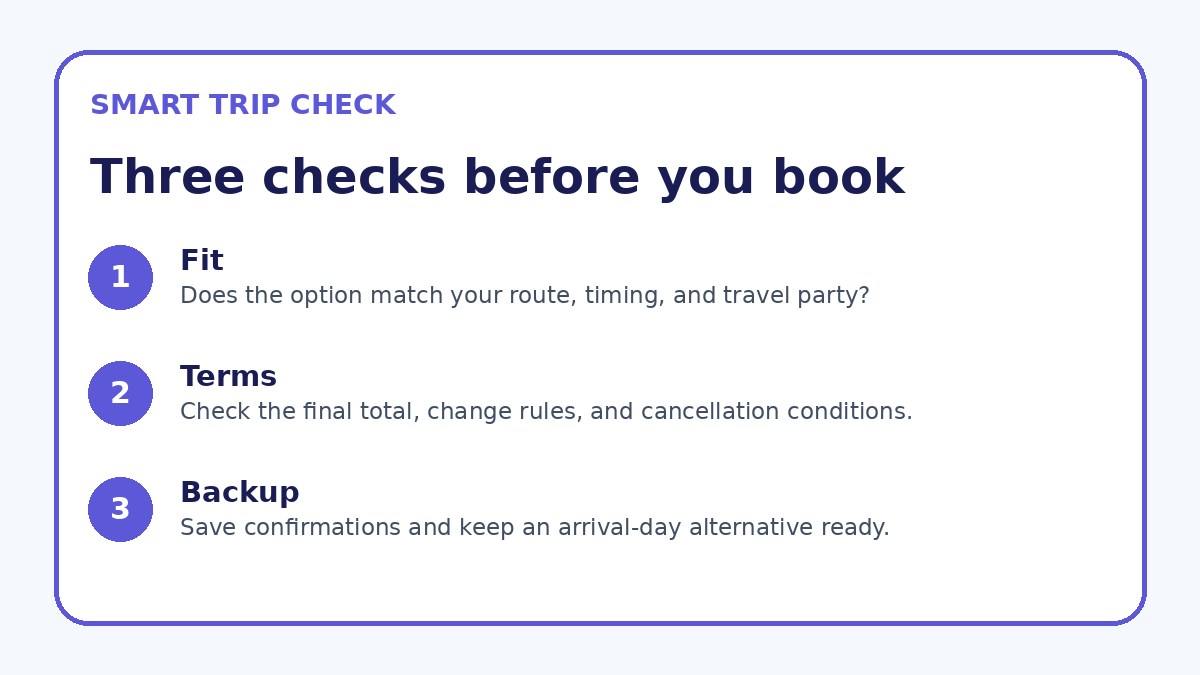
When comparing itineraries, weigh the obvious tradeoffs: direct flights usually save time and reduce complexity but can cost more; connecting flights can save money or offer better schedule fits but add risk and fatigue. For families, the non-monetary costs—sleep disruptions, crankiness, and the mental load of navigating transfers—can be decisive. Make a checklist of what matters (total travel time, number of airport changes, bedtimes and napping windows, and the ability to prebook bassinets or adjacent seats) and score each itinerary against it.
Also factor in the hidden costs and contingencies: will you pay for extra checked bags, seat assignments, or infant fares? How flexible is the ticket if you need to change plans? Check the fine print for rebooking fees, refundability and what happens if you miss a connection due to an airline delay. For any itinerary you shortlist, verify these details on the airline’s booking page and consider purchasing flexible fares or travel insurance that covers delays and missed connections—especially when travelling with young children.
Before you book
- List the family’s top priorities (shortest total time, lowest cost, sleep-friendly schedule) before searching itineraries.
- Compare door-to-door travel time for each itinerary, including expected transfer times and ground transport at both airports.
- Confirm baggage rules, whether bags are checked through on connections, and any extra fees on the airline’s final booking page.
- Reserve seats together and check bassinet or infant seat policies directly with the carrier before payment.
- Plan buffer time for connections: allow at least 90–120 minutes for international transfers that may require immigration and baggage re-checks.
- Pack a family transit kit (medication, snacks, spare clothes, chargers, comfort items) and carry a change of clothes for young children in hand luggage.
Making the right booking decision and preparing to travel
Before you click purchase, do a final cross-check: compare total door-to-door time (including ground transfers), total cost after extras, and the real-world transfer logistics at each airport involved. Look at departure and arrival times relative to your children’s sleep schedules, and check cabin layout and seat maps so you can reserve seats that keep your family together. If you’re choosing a connection, aim for at least 90–120 minutes for international transfers that involve immigration, or confirm that bags are checked through to the final destination to avoid a mid-journey baggage re-check.
Pack a transit kit with essentials to reduce transfer stress: spare clothes, quick snacks, sanitising wipes, familiar toys and necessary medications. Arrive at the departure airport early to allow time for family check-in and stroller gate checks. Finally, note airline family policies such as early boarding or bassinet availability on the carrier’s booking page; these benefits vary and can make a direct or connecting flight noticeably easier or harder for your family.
Frequently asked questions
Are direct Sydney to Auckland flights always better for families?
Not always. A direct flight removes the need to move between terminals and reduces the number of things that can go wrong, which is often worth the extra cost. However, if direct options don’t match your preferred departure times, or if a connecting itinerary offers meaningful savings while keeping a single, short transfer, the connecting option can be preferable—especially for families comfortable managing a layover or who plan an overnight stop. Evaluate the total travel time, connection logistics and whether the airline checks bags through.
How should I evaluate connection times and airport transfers with kids?
Look beyond the clocked layover length and consider what the transfer actually involves: same-terminal gate changes are easier than transferring between terminals with shuttle buses. Check whether you must clear immigration and re-check bags, which can add 30–90 minutes. Aim for enough buffer to allow restroom breaks, stroller retrieval, and security queues—generally at least 90 minutes for international-to-international transfers that involve immigration. If details aren’t clear, confirm the transfer process on the airline’s booking page or call the carrier for specifics before booking.
What additional costs should families check before booking a connecting itinerary?
Compare total ticket price plus likely extras: checked-baggage fees, seat-selection charges to keep family together, infant fares, and costs for food during long layovers. If a connection requires exiting the airport for accommodation, factor hotel and local transport costs. Also check change and cancellation fees so you understand flexibility if schedules shift. Confirm these fees on the airline’s final booking page; booking engines may not show all ancillary fees until checkout.
Final planning note
Choosing between direct and connecting Sydney to Auckland flights comes down to which tradeoffs your family can manage. Direct flights reduce logistical friction and are often worth paying for if you value time, simplicity and fewer points of failure. Connecting itineraries can save money or offer better timing, but they introduce transfer complexity, potential baggage re-checks and more moving parts—factors that can be especially stressful when travelling with children. Make a short decision matrix of priorities, compare door-to-door time and total expected costs (including extras), and always verify seat, baggage and family-policy details on the airline’s booking page before you finalise. If you want to shop live options, Trip.com can display current itineraries alongside other tools, but confirm all provider-specific rules directly with the carrier.
Continue planning
Check current options and final conditions
Use the provider page to confirm live availability, the final total, cancellation terms, and every condition that matters to your trip.
This evergreen planning guide was created with AI-assisted drafting and a structured quality review. It does not display live prices, schedules, availability, visa guidance, or provider rankings. Verify current details before booking. Some links are affiliate links; we may earn a commission at no additional cost to you.