For families moving between Hanoi and Da Nang, practical transfer planning beats general travel tips. Start by deciding whether you’ll travel by train, plane or a combined route—each choice changes which station or terminal matters and what’s realistic with kids and luggage. Focus your planning on the first and last mile: how you’ll get from your Hanoi accommodation to the departure station or airport, and how you’ll continue from Da Nang’s arrival point to your hotel. That means checking door-to-station pickup options, taxi or private transfer reliability, stroller and baggage handling rules, and how long buffer time you need for check-in or boarding with children. This article gives clear decision checkpoints, compares common transfer approaches, and offers a family-ready checklist so you can choose the least stressful door-to-door plan.
See current options before you compare the details
Availability and final conditions change. Open Trip.com now or keep reading for the practical comparison.
Choose the main mode first: train, plane, or mixed
The very first decision—train, plane, or mixing modes—frames every station and terminal choice. Trains typically arrive at Da Nang Railway Station, positioned near the city center, which can reduce onward travel time if your hotel is central. Flights land at Da Nang International Airport, which lies a few kilometers from beaches and many resorts, so airport transfers often add predictable driving time. For families, trains offer room to move and simpler luggage handling onboard, while flights shorten travel time but create more constraints around security, carry-on limits, and stroller policies.
If you consider a mixed route (for example, Hanoi to a nearby city then onward by road), each extra leg adds a new terminal and more handoffs. Weigh that against cost and total door-to-door time: two shorter legs with comfortable transfers can sometimes be easier for children than one long leg followed by a rushed arrival at a distant terminal. Before booking any ticket, list the exact physical locations of departures and arrivals and check the practicalities of getting a taxi, private van, or public transit with children at those points.
Planning the Hanoi departure: station and airport transfer choices
In Hanoi, transfers typically start from your accommodation to either the city’s main train station or the airport. For trains, confirm which railway station your service uses and whether morning or evening services change platform or boarding procedures; older stations can have stairs and limited elevator access. For flights, factor in recommended family check-in windows, whether the airline offers priority boarding for families, and the distance from your neighborhood to the airport. Assess local traffic patterns, since peak-hour congestion can turn a short drive into a stressful rush when you have children and luggage.
Decide between public taxi, app-based ride, hotel transfer, or private van based on the group size and the number of bags and child seats. A hotel-arranged transfer often simplifies stroller and luggage handling but verify vehicle size and child-seat availability. If using a rideshare or taxi, pre-book when possible and confirm driver can carry larger baggage; keep a transit plan B—such as a nearby hotel lobby or café—if you must wait for the next vehicle or need a last-minute diaper change before boarding.
| Approach | Best for | Tradeoff to check |
|---|---|---|
| Direct private transfer (door-to-door) | Families with lots of luggage, small children, or limited mobility | Higher cost but minimal handoffs and predictable timings |
| Train travel with taxi to/from stations | Families wanting more space onboard and central arrival points | Longer journey time and potential platform stairs or crowded station areas |
| Flight with airport shuttle or taxi | Families prioritizing shorter in-transit time between cities | More structured check-in/security and stricter carry-on rules for child items |
| Public transport or rideshare legs | Budget-conscious families comfortable with flexible schedules | Multiple handoffs and variable vehicle capacity for large strollers or many bags |
Ready to check the option that fits your plan?
Use your exact dates and traveler details so the provider page can show the current total and conditions.
Arriving in Da Nang: terminal realities and onward transfers
Arrival planning in Da Nang depends on whether you disembark at the train station or the airport. Da Nang Railway Station is centrally located, which often shortens taxi rides and allows you to reach many city hotels quickly. At the airport, while many hotels and resorts provide shuttle services, you’ll still usually need a car transfer to reach beachfront or out-of-town properties. Make sure you know how far your hotel is from the arrival terminal and whether there are heavy stairs, long corridors, or baggage trolleys—factors that matter when juggling kids, suitcases and strollers.
Consider pre-arranged pickups when arriving with children—this reduces time spent queueing for taxis or negotiating fares. If you plan to take a public taxi or rideshare from the station or airport, have small local currency ready and a backup phone charger. For train arrivals, check whether platforms open directly onto a taxi rank or require a short walk through narrow exits. If you need medical or child-care facilities on arrival, locate local clinics or designated airport assistance services before you travel and keep emergency numbers and addresses accessible.
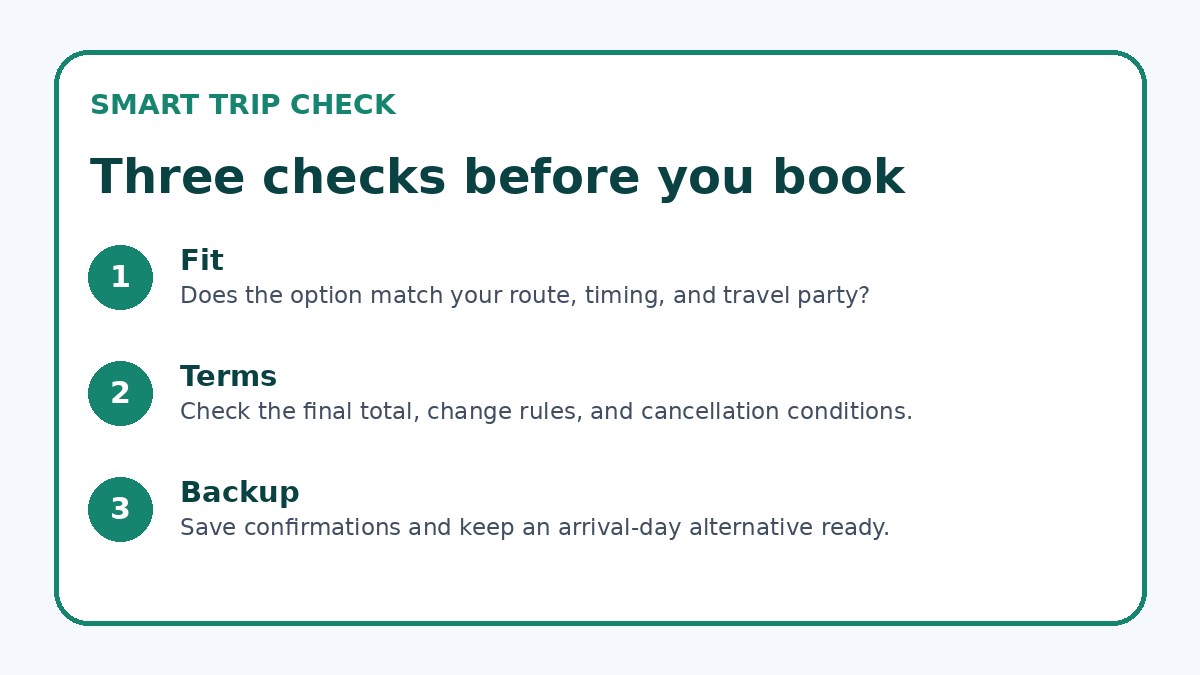
Before you book
- Confirm the exact departure and arrival station or terminal addresses and save them in your phone for drivers and maps.
- Pre-book a private transfer or reliable taxi if you have a stroller, car seat, or more than two large suitcases.
- Check your carrier’s rules on strollers, car seats, and hold-luggage on the provider’s final booking page before you commit.
- Allow a generous buffer for traffic, check-in, ticketing, and child breaks—add 30–60 minutes more than an adult-only schedule.
- Pack a small overnight bag with snacks, diapers, basic medicines, chargers, and a change of clothes for quick access during transfers.
- Have printed and digital copies of tickets, hotel address, and local emergency contacts; share them with the driver or transfer provider.
Tradeoffs and criteria: what matters for family comfort and reliability
When choosing transfer options, trade speed for predictability if traveling with young children. Flights save in-vehicle time but introduce more structured check-in and security steps that can be stressful; trains may take longer overall but let children move around and simplify boarding with larger items. Vehicle choice matters too: private transfers increase reliability and reduce walking with luggage, but public taxis and rideshares are often cheaper and more flexible for staggered schedules. Balance cost, door-to-door time, and the number of handoffs—each additional handoff raises the chance of delay or lost items when children are involved.
Also weigh stroller and car-seat needs: a compact umbrella stroller that folds easily is easier to manage on platforms and through airports, but younger children may require car seats for road transfers—check whether private transfer providers can supply or allow you to fit your own. Finally, build time cushions into your schedule for rest breaks, toilet stops and unexpected traffic; err on the side of extra time rather than squeezing connections tight when your family’s comfort is at stake.
Frequently asked questions
How do I decide between taking the train or a flight from Hanoi to Da Nang with kids?
Compare door-to-door travel time, not just journey duration. Trains can be more relaxed for families—more space to move, simpler luggage routines and central station arrival—but they can be slower. Flights cut travel time but add fixed check-in and security steps and stricter baggage rules. Consider how well your children handle confined seats versus moving between carriage spaces, whether you need car seats for road transfers, and how many handoffs you’re willing to manage. Use those criteria to choose the mode that minimizes stress for your family.
What’s the safest way to get from Da Nang arrival points to family hotels or resorts?
The safest and most reliable option for families is a pre-booked private transfer with seat-belts and space for luggage; it removes uncertainty at arrival and lets you request car seats. If you prefer taxis or rideshares, pick licensed companies, confirm vehicle size for strollers and bags, and keep small cash for meter fares. Many hotels offer shuttle services—confirm pickup points and schedules with your hotel. Whichever option you pick, share the exact hotel address and a local contact number with the driver and keep children secured in age-appropriate restraints for road safety.
How much time should I leave between arrival and checking into a Da Nang hotel with children?
Plan extra buffer time beyond official arrival times: factor in immigration or station disembarkation, baggage collection, a short rest break, and the transfer drive. For flights, add time for security exit and taxi queues; for trains, allow extra for platform exits and locating your pre-booked vehicle. If early check-in matters, contact the hotel beforehand to request early room availability or at least a luggage hold. Build in 45–90 minutes from terminal or station arrival to hotel check-in as a practical starting point, adjusting for distance and likely traffic.
Final planning note
Families traveling Hanoi to Da Nang benefit most from thinking in legs: from home to the departure terminal, the intercity leg itself, and from arrival terminal to lodging. Choose the main mode—train or flight—based on whether space and movement or shorter transit time matters more to your children. Then lock in transfers that minimize handoffs: pre-booked private vehicles or coordinated hotel shuttles will usually lower stress. Verify stroller and car-seat rules on the provider’s final booking page, confirm exact addresses and pickup details with drivers, and give yourself generous buffers for breaks and traffic. With these checks done, you can focus on enjoying Da Nang with less transfer friction and more time for family activities.
Continue planning
Check current options and final conditions
Use the provider page to confirm live availability, the final total, cancellation terms, and every condition that matters to your trip.
This evergreen planning guide was created with AI-assisted drafting and a structured quality review. It does not display live prices, schedules, availability, visa guidance, or provider rankings. Verify current details before booking. Some links are affiliate links; we may earn a commission at no additional cost to you.